



Today, the Bank of Japan made a yen-supportive policy decision, keeping its interest rate at 1.25%. This was done via an 8-1 vote. The BOJ also provided hawkish guidance, raising its inflation forecast and doubling down on its intent to raise interest rates down the road. One board member wanted an immediate 0.25 percentage point hike to 1.50%.
The USD/JPY responded to the hawkish guidance with some yen strengthening, dragging the pair down to 156.96. However, USD strength later in the session pushed the pair upwards, where it has now settled at 157.37. The USD/JPY’s reaction suggested the market had largely priced in the hawkish hold. However, the pair’s action was largely tainted by the USD’s response to the Federal Reserve’s interest rate decision on Wednesday, which provided a murky price picture on many USD pairs in Friday’s trading session.
USD/JPY: Key Market Drivers
1. BOJ Enters a New Policy Phase
The Bank of Japan’s decision appears to mark a shift in its policy outlook: from focusing on keeping inflation under 2% to preventing it from overshooting that target. BOJ Governor Kazuo Ueda has also indicated that a rate increase is possible at every policy meeting, including the next one in December. This follows the BOJ raising its 2027 fiscal year inflation forecast from 2.4% to 2.6%. The BOJ is also speeding up sales of exchange rate funds, with the pace set to increase from ¥330 billion to ¥860 billion as of January 2027. All of this points to one thing: the pathway toward greater normalization of BOJ monetary policy is now underway.
2. Dec Rate-Hike Expectations
Even as BOJ Governor Ueda refused to commit to a predetermined tightening cycle, emphasizing a data-dependent approach to future decisions, markets are increasingly pricing in a December rate hike to 1.50%. Consistent wage growth and domestic price pressures will heighten expectations of further tightening: a Yen-supportive event. However, the BoJ may follow a more cautious path if data show deteriorating economic conditions or weakening consumption.
3. US Treasury Yields
Any policy changes by the Fed or BoJ in December would affect the interest rate differential between the two currencies. If US bond yields decline sustainably, Yen strength and a further weakening of USD/JPY would follow. However, rising US bond yields could offset the impact of the BOJ’s hawkish guidance.

4. Japanese government intervention risk
Japanese government interventions in USD/JPY remain a risk factor for traders betting against the Yen. The 160.00 psychological resistance level continues to attract scrutiny, as this has been the site of recent interventions by the Japanese financial authorities. Whenever price approaches this level, the risk of Japanese government intervention increases. Traders should monitor any commentary from the Ministry of Finance on yen weakening as it approaches this level.
USD/JPY Forecast Scenarios
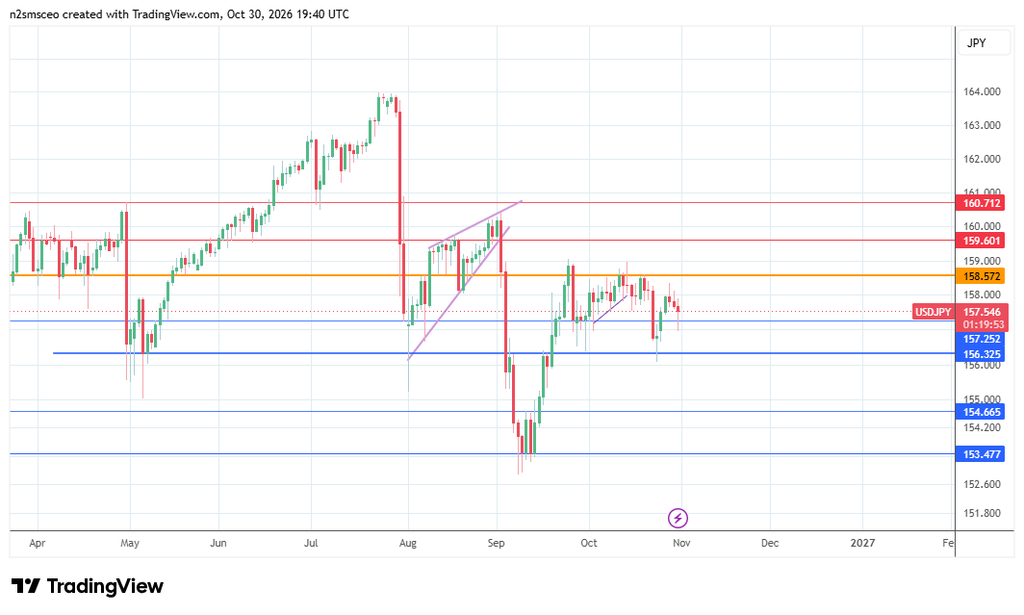
Bull case: Stronger US Treasury yields and BOJ commentary showing a more cautious approach to further tightening support a break and sustained move above 158.57. This would expose 159.60 and potentially 160.20.
Base case: A balance between the BOJ’s increasingly hawkish posture and elevated bond yields could keep the pair range-bound, as traders await fresh directional clues. Consolidation could range between 156.32 and 158.57.
Bear case: A sustained break below 156.32 could follow heavier hawkish repricing of the BoJ policy pathway, and a decline in US bond yields/less hawkish pricing of the Fed’s December decision. This would expose downside targets at 154.66 and below.