



- AUD/JPY fell towards 110.45 following the BOJ’s policy announcement.
- Japan held rates at 1.25%, but a higher inflation forecast kept further tightening in focus.
- Australia’s November 3 decision could determine whether the interest-rate advantage continues to support the Aussie.
The Australian dollar fell against the Japanese yen on Friday after the Bank of Japan held interest rates steady but signalled further increases remained possible, while a selloff in technology shares encouraged investors to reduce risk.
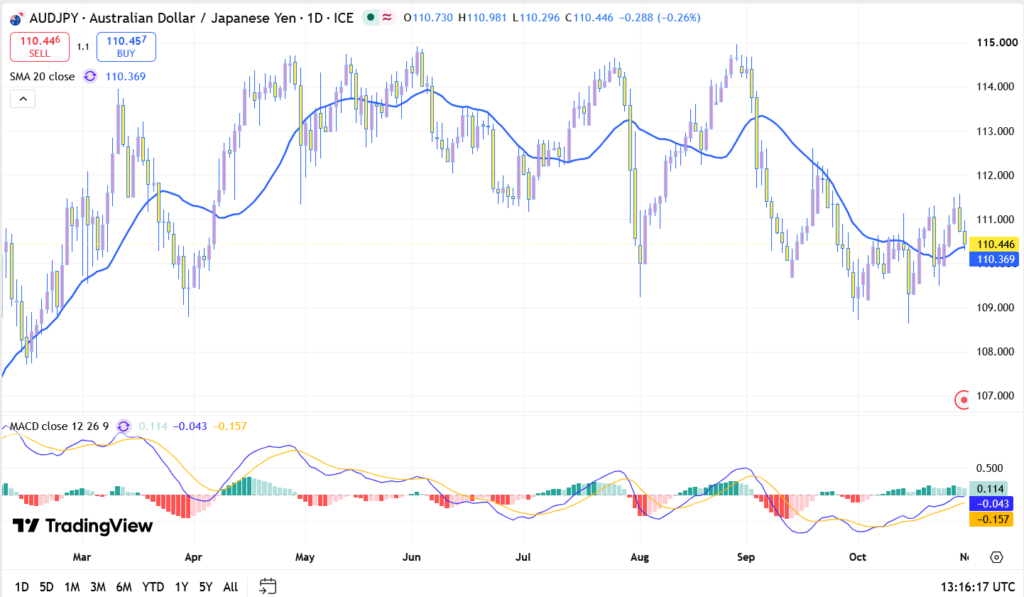
AUD/JPY traded around 110.45 at 13:16 GMT, down 0.26%, after reaching 110.98 earlier in the session. The decline brought the pair close to its 20-day moving average near 110.37, leaving its October recovery under pressure.
The next major test comes from Australia. The Reserve Bank of Australia announces its decision on November 3, with persistent inflation strengthening expectations for another increase.
Why Is AUD/JPY Falling Today?
The yen strengthened after the BOJ indicated that its pause did not mark the end of monetary tightening. Reuters reported that the currency was heading for a third daily gain against the US dollar. A renewed selloff in AI-related shares also helped the yen as investors sought defensive assets. The Australian dollar is generally more sensitive to changes in growth expectations and investor appetite for risk, leaving AUD/JPY exposed when equity markets weaken.
The combination put pressure on the cross even though Australian interest rates remain substantially higher than Japan’s. For investors holding Australian dollars against borrowed yen, an adverse currency move can outweigh the interest earned. That makes the pair sensitive to both policy expectations and abrupt changes in market sentiment.
Bank of Japan Holds Rates but Keeps Further Hikes Open
The BOJ kept its short-term policy rate at 1.25% on Friday in an 8–1 vote. Board member Hajime Takata favoured an increase to 1.50%. Policymakers raised their inflation forecast and reiterated their readiness to increase borrowing costs further.
The decision was widely anticipated, making the guidance more important for the yen than the unchanged rate itself. Reuters reported that the bank described a more hawkish phase in which increases could occur every few months.
That gives markets a reason to reassess Japan’s future rate path. However, it does not establish a fixed timetable: the pace of tightening will still depend on economic conditions. For AUD/JPY, the question is whether Japanese rates rise faster than investors previously expected, narrowing Australia’s advantage.
RBA Interest Rate Decision Due November 3
The RBA’s next decision is scheduled for November 3 at 2:30 p.m. AEDT, alongside its updated Statement on Monetary Policy. Australian inflation figures released this week strengthened the argument for another increase. Annual trimmed mean inflation reached 3.7% in the third quarter, above the 3.6% forecast, while the quarterly measure rose 1.0%.
The cash rate currently stands at 4.60%. Following Wednesday’s figures, markets priced an approximately 88% probability of a quarter-point increase, Reuters reported. That pricing reflects the response to the inflation release rather than a confirmed policy decision.
A rate increase could support the Australian dollar, particularly if the RBA signals that inflation requires further action. But with much of the move already anticipated, the accompanying forecasts and guidance may carry greater weight. A hold would challenge those expectations and could leave the Aussie vulnerable against the yen.

The euro is also responding to this week’s central bank decisions. Read our EUR/USD forecast as buyers attempt to reclaim 1.1200.
AUD/JPY Carry Trade Faces a Policy Test
Australia’s 4.60% cash rate exceeds Japan’s 1.25% policy rate by 3.35 percentage points. The difference helps explain the appeal of holding Australian dollars against yen, although actual financing returns depend on market rates and trading costs.
The direction of that gap now matters as much as its size. If both central banks tighten, the advantage may persist. If the BOJ becomes more aggressive while Australian policymakers approach a pause, the incentive could weaken.
Friday’s decline also shows why interest income offers limited protection during sudden currency moves. Investors may reduce positions when volatility rises, adding to pressure on AUD/JPY.
AUD/JPY Technical Analysis: 110.37 Support in Focus
AUD/JPY is testing its 20-day moving average near 110.37 after falling from Friday’s high around 110.98. A sustained break below the average would bring 110.00 into focus, followed by the October lows around 108.80–109.00.
Resistance sits near 111.00, with the recent highs around 111.50 beyond it.
Momentum is mixed. The MACD line remains above its signal line, but below zero, suggesting the recent recovery has improved conditions without establishing a strong upward trend.
A hike accompanied by firm guidance could support the pair. Because an increase is already widely expected, the Australian dollar may need a stronger policy message to sustain gains.
Investors often reduce exposure to growth-sensitive currencies such as the Australian dollar and close yen-funded positions, supporting the yen.
Australia retains a sizeable rate advantage, but yen appreciation and financing costs can outweigh the interest earned.