


- SNB at 0%; franc supported by French risk.
- Key support 0.9200; resistance 0.9246 and 0.9300.
- Bull above 0.9300; bear below 0.9200.
In times of instability throughout Europe, funds tend to flow into Switzerland. This is the reason why EUR/CHF exists.
The SNB held its policy rate at 0% on 24 September, the fifth straight hold, according to Admiral Markets, yet the franc keeps attracting buyers. Our chart below shows exactly where that battle stands.
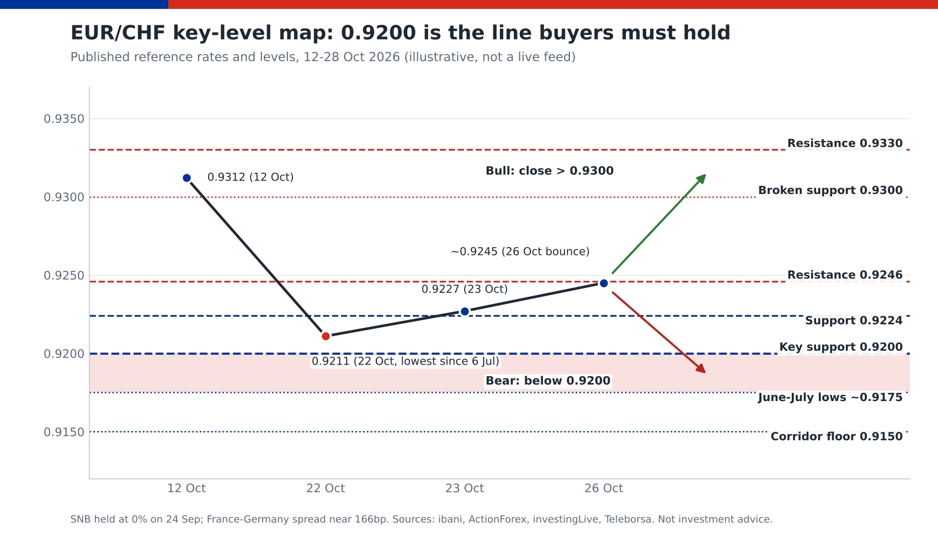
Figure 1: EUR/CHF key-level map in Swiss red and euro blue, built from published reference rates and levels (illustrative, not a live feed).
Tracing the Slide
On 12 October, follow the line from.9312 to.9211 on 22 October, which is marked with a red dot. That was the lowest level since 6 July. A bounce occurred after that time:.9227 on 23 October, and about.9245 on 26 October. The pink area in between.9175 and.9200 indicates the June-July lows, and that is where the sellers have been testing the market.
EUR/NZD report shows the euro can still rebound elsewhere.
The larger picture is clear. It was only at the 0.9485 recent peak that this pair was trading above its current levels. And when you look at the 0.8979 low, you can see how long the long-term trend has been in effect. However, the working corridor (0.9150-0.9400) continues to define what the market does. This is important to investors because as the Swiss Franc gains strength, it makes it more difficult for Swiss companies to sell their products globally and for Europeans holding Swiss investments to hedge against currency risk. Therefore, this pair will directly affect both corporate earnings and the cost to hedge portfolios.
What does this mean? The EUR/CHF is an indicator of how stressed Europe is. If the EUR/CHF goes down and there is no change to what the SNB has done with its policies, then the market believes that there will be more political and fiscal risk in the future, not higher interest rates.
France, the Franc and the Chart
The daily chart is currently trading below its March-May trendline, the 100-day average and 0.9300, which has left some buyers feeling uneasy. The France-Germany bond spread was trading at around 166 basis points after reaching 176, its highest level since 2011.
The franc “will remain an attractive alternative whenever European risks flare up again”, investing Live writes. Risk appetite matters too, as our Nasdaq 100 outlook shows.
Key Levels and Forecasts
Resistance sits at 0.9246, then 0.9300 and 0.9330. Support is 0.9224, 0.9200 and the 0.9150 floor of the corridor. ActionForex keeps a neutral bias with “further decline is mildly in Favor”. Defensive assets feature in our gold analysis.
Forecasts diverge. UBS sees 0.9500 by year-end with 0.9000 as the downside case, per ibani.
Scenarios and Outlook
The SNB does not have to act due to low inflation of only 1%, whereas the ECB has already raised rates twice this year. This difference in interest rates will eventually benefit the euro, however, political factors are currently dominating over those. Do not go against the trend until there is a daily close above 0.9300. Use smaller size with European political headlines because gaps increase significantly with increased risk. In the short-term, monitor 0.9200 closely. In the long-term, observe if the 0.9150 corridor floor can withstand additional French political pressure.

The SNB has stated that they will “intervene in the foreign exchange market as required”, thus preventing rapid increases in the value of the Swiss Franc.
• Bullish: a close above 0.9300 targets 0.9330.
• Bearish: a close below 0.9200 targets 0.9175, then 0.9150.
• Neutral: range between 0.9200 and 0.9246.
In the near-term, French politics and the SNB’s willingness to step in will determine the market’s direction. In the long-term, we can expect to see another assessment by the SNB in December. Our day trading strategies guide can help you size trades. Will 0.9200 hold, or is the franc about to win again?
Frequently Asked Questions
Why is the Swiss franc strong against the euro?
The combination of French bond market pressure and the growing political uncertainty across Europe is prompting investors to seek out the Swiss franc as a safe haven asset. This is true despite the fact that the Swiss National Bank (SNB) has its policy rate set at zero percent.
What is the key EUR/CHF support level?
The key area of support is 0.9200. If price falls below that point, we will likely see support from the June-July low levels around 0.9175 and the floor of the channel at 0.9150.
When is the next SNB decision?
The SNB’s next monetary policy assessment will take place in December 2026. This will follow on from the five times in a row that the SNB has left interest rates unchanged at 0% (September).