


- The Fed decision. Core PCE Price index data and corporate earnings of Alphabet, Microsoft and Amazon are key Nasdaq 100 drivers this week.
Current setup
The Nasdaq Futures index is currently trading at 28.943, or 0.12% lower as the impact of last week’s tech selloff continues to weigh on the index. The Nasdaq had closed the previous week at, even as oil prices rose to $117 per barrel and the 10-year Treasury yield hovered just below the 5.00% benchmark. However, the losses appear to have been minimized by President Donald Trump’s comments to reporters on Sunday, indicating that “there will not be a strike (on Iran) today.” This has allayed fears of a re-escalation and Brent crude has pulled back from Friday’s six-month highs.
This week brings several high-volatility risk events for the Nasdaq. These include the Fed interest rate decision, earnings of major technology companies (Alphabet, Microsoft, Amazon) and the September Core PCE inflation data.
The Nasdaq 100 index is expected to be vulnerable to the heightened volatility that these events will bring this week. Investors are still reassessing the impact of AI-related capital expenditure, crude oil prices (which still remain at elevated levels), and the expected outlook for U.S. interest rates. The impact of the selloff in semiconductor stocks, after the latest corporate earnings renewed AI caper concerns, is expected to create some volatility ahead of these key events.
Nasdaq: Macro Drivers
1. AI Capex and Tech Earnings
As the earnings results of tech companies are released to the markets, investors are scrutinizing these reports to see if the earnings and cash flow data show sufficient financial returns from AI capex spending. For instance, Meta’s share price has fallen sharply after its earnings report showed it still had committed capital expenditure approaching $900 billion (with concerns that this could pressure cash flow even as revenue and earnings growth remain solid).
The results of tech giants Microsoft, Amazon, and Alphabet will further test AI capex against cloud demand, operating margins, and the stability of heavy capital spending relative to future earnings growth. If these results show stronger-than-expected earnings that match AI capex spending with credible AI monetization numbers, this could restore risk appetite for tech stocks and help the Nasdaq bounce from its current lows. However, if guidance disappoints or data are deemed insufficient to match the scale of AI infrastructure spending, this could put pressure on the Nasdaq. Because the Fed decision and the core PCE price index are due this week, this market driver may not be the main price mover for the Nasdaq this week.
2. Fed Decision
The Federal Reserve releases its latest interest rate decision on 28 October. This is considered a major near-term catalyst and macro driver. Markets broadly expect a hawkish hold, with the Fed holding rates but providing hawkish guidance ahead of a potential rate hike in December.
A hawkish outlook may push long-term US bond yields above 5.00% again, pressuring the valuation of tech and growth stocks. Less hawkish guidance could support the Nasdaq, but it would require a steep fall in oil prices to provide sufficient upside impact.

3. US Treasury Yields
The US 10-year Treasury yield fell to 4.961% on Thursday, 22 October. However, Friday’s surge in oil prices pushed it close to 5.00%. Higher oil prices push inflation expectations higher, and if Thursday’s Core PCE Price Index data reflects this, the Nasdaq’s high-valuation tech stocks could face renewed valuation compression. Conversely, a decline in US bond yields is seen as constructive to the Nasdaq.
4. Geopolitical Risk and Brent Crude
With Brent crude trading above $115 per barrel as of writing, geopolitical tensions in the Middle East continue to fuel inflationary concerns, with the attendant impact on bond yields noted above. Higher oil prices not only raise input costs but also weakenlso weaken consumer purchasing power, reducing demand for luxury and discretionary products.
Nasdaq Forecast Scenarios
Here are the three potential scenarios for the Nasdaq 100 in the short term, considering the rash of high-impact risk events.
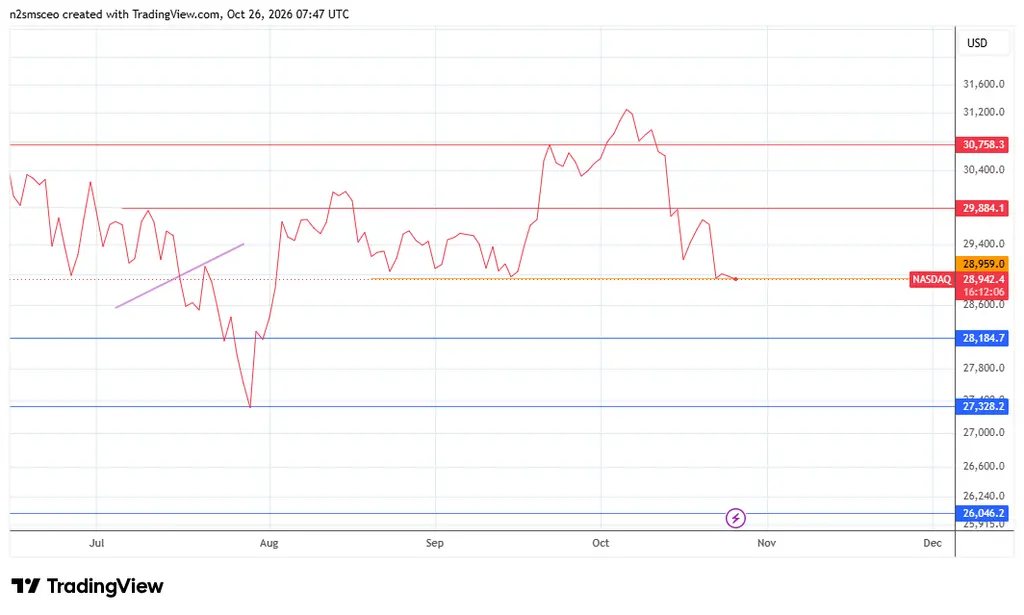
Bull case: Strong tech earnings showing earnings growth and cash flow that indicate appropriate AI capital monetization. These, along with stabilizing U.S. bond yields and a less hawkish Fed decision this week, will contribute to a bull scenario for the Nasdaq 100 index. In this scenario, we could see a strong bounce from 28,930, with a potential to break above 29,890.
Base case: The index could display two-way volatility in the 28,930 – 29,200 range as investors balance stellar tech earnings and AI monetization against high inflationary expectations, a rise in US bond yields and a potentially hawkish Fed outlook.
Bear case: A sustained breakdown move below 28,930 could expose 28,200 and 27,330 if the earnings reports indicate weak AI monetization vs. high capex. This scenario is worsened by a hawkish Fed, elevated oil prices, and a sharp spike in US bond yields above 5.00%.