



- The RBI's intervention & a 2% decline in Brent crude this Monday has pushed the USD/INR below the 95.00 price mark, but upside risks remain.
Current Setup
USD/INR is trading below the 95.00 mark and at 1-month highs, largely due to the RBI’s aggressive stabilization effort. As of writing, the pair is at 94.82, following last week’s 2% rupee gain. A modest decline in oil prices and increased dollar sales by foreign banks have reinforced the recovery.
The US dollar started the week on weak footing, giving the rupee a chance to resume trading vs the greenback from a position of strength. However, the unpredictable oil-price picture (which remains elevated) and foreign capital outflows mean the rupee remains at risk of returning to depreciation. The recent rupee strength is more of a relief rally at this point, not a full reversal, since the macro drivers that would reverse USD/INR’s uptrend are not yet in place. RBI intervention is not a substitute for stronger rupee-strengthening fundamentals.
USD/INR: Key Macro Drivers
1. RBI Defense
A key driver of USD/INR is the introduction of a separate, dedicated dollar supply window for state-run oil refiners. Other measures introduced by the Reserve Bank of India include higher costs for certain FX transactions for banks and additional charges for importer-hedged transactions. These measures were introduced to curtail spot market dollar demand, which is putting additional pressure on the rupee. It is also meant to reduce speculation against the local currency. The measures have largely succeeded in the short term, pushing the pair down from above 97.00 to below 95.00. However, these measures are only short-term, and any sustained appreciation will require reversing the current macro drivers behind the ongoing rupee pressure.
2. Oil prices remain the principal risk
Elevated oil prices remain the principal risk driver for USD/INR. Despite a 2% fall in Brent crude to $107.70 per barrel on 19 October, oil remains expensive for major importers such as India. As the world’s third-largest oil importer, India’s economy is particularly susceptible to elevated oil prices. The rupee benefits from lower oil prices, as they reduce the import bill and the need for additional dollars to cover higher import costs. However, any immediate rally in oil prices will lead to an increase in dollar demand to pay for the extra cost of the product, which is priced in U.S. dollars. This could reverse the rupee’s recent recovery and lead to a retest of recent price highs.
3. RBI policy and interest-rate expectations
The RBI’s recent 25-basis-point rate hike sent the repo rate to 5.50% in September. However, inflation expectations remain elevated because of persistently high oil prices, and markets have begun to price in further tightening due to these pressures, as well as rising government bond yields. Higher interest rates will support the rupee by tightening domestic financial conditions. However, a high-interest-rate environment could also stifle growth and increase borrowing costs for businesses.
Traders are still watching for the next policy signals and the Federal Reserve’s stance, which is due to release its next monetary decision on 28 October. This will be important for the currency pair’s outlook.

USD/INR Forecast Scenarios
Bullish above 95.50 | Neutral 94.00–95.50 | Bearish below 94.70, with confirmation
Bull case for USD/INR — Consistently high crude oil prices and increased portfolio fund outflows from Indian markets put additional pressure on the rupee. In this scenario, a sustained recovery above 95.50 opens the door to the recent upside target at 96.00 or higher.
Base case — Consolidation: The pair is expected to trade between 94.00 and 95.50 if persistently elevated oil prices counteract the RBI’s rupee-strengthening measures.
Bear case for USD/INR — A confirmed break below 94.50 is possible if oil prices ease, adding to the RBI’s measures to curb excess dollar demand. In this scenario, downside targets at 94.50 or lower become available targets for the bears.
Technical outlook
Bears are currently challenging the 94.91 support (7 July and 14 August lows). A breakdown of this support exposes the 94.30–94.04 support. If the breakdown move extends below this support zone, the next arrival point would be the 93.40 support formed by the neckline of the 8/17 April double bottom.
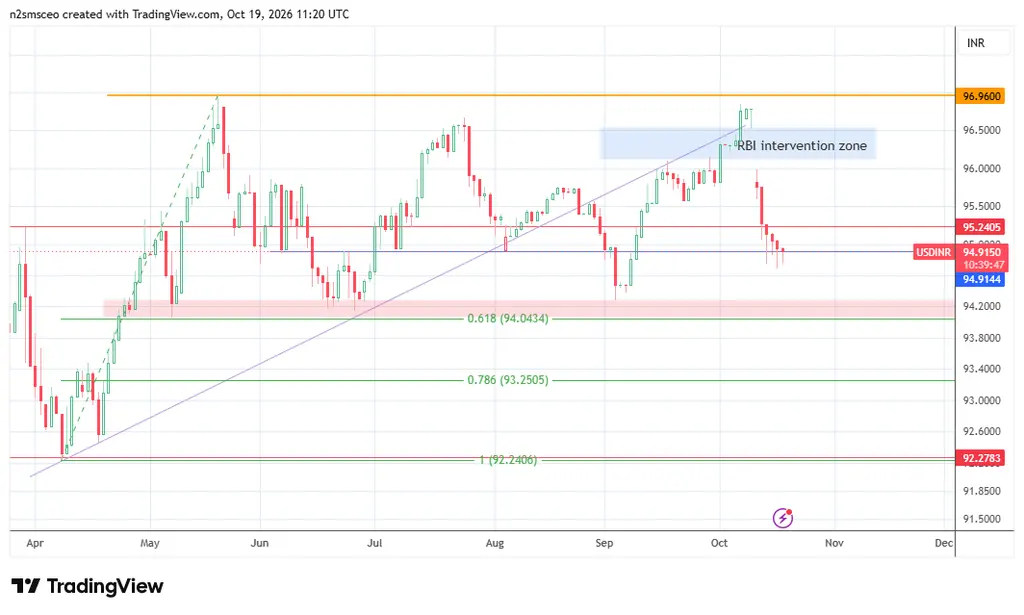
Conversely, a recovery above 95.24 exposes the 96.00 psychological resistance and the 12 October high. Above this level, upside targets reside at 96.50 and 96.96.