




- The USD/INR is pushing hard against the RBI's intervention benchmark of 96.00 as US bond yields surge to 24-year highs.
Current setup:
The rupee clawed back some gains vs the US Dollar this Wednesday after weakening to 96.15 on Tuesday, a two-month low. However, the pair still trades close to the psychologically important 96.00 level, which has recently emerged as the line in the sand that has brought about intervention by the Reserve Bank of India in recent sessions.
The immediate bias for USD/INR is cautiously bullish as long as price remains above 94.00 and 96.00. Once price edges above 96.00, the risk of RBI intervention makes further bullish bets precarious.
Macro Drivers: USD/INR
1. Brent Crude
Brent pulled back below $100 and ended the trading day at $98. This enabled the rupee’s slight gains against the greenback. This proves once more that oil prices remain the primary driver of the USD/INR’s price action. However, stalled US-Iran negotiations and the ongoing blockade of oil shipping routes keep the geopolitical risk premium elevated. Higher crude prices raise India’s import costs and increase demand for US Dollars to pay for the product. This puts more pressure on the rupee.
2. RBI Intervention
The RBI’s repeated intervention has limited the rupee’s weakness and kept USD/INR from surging out of control. The 96.00 mark has been identified as the recent intervention price barrier. Reuters is also indicating that state-owned banks are participating in the interventions by selling US Dollars around 96.00. Thus, the RBI is actively curbing the pair’s upside momentum.
3. Fed Rate Expectations
The Fed recently hiked rates to 3.75%–4.00% in September, along with a hawkish dot plot delivery. US bond yields are around 19-year highs, increasing the attractiveness of the US Dollar and dollar-denominated assets. However, the cooler-than-expected

However, today’s softer oil prices and reduced expectations for additional Fed tightening have provided some relief to INR.
4. Foreign Portfolio Flows
The rupee’s weakness and rising oil prices have sent Indian equities sharply lower since the war began. The rupee is now one of Asia’s weakest currencies in third-quarter performance, down 1.2%. This has sent foreign portfolio funds out of India’s markets as they seek to preserve value and seek alternative channels of returns.
USD/INR: Forecast Scenarios
Base case: RBI intervention around the 95.70–96.20 zone is expected to contain upside moves in USD/INR, even as the rupee remains pressured by the oil shock risk premium and rising US bond yields.
Bull case: An oil spike above $105, a surge in US bond yields above 5.30% or aggressive selling of Indian stocks by foreign portfolio funds could overcome the RBI’s intervention capacity at 95.70-96.20. This could push it toward 96.50 or higher.
Bear case: Geopolitical de-escalation or a sharp decline in Brent crude will force down US bond yields and depreciate the US Dollar. This aids INR recovery, sending the pair toward 95.24.
Technical Outlook
The current battleground of interest lies at 96.00–96.20. A sustained daily close above this range indicates the RBI’s intervention area has been breached. This unlocks access to the 96.55 intraday pivot, followed by the 96.96 all-time high of 20 May 2026.
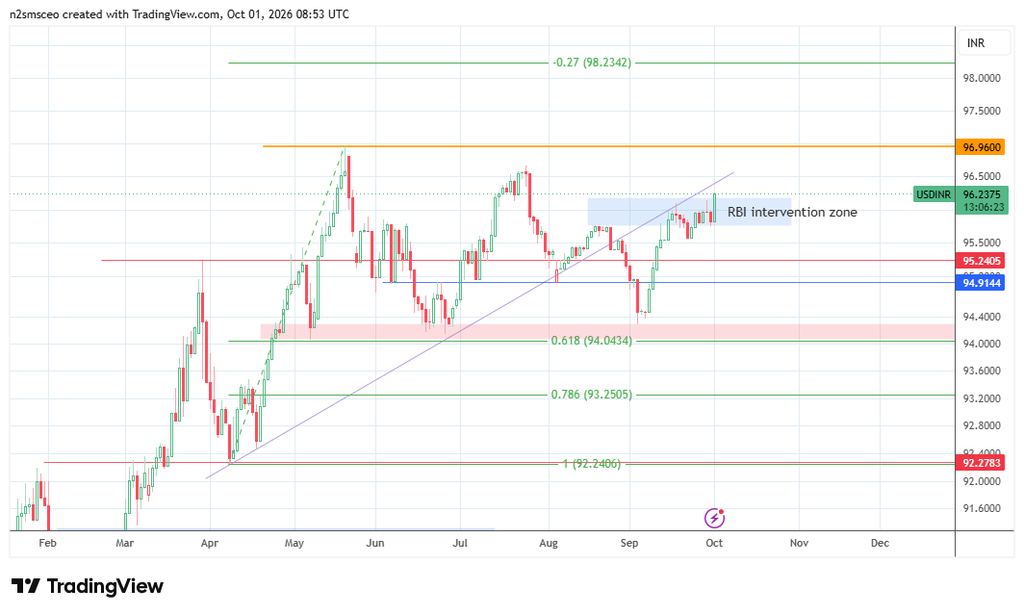
Conversely, if the RBI’s intervention line in the sand at 96.00 remains intact, a retracement move aims for 95.24 initially. A deeper retracement targets the 94.88 support pivot that formed the neckline of the 18 June/25 June double bottom, followed by 94.04 support (the 61.8% Fibonacci retracement level).