



- The USD/INR will trade as an interplay between the US Treasury's bond buyback program and the geopolitical scenarios.
Current Setup and Live Chart
With the US Dollar entering the week with negative sentiment, USD/INR’s upside may be capped or limited. This is because the rupee has significant exposure to the current geopolitical environment in the Middle East. This factor poses a substantial upside risk for the rupee.
USD/INR is mildly bearish at the moment. But significant oil-related upside risk means the pair’s direction could be driven more by the rupee’s response to oil prices than by the USD’s response to the local fiscal environment.
Last week brought news of the US Treasury’s intention to double its bond buyback program. Under this arrangement, the US Treasury will double the maximum limit of its 10–30-year liquidity-support buybacks from $2 billion to $4 billion per operation, with commencement set for 9 September 2026. The announcement caused a drop in US long-term yields and weakened the dollar’s yield advantage. But any geopolitical escalation puts the rupee on the back foot, meaning the pair could resume the upside even if the greenback is broadly weak.
USD/INR Forecasts: Key Scenarios This Week
The scenarios that will determine the USD/INR forecasts are straightforward:
- US Dollar ↓ + oil stable → USD/INR ↓ (mildly bearish)
- Dollar ↓ + oil ↑ sharply → USD/INR could still rise.
- Dollar ↑ + oil ↑ → strongly bullish for USD/INR.
There are asymmetric risks to the USD/INR pair. In other words, any fresh escalation of the US-Iran conflict, particularly regarding the Strait of Hormuz, will quickly override any weakness from the US Treasury buyback intervention.
Macro Drivers for the USD/INR right now
1) The Treasury Buyback Program
The US Treasury’s long-end buybacks are set to increase to at least $4 billion per operation and will cover 10–30-year securities. This has reduced the USD’s yield advantage.
Although this move aims to improve liquidity and reduce pressure on the long end of the U.S. Treasury curve, it could reduce the appeal of USD-denominated assets. This impact is already being felt across several emerging market FX pairs.
2) Oil prices

Elevated oil prices remain the rupee’s biggest threat. India is the world’s third-largest economy, and elevated oil prices hurt the rupee. India’s structural dependence on imported crude means higher prices risk importing inflation into India and keeping import bills high. The accompanying deterioration in the trade balance puts pressure on the local currency. Indeed, persistently high oil prices could weaken the rupee enough to offset any losses the USD suffers from Treasury intervention.
3) Geopolitical risk
The conflict around Iran and the Strait of Hormuz creates three channels of pressure. The first is from higher crude prices, which raise import costs. The second is from higher freight and insurance costs incurred from using longer alternative oil shipping routes. The third is the exit of portfolio funds from emerging markets due to risk aversion. India’s current growth provides some buffer, but it does not reduce the risk premium that hits the rupee amid geopolitical escalation. risk
4) The RBI as a Manager of Rupee Volatility
The Reserve Bank of India (RBI) typically steps in to manage excessive rupee volatility. One way it does this is by deploying some of its external reserves to defend the rupee and prevent a disorderly, outsized depreciation.
USD/INR Price Catalysts
1) Brent crude direction: For the rupee, this is the most important variable right now. Lower Brent crude prices reduce India’s import bill and favor a USD/INR downside. A sharp rise in Brent crude raises import costs and supports the pair. As prices approach $100, this factor becomes more important.
2) US Treasury Yields: The bond buyback program is basically an intervention that determines the yields on long-term US borrowing costs. They were introduced to stabilize the bond market at the long end. If US Treasury yields decline as a result, the US Dollar also declines, and this supports the rupee. Ultimately, this is meant to cap the upside in the USD/INR. The reverse is also the case. If the program fails to curtail the rise in bond yields, we would see the USD regaining lost ground. Rising oil prices are bullish for the USD/INR.
3) Foreign portfolio flows: A decline in US bond yields and a weaker dollar improve the appeal of emerging-market FX such as the rupee. It would favor an influx of foreign portfolio funds into the Indian market. These funds need to convert into the local currency to participate in the Indian market; this is bullish for the rupee. Conversely, a global risk-off episode (such as a geopolitical escalation) could send these portfolio funds fleeing to safety and out of the Indian markets. This is a rupee-negative scenario.
USD/INR Technical Outlook
The ascending trendline support is under threat, as the daily candle has violated it. We need to see the 95.24 support level (30 March high) break down for a push lower toward the 94.04 support and the 61.8% Fibonacci retracement of the 8 April – 20 May upswing. Below this level, additional support is seen at 93.25.
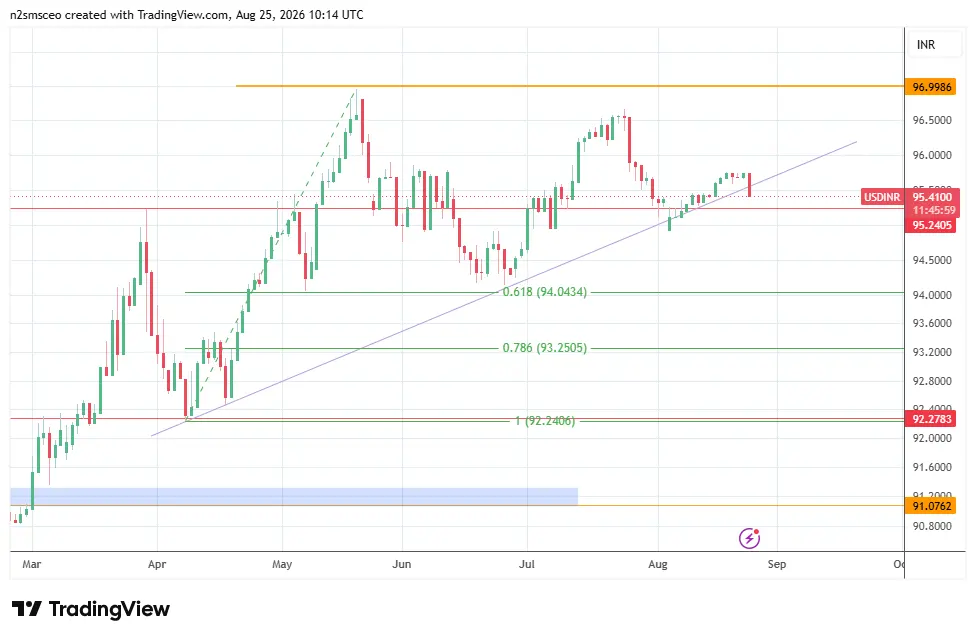
Conversely, recovery above the trendline maintains its integrity. The bulls would need to force a bounce from there to aim for the 96.99 resistance as the next upside target. However, there is a potential for a pitstop at the most recent high seen on 24 July at 96.67. Only if this point is surpassed can we see a reclaim of 96.99.