



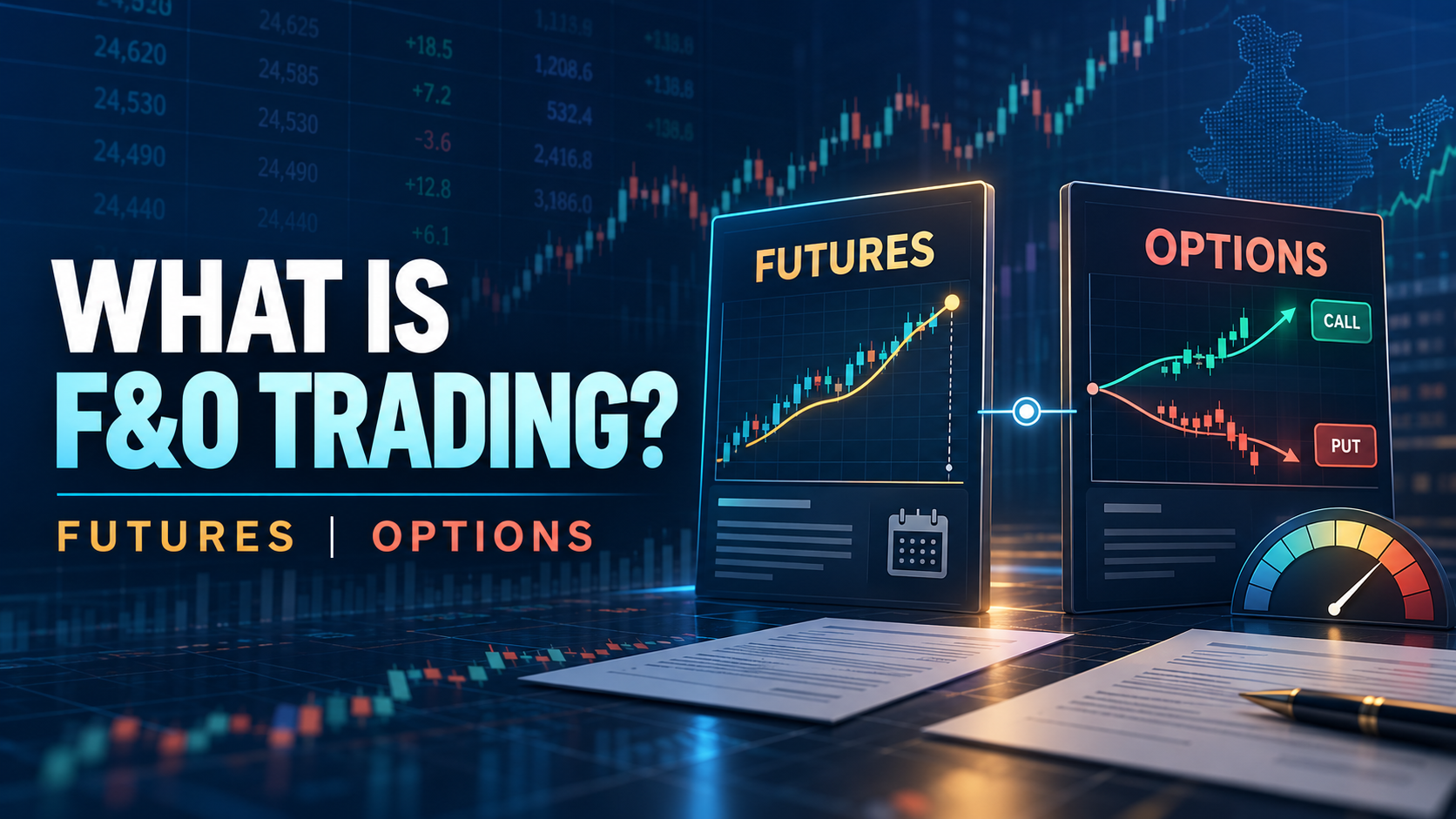
F&O trading involves buying and selling futures and options contracts whose value is linked to an underlying asset such as a stock or market index. Traders use these contracts to speculate on price movements, hedge existing investments or gain market exposure without buying the asset directly.
The risks are substantial. A SEBI study published in August found that 87.7% of individual equity-derivatives traders lost money in the 2025-26 financial year. Their combined net losses reached approximately ₹91,685 crore, even after the number of individual traders fell by about 20%.
How Does F&O Trading Work?
Futures and options are derivatives because their prices are derived from another asset. In India, the underlying asset may be a stock such as Reliance Industries or an index such as the Nifty 50 or Bank Nifty.
Each contract has an expiry date, lot size and agreed terms. Traders do not usually buy a single share through F&O. They trade standardised lots, which means the total position can be much larger than the initial amount paid or deposited.
This leverage is one reason F&O trading attracts active traders. It is also what makes losses escalate quickly when the market moves in the wrong direction.
What Is Futures Trading?
A futures contract is an agreement to buy or sell an underlying asset at a predetermined price on a future date. A trader expecting the Nifty 50 to rise can buy a Nifty futures contract. If the index rises, the position may make a profit. If the index falls, the trader may incur a loss.
Futures traders deposit margin rather than paying the full contract value. Positions are marked to market daily, meaning gains and losses are calculated as prices change. A trader may need to add more money if the available margin falls below the required level.
Unlike an option buyer, a futures trader has an obligation under the contract. Losses can therefore exceed the initial margin deposited.
What Is Options Trading?
An option gives its buyer the right to buy or sell an asset at a specified strike price before or on the expiry date. A call option is generally bought when a trader expects the underlying asset to rise. A put option is generally bought when the trader expects it to fall.
The option buyer pays a premium. If the option expires without value, the buyer can lose the entire premium. The option seller receives that premium but accepts a potentially much larger obligation. Selling uncovered options can produce heavy losses when prices move sharply.
An option’s price is affected by the underlying asset, strike price, remaining time, expected volatility and interest rates. A trader can therefore predict the general market direction correctly and still lose money if the move is too small or occurs too late.
Futures vs Options
The main difference is the obligation created by each contract. A futures buyer and seller are both bound by the contract. An options buyer has a right without the same obligation, while the seller must fulfil the contract if it is exercised.
Futures also create direct exposure to changes in the underlying price. Options are more complex because their value is affected by time decay and changes in implied volatility.

For option buyers, the maximum loss is usually the premium paid. Futures and uncovered option-selling positions can create losses well beyond the amount initially deposited.
Why Do Traders Use F&O?
Traders commonly use F&O contracts for three reasons:
- Speculation: Taking a position based on an expected rise or fall.
- Hedging: Reducing the risk of an existing investment.
- Arbitrage: Attempting to benefit from price differences between related markets.
A long-term investor holding a stock portfolio may buy put options to reduce the effect of a sharp market decline. An active trader may use index futures to take a short-term view on the Nifty 50.
The product itself does not determine whether a trade is prudent. The position size, purpose and risk controls matter.
Why Is F&O Trading Risky?
Leverage allows a small amount of capital to control a larger market position. Even a modest price change can therefore create a significant gain or loss.
Expiry-day trading adds another layer of risk. SEBI found that more than 75% of index-options turnover occurred on or close to expiry. The regulator has increased contract sizes, reduced weekly expiries and introduced upfront premium collection to discourage excessive short-term speculation.
Professional firms also have advantages in technology, execution speed and risk systems. SEBI reported that proprietary traders earned gross profits of approximately ₹44,000 crore in FY26, while foreign portfolio investors made about ₹14,000 crore. Almost 99% of those profits came from algorithmic trading.
Latest F&O Market News
Foreign investors entered the October derivatives series with significantly larger bearish positions after the Nifty 50 fell 6.7% in September. Net foreign index-futures shorts increased from about 184,000 to 267,000 contracts, while Nifty futures open interest rose nearly 30%.
The figures show how futures can be used to express a market view or hedge exposure. They do not mean retail traders should automatically copy institutional positioning.
F&O trading is complex and highly leveraged. Beginners should understand margins, expiry, volatility and maximum loss before placing a trade.
The contract is settled according to exchange rules. Depending on the product, settlement may be in cash or through delivery of the underlying shares.
Yes. Futures and uncovered option-selling positions can lose more than the initial margin. An option buyer’s loss is generally limited to the premium paid.