




Forex trades around the clock from Monday morning in the Asia-Pacific region until Friday evening in New York. That does not mean every hour looks the same. Trading activity moves between Sydney, Tokyo, London and New York as banks, companies, funds and other market participants begin their working day.
Understanding forex session times helps traders interpret changes in liquidity, spreads and price movement. It also prevents a common mistake: treating session hours as fixed UTC times even though London, New York and Sydney adjust their clocks during the year.
This guide gives the main session times in local time and UTC, explains the most important overlaps, and shows how the schedule converts to East Africa Time and West Africa Time. The hours are practical market conventions rather than the opening times of one central exchange because spot forex is an over-the-counter market.
In This Article We Will Cover
- The opening and closing times of the four major forex sessions
- How the Asian, London and New York sessions differ
- The busiest overlaps and major currency pairs
- How daylight saving time changes the schedule
Forex Session Times
The four commonly followed forex sessions are Sydney, Tokyo, London and New York. Together, they create continuous weekday trading because one financial centre is usually active as another begins to close.
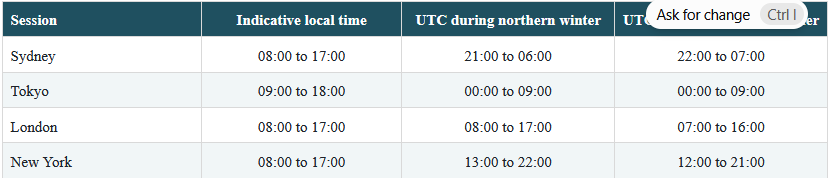
These are reference hours for the periods when each financial centre is most active. A broker’s platform may differ around public holidays and daylight-saving transitions.
The trading week generally begins at 5:00 p.m. Eastern Time on Sunday and ends at 5:00 p.m. Eastern Time on Friday. Liquidity can be limited near the weekly open and Friday close. Weekend news may also cause prices to reopen at a different level.
Asian Session Forex Time
The Asian session forex time is usually associated with Tokyo, which is active from 12:00 a.m. to 9:00 a.m. UTC. Sydney opens earlier, while Singapore and Hong Kong contribute to the broader Asian period.
The Japanese yen, Australian dollar and New Zealand dollar often receive more attention during these hours. USD/JPY may respond to Japanese data or Bank of Japan news, while AUD/USD and NZD/USD can react to releases from Australia, New Zealand and China.
The Asian session is often quieter than London or the London-New York overlap, especially for European pairs. Important data and central bank decisions can still cause sharp moves.
Traders often watch the Asian session’s high and low as reference points when London opens. These levels are areas to monitor, not automatic breakout or reversal signals.
London Session Forex Time
The London session forex time is 8:00 a.m. to 5:00 p.m. local time. That equals 8:00 a.m. to 5:00 p.m. UTC in winter and 7:00 a.m. to 4:00 p.m. UTC during British Summer Time. London’s morning briefly overlaps with late Asian trading, while its afternoon overlaps with New York. This makes it one of the most closely watched sessions.
Activity often increases around the London open. EUR/USD, GBP/USD, EUR/GBP and GBP/JPY may see stronger movement than during quieter Asian hours. European data and decisions from the European Central Bank or Bank of England can add to that activity.
The London open can produce quick changes in direction as traders respond to overnight news. An initial move is not guaranteed to continue, so the wider trend, scheduled data and nearby technical levels still matter.
New York Session Forex Time
The New York session forex time is 8:00 a.m. to 5:00 p.m. Eastern Time. That is 1:00 p.m. to 10:00 p.m. UTC in winter and 12:00 p.m. to 9:00 p.m. UTC during daylight saving time.
The first part of the session overlaps with London and is usually the busiest part of the North American trading day. EUR/USD, GBP/USD, USD/JPY and USD/CAD often attract more activity, while U.S. and Canadian data are commonly released during the New York morning.
U.S. inflation data, employment reports and Federal Reserve decisions can create rapid moves. Spreads may widen around major announcements, and fast markets can increase slippage. Activity often falls after London closes. The New York afternoon may become quieter unless an important event keeps participants engaged.
When Do Forex Trading Sessions Overlap
Session overlaps occur when two major financial centres are active at once. More orders can support higher liquidity and faster movement, although the result still depends on the currency pair and the day’s news.
The main overlaps are:
- Sydney and Tokyo: approximately 12:00 a.m. to 6:00 or 7:00 a.m. UTC. AUD and NZD pairs may attract greater attention.
- Tokyo and London: approximately 7:00 or 8:00 a.m. to 9:00 a.m. UTC. EUR/JPY and GBP/JPY are among the pairs traders may monitor.
- London and New York: approximately 12:00 p.m. to 4:00 p.m. UTC in summer and 1:00 p.m. to 5:00 p.m. UTC in winter. This is generally the most active overlap.
The London-New York overlap combines European and North American participation with a busy economic calendar. Higher activity also increases risk, so position size and maximum loss should be set before entry.
Major Currency Pairs
Major currency pairs traditionally refer to the most heavily traded pairs that include the US dollar. The usual retail list is EUR/USD, USD/JPY, GBP/USD, USD/CHF, AUD/USD, USD/CAD and NZD/USD. The term is a market convention rather than a fixed official classification.

Turnover rankings can change. BIS research based on the April 2025 survey found that USD/CNY had overtaken GBP/USD to become the third most traded currency pair globally, behind EUR/USD and USD/JPY. That shift shows why a traditional list of majors does not capture every important source of global currency activity.
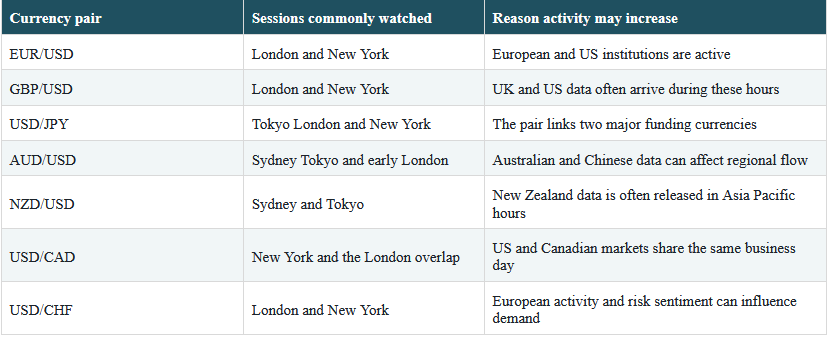
The most relevant session is usually when the markets connected to both currencies are active. EUR/USD often attracts greater participation during the London-New York overlap. AUD/JPY may be more active during Sydney and Tokyo hours, while USD/CAD commonly responds to North American data.
The economic calendar remains important because a major announcement can shift activity outside a pair’s usual pattern
How Daylight Saving Time Changes Forex Market Hours
Daylight saving time is the main reason forex session tables appear to disagree. Tokyo stays on Japan Standard Time throughout the year, but London, New York and Sydney change their clocks seasonally. Their UTC opening and closing times therefore move by one hour.
The United States and United Kingdom do not always change their clocks on the same weekend. The London-New York overlap can therefore shift temporarily. Sydney follows the southern hemisphere’s seasonal calendar.
Use UTC as the reference and confirm the current conversion in March, April, October and November, when clock changes are most likely to affect the schedule.
How Do Forex Session Times Affect Spreads and Volatility
Liquidity tends to improve when a large number of banks and other participants are quoting the same currency pair. Competition between prices can narrow the bid-ask spread, particularly in heavily traded pairs during their most active sessions.
When participation is thin, spreads can widen and a smaller order may move the available price further. This is more common around the weekly open, the daily rollover, major holidays and the quieter period after New York closes.
Volatility and liquidity are related but different. A busy market can be liquid and volatile at the same time. During a major data release, many participants may trade, yet prices can move so quickly that spreads widen and orders fill away from the price displayed moments earlier.
What Is the Best Forex Session to Trade
There is no single best forex session for every trader or currency pair. The useful question is whether the chosen session matches the pair, the planned holding period and the trader’s availability.
A trader following EUR/USD may prefer London hours or the London-New York overlap because both currencies have active home markets. Someone monitoring AUD/USD may find the Sydney and Tokyo sessions more relevant. A longer-term position may be less dependent on one session because its expected move spans several trading days.
Session choice does not create an edge on its own. Economic releases, central-bank decisions, spreads, execution quality and risk limits remain important. Traders should test any session-based idea with realistic costs and avoid assuming that a busy period will produce a predictable direction.
How to Choose the Best Forex Trading Hours
There is no single best time to trade forex for every trader. The right hours depend on the currency pair, the strategy and the level of price movement a trader can manage. Short-term traders may prefer the London open or London-New York overlap. Range traders may study quieter hours, while longer-term traders may place less emphasis on the exact session.
Before choosing a trading window, consider:
- whether both currencies are active at that time
- whether high-impact economic data is due
- whether the likely spreads, volatility and execution suit the strategy
The most useful schedule is one that can be followed consistently. Many traders focus on one or two repeatable windows rather than monitoring every session.
How to Use Forex Session Times in a Trading Plan
- Set the platform to a known time zone and note whether the broker changes server time during the year.
- Match the currency pair with the financial centres most closely connected to it.
- Check the economic calendar before the session begins, including releases scheduled outside the pair’s home region.
- Review the live spread before entering because an advertised minimum may not reflect current conditions.
- Record the session, spread and execution price in a trading journal to test whether timing affects actual results.
- Use position size and risk limits that remain manageable if volatility increases or an order experiences slippage.
Final Takeaway
Tokyo anchors the Asian session, London leads European trading and New York carries activity into the final part of the day. The London-New York overlap is usually the busiest window, while the most relevant session depends on the currencies involved. Confirm daylight-saving changes, review the economic calendar and choose hours that suit the pair and the strategy’s risk limits.
The global trading week commonly begins at about 5 p.m. Sunday in New York, when Asia-Pacific markets start the Monday session. A broker may open a few minutes later or apply different product hours.
The weekly market commonly closes at about 5 p.m. Friday in New York. Positions may remain open over the weekend, but normal spot trading and broker pricing generally pause until Sunday.
Local session hours usually stay similar, but their UTC conversion changes when London, New York or Sydney adjusts for daylight saving. Tokyo, EAT and WAT do not currently make seasonal clock changes.
Retail forex is generally available 24 hours a day during the working week, subject to broker hours and short maintenance pauses. Availability does not mean liquidity, spreads or execution conditions are equal at every hour.