


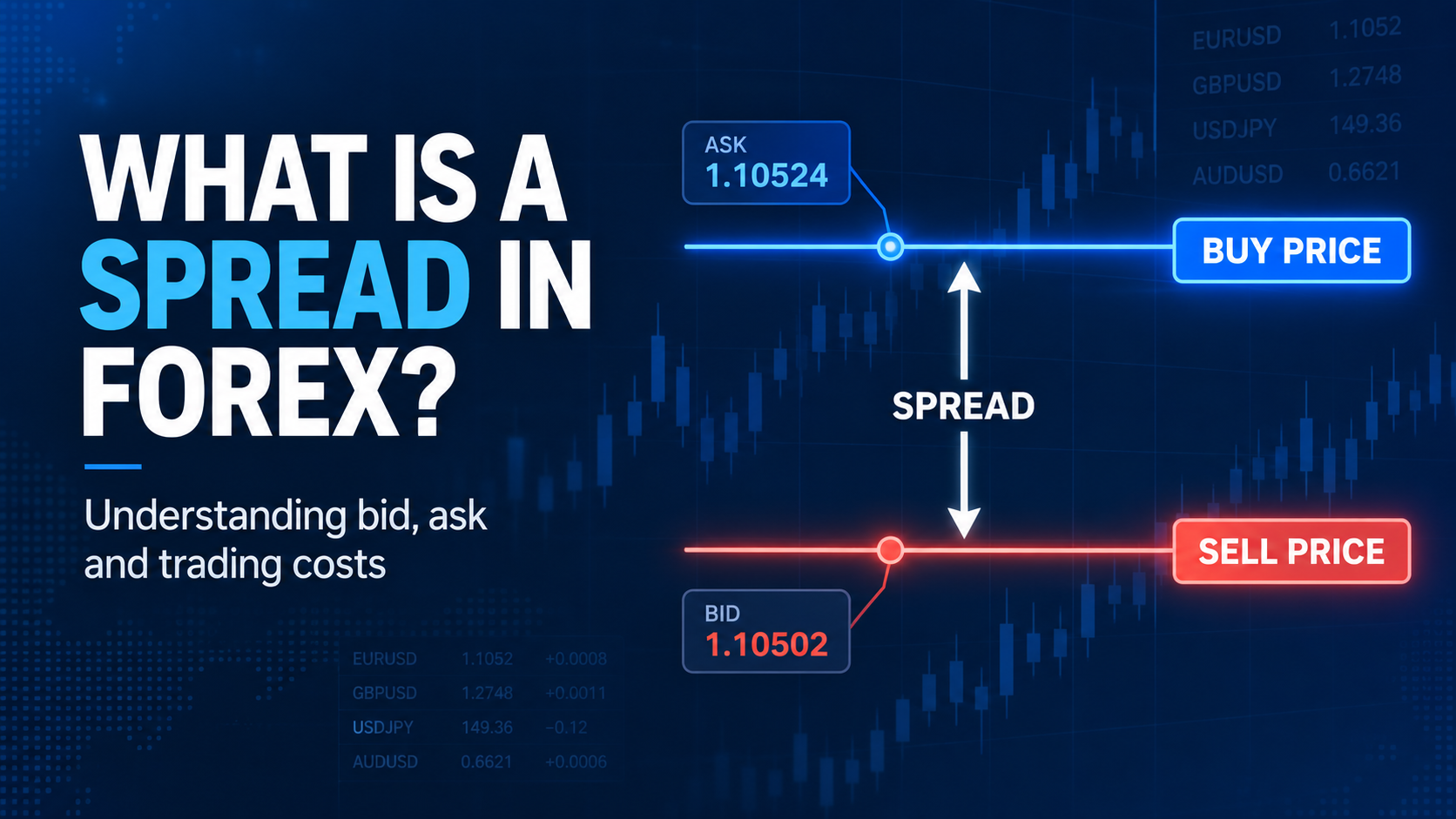
- The spread in forex is the difference between a currency pair’s bid price and ask price.
- Forex spreads are normally measured in pips and represent part of the cost of opening and closing a trade.
- Spreads can widen when market liquidity falls or volatility increases, particularly around major economic announcements.
If you are wondering what a spread is in forex, you are asking one of the most useful questions a trader can ask. The spread is one of the main costs of opening a currency trade, so it affects where a position begins, how far the market must move to reach break-even and whether a short-term strategy is realistic after costs.
This guide explains forex spreads in plain language and shows how to calculate them without burying the answer in jargon. It also examines fixed, floating, stable and raw spreads; compares spread-only and commission-based accounts; and explains what to check before choosing a broker.
In This Article We Will Cover
- What a forex spread means and how bid and ask prices work
- How spreads are measured in pips
- How to calculate the spread and its cash cost
- The differences between fixed floating stable and raw spreads
- Why spreads widen during news events and quiet trading periods
- How spread-only pricing compares with commission-based pricing
- How traders can account for spreads in planning and risk management
- How to compare brokers without relying on headline claims
- Answers to common questions about forex spreads
What Is a Spread in Forex
A forex spread is the difference between a currency pair’s bid price and ask price. The bid is the price at which you can sell the base currency. The ask is the price at which you can buy it. The ask is normally higher, and the gap between the two prices is the spread.

In this example, a market buy opens at 1.0854. If the bid remains at 1.0852, the position cannot be closed at the entry price; it would close at the lower bid. The bid therefore needs to rise by two pips before the trade reaches break-even, assuming there are no commissions, financing charges, slippage or currency-conversion costs.
How Do Forex Spreads Work in Practice
Forex platforms display two prices because buying and selling occur on opposite sides of the quote. A trader who buys enters at the ask and later exits at the bid. A trader who sells enters at the bid and later exits at the ask. That difference appears immediately in the position’s running profit or loss. It is not usually charged as a separate line item on a spread-only account; it is built into the quoted prices. A narrow spread gives the trade a shorter distance to break-even. A wider spread increases that distance.
This matters most when the expected price move is small. A two-pip spread may be a modest part of a trade targeting 100 pips, but a large part of one targeting five pips. The spread does not determine whether a trade succeeds, but it changes the hurdle the trade must clear.
How Are Forex Spreads Measured in Pips
Most currency pairs are quoted to four decimal places, with one pip equal to 0.0001. Japanese yen pairs are usually quoted to two decimal places, with one pip equal to 0.01. Many platforms show an extra decimal place called a pipette or fractional pip, equal to one-tenth of a pip.

How Do You Calculate a Forex Spread
The basic calculation is simple:
Spread = Ask price − Bid price
For EUR USD quoted at 1.0852 bid and 1.0854 ask, subtract 1.0852 from 1.0854. The result is 0.0002. Because one pip is 0.0001 for EUR USD, divide 0.0002 by 0.0001 to get a two-pip spread.
Always read the broker’s quote format before calculating. If the platform shows five decimal places for EUR USD, the final digit is usually a fractional pip rather than a full pip.
How Much Does a Forex Spread Cost
The number of pips tells you the size of the spread, but position size determines its cash value. A useful calculation is:
Spread cost = Spread in pips × Pip value × Number of lots
For a US dollar account trading a pair in which the US dollar is the quote currency, such as EUR USD, the approximate pip values below apply. Pip values can differ when the account currency or quote currency changes.

Suppose you buy one standard lot of EUR USD with a two-pip spread. Each pip is worth about $10, so the spread cost is approximately $20. The same quote costs about $2 for one mini lot and $0.20 for one micro lot.
The amount shown is the cost of crossing the spread under the stated quote. The final result can differ if the price changes during execution, the order is partially filled or the account applies an additional commission.
What Is a Fixed Spread
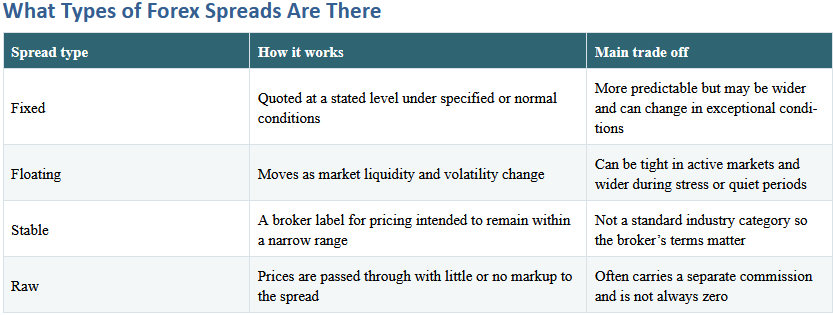
A fixed spread is designed to remain at a stated level during the conditions described by the broker. It can make estimated costs easier to calculate, but fixed does not always mean guaranteed at every second. Some providers reprice, restrict execution or use different spreads when markets become disorderly. The account terms should explain the exceptions.
What Is a Floating Spread
A floating spread changes with the market. It may narrow when many buyers and sellers are active, then widen when liquidity falls or prices move quickly. Floating pricing can be attractive during liquid sessions, but the live spread at the moment of entry matters more than an advertised typical figure.
What Is a Stable Spread
Stable spread is not a universally defined market term. Brokers generally use it to describe a spread engineered to stay relatively consistent for selected instruments or conditions. Treat it as a product description, not a regulated category: check how the broker defines stable, when the quote can change and whether a commission is added.

What Is a Raw Spread
A raw-spread account aims to show prices close to those received from liquidity sources. The displayed spread may reach 0.0 pips at times, but a separate commission commonly applies. A zero minimum does not mean every trade is free; average spread, commission and execution quality determine the all-in cost.
Why Do Forex Spreads Change
Spreads reflect the cost and risk of providing an immediately tradable price. They tend to narrow when trading is active and price competition is strong. They can widen when dealers and liquidity providers face greater uncertainty or have fewer counterparties available.
- Liquidity Major pairs usually have tighter spreads than thinly traded pairs because more orders compete near the current price.
- Volatility Fast price changes increase execution risk, so quoted bid and ask prices may move farther apart.
- Economic news Inflation, employment, interest-rate and central-bank announcements can trigger abrupt repricing and temporary spread expansion.
- Trading session Spreads are often tighter when major financial centres overlap and wider around the daily rollover or market open.
- Currency pair Exotic and less-liquid pairs generally carry wider spreads than heavily traded majors.
- Broker and account Pricing model, liquidity sources, markup, commission structure and execution method can all change the quote a client receives.
What Is the Difference Between Spread and Slippage
The spread is the gap between the bid and ask visible at a particular moment. Slippage is the difference between the price requested or seen and the price at which the order is actually filled. They are related to trading conditions, but they are not the same cost.
A tight displayed spread does not guarantee a precise fill in a fast market. Market orders prioritise execution, not an exact price. Limit orders control the worst acceptable price but may not be filled.
Spread vs Commission Which Costs Less
Neither pricing model is automatically cheaper. The correct comparison is the total cost for the instrument, trade size and time you expect to trade. Spread-only accounts build most transaction cost into the quote. Raw or commission accounts may show tighter spreads and charge a separate fee.

The raw account is cheaper in this illustration, but the outcome changes if its average spread rises or the commission is quoted per side rather than round trip. Brokers may publish commissions per lot, per side or per monetary value traded. Convert every charge to the same position size and full opening-and-closing cycle before comparing.
What Other Forex Trading Costs Should You Check
Spread is only one part of the bill. A fair comparison should also include commissions, overnight financing or swap charges, conversion fees, inactivity or withdrawal fees where applicable, and the possible effect of slippage. Holding period matters: financing can outweigh the entry spread on a position kept open for many days.
How Can Traders Account for Spreads
There is no technique that removes the spread, but traders can stop it from becoming an overlooked variable. The aim is not to trade only when the spread is at its absolute minimum; it is to know the live cost and decide whether the planned trade still makes sense after that cost.
- Check the live bid and ask before submitting an order rather than relying on a broker’s minimum spread.
- Compare the spread with the planned stop distance and profit target. A large cost relative to either can materially change the setup.
- Use an economic calendar and understand that spreads may widen before, during and after major announcements.
- Backtest with realistic spreads, commissions and slippage. Testing with zero costs can make a weak strategy look viable.
- Record actual transaction costs in a trading journal so comparisons are based on fills rather than marketing claims.
- Avoid increasing position size simply to make a small price target worthwhile. Higher size raises both potential loss and spread cost.
Final Thoughts
A forex spread is the difference between the bid and ask prices, but its practical importance goes beyond a two-number quote. Position size converts the spread into money, market conditions make it change, and account structure determines whether commission is added.
Before placing a trade, check the live spread and calculate the full cost for the intended position size. Before choosing a broker, compare average pricing, commissions, execution terms and regulation together. That gives a more useful answer than any promise of the lowest spread.
A good spread is competitive for the pair, account type and market conditions. Major pairs often trade more tightly than exotic pairs. Compare average spreads and all-in costs rather than treating one number as universally good.
A lower spread reduces one trading cost, but it does not by itself make a broker or account better. Commission, execution quality, regulation, financing and other fees also matter.
A displayed spread can reach 0.0 pips on some raw accounts and liquid pairs. It may last briefly and usually does not remove commissions or slippage.
The cost arises because you trade across the bid and ask. It is reflected when the position opens and is realised through the entry and exit prices rather than necessarily appearing as a separate charge.
A buy opens at the ask but is valued for closing at the bid, while a sell opens at the bid and is valued at the ask. The initial difference normally reflects the spread, plus any commission charged at entry.
Spreads can widen when major markets are closed, order flow is thinner or the market passes through the daily rollover. The exact pattern depends on the pair and provider.
Highly traded major pairs such as EUR USD often have relatively tight spreads because liquidity is deep. No spread is fixed across all brokers and times.
Fixed spreads make costs more predictable under stated conditions, but they do not remove market risk and may have exceptions. Floating spreads can be lower in liquid markets but can widen sharply.
Leverage does not change the spread in pips. It allows a trader to control a larger position with less margin, which can increase the cash value of the spread and the potential gain or loss if position size rises.
Tax treatment depends on jurisdiction and personal circumstances. Keep complete trading records and consult a qualified tax professional rather than relying on a general trading guide.