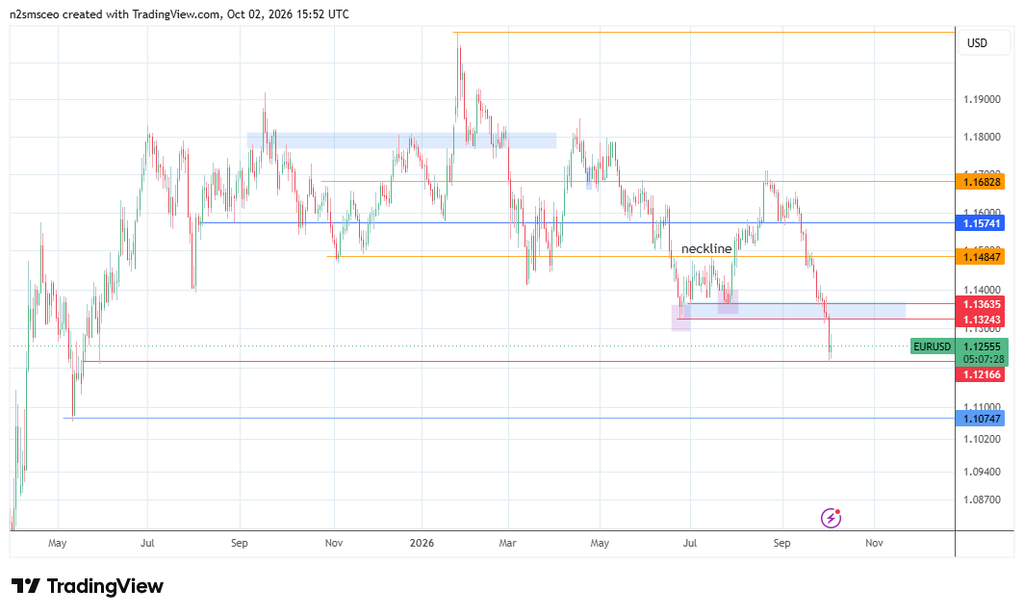
- The EUR/USD rebounds after the weak NFP, but bond yields remain stubbornly high and the uptick could be shortlived.
Current setup
Following an initial drop in the London session, the EUR/USD has rebounded strongly in the NY session. The pair now trades at 1.1250–1.1260 following the release of the September 2025 Non-Farm Payrolls report that showed a weakening of public sector hiring (minus Agriculture). The weak jobs data triggered a decline in the US Dollar, allowing for the >30-pip rebound in the Euro vs the greenback. The softer jobs report also dampened expectations for October Fed rate hike, which is also in tandem with the scaleback of rate hike expectations by Goldman Sachs from October to December 2026.
However, the Euro’s upside is limited by emerging fiscal concerns, the continued elevated state of energy prices, and rising Eurozone bond yields. This leaves the EUR/USD in a two-sided battle of monetary policy on both sides of the divide:
Weak US jobs data → lower US bond yields (not much) → Less hawkish Fed (USD negative) → EUR/USD higher
versus
Hot Eurozone inflation → ECB more hawkish → EUR positive → EUR/USD higher
EUR/USD: Today’s Macro Drivers
1. Soft US NFP — dollar-negative surprise
September US nonfarm payrolls rose only +29K, versus a consensus of +90K, indicating public-sector hiring has tailed off. August payrolls were also revised lower to +133K. The unemployment rate rose from 4.1% to 4.2% amid a participation rate of . Average Hourly Earnings fell from 0.3% (prior and consensus) to 0.1%.
The data set the odds of an October rate hike, as reflected in the CME’s Fedwatch tool, where the probability fell from 24% pre-NFP to 15% as of writing.
↓ NFP → ↓ Fed hike expectations → ↓ US 10-year Treasury yields → ↓ USD → ↑ EUR/USD
2. Hotter-than-Expected Eurozone Flash CPI
The Eurozone’s Flash headline inflation rose sharply to 3.8% YoY in September, beating the 3.6% estimate after rising from 3.2% in August. The Core CPI Flash Estimate also rose from 2.4% to 2.5%. The energy component of the headline figure came in at 18.8% YoY.
Rising inflation, amid growth worries for the region’s central bankers, has put the ECB in a bind. It has to balance the drive to keep energy-risk-derived inflation within its 2% target with resisting the urge to tighten further, given the attendant growth risks to the Eurozone. Core inflation suggests the energy risk premium has driven EU-wide inflation less than previously feared. The data keeps EUR/USD supportive amid weak US jobs data and justifies last month’s ECB rate hike.
3. The US 10-year Yield
The US 10-year Treasury yield retreated slightly on the dismal NFP, but it remains close to 5.34% and still shows signs of recovery. This could erase any gains the EUR/USD has made post-NFP. It is therefore a better determinant of the USD’s performance than any other US data point at the moment, NFP inclusive.

For EUR/USD, the transmission runs as follows:
↓ 10Y yield + ↓ USD index + ↑ EUR/USD
↑ 10Y yield + ↑ USD index + ↓ EUR/USD
Bond yields staying above 5.2% keep the USD resilient enough to withstand initial drops.
EUR/USD Forecast Scenarios
Bull case: EUR/USD breaks above 1.1363, with an extension above 1.1484
If US Treasury yields decline further following the soft NFP, we could see a break of 1.1363 in the first instance. However, we also need to see a corresponding drop in oil prices to sustain the decline in US bond yields.
Base case: EUR/USD trades between 1.1216 and 1.1324-1.1363.
This range-bound scenario is likely if the market attributes the weaker NFP to seasonal distortions rather than a true labor market collapse. Traders would then watch the US bond yield picture to reassess the outlook from the Fed. This is more or less a “wait-and-see” scenario.
Bear case: EUR/USD falls below 1.1216, targeting 1.1074 (May 2025 lows)
This bearish scenario gains more credibility if US yields push back above 5.30%, with another uptick in oil prices. The Eurozone is a net energy importer and the risk of higher oil punishing its growth aspirations is a real worry.