



- The DAX index retains upside momentum after Nvidia's strong Q2 results boosted demand for the semiconductor and electrical stocks.
The DAX index continues its moderately bullish path, trading amid improving German economic expectations and upbeat corporate earnings. However, Europe’s monetary policy outlook is becoming more complicated amid the Middle East geopolitical standoff, which may cap the DAX index’s upside.
The index is currently trading at 26,380, slightly below its record high of 26,580 reached earlier in August. The index’s 3.4% gain over the last month has largely come from improved sentiment in global stock markets, driven by the fall in oil prices. Brent crude is trading around $86 a barrel, as indications from the Iran-Oman talks suggest that safer navigation through the Strait of Hormuz may be much closer than markets expected. The fall in oil prices has also reduced the potential for inflationary shock, which is why European equities such as the DAX index are trading moderately higher this week.
Markets are also responding to Nvidia’s surprisingly strong Q2 FY2027 earnings report, which indicated triple-digit earnings growth. The sentiment boost from the report, which indicates that AI earnings are justifying capex budget ramps, is seeping into global markets.
DAX Index: Broader Fundamental Playbook
Here is some background on the German equity market’s performance. The fundamental environment is improving, even as monetary policy risks return amid rising inflation. Rising exports contributed to the German economy’s 0.3% growth in the second quarter. The IFO export expectations index rose to 9.6%, representing its strongest reading in four and a half years.
Furthermore, declining crude oil prices have eased some of the inflationary pressures associated with the geopolitical crisis, which is particularly helpful for Germany’s industrial complex. However, the European Central Bank remains concerned that the impact of previous oil prices, which were above 90%, may start to seep into the economy. This has led to increased bets that the ECB may be preparing for a September rate hike.
The investment case for the DAX index is as follows:
- A bullish view of the DAX stems from a boost in Germany’s growth, the fall in oil prices, and the ramp in AI investments.
- However, those bearish on the DAX are banking on higher oil prices, a more hawkish ECB, and rising European bond yields.
Overall, the risk balance remains constructive, and if crude oil prices continue to sustain their current decline, the German economy could see a broader economic recovery. However, geopolitical energy shocks could return, forcing the ECB into a more aggressive hawkish cycle. This would pose a new risk to the DAX’s bullish thesis, even as the index trades near-record highs.
DAX Index: Current Macro Drivers
1) Improvement in German Economic Expectations
German business sentiment is improving, as the IFO export expectations index rose sharply in August (9.6% vs prior -2.8%). This was not only a large jump but also represented a spike to 4-year highs. The strong print signals stronger expectations for AI demand, digitalization, and government-backed investment. Germany’s economy grew 0.3% in the second quarter, even as exports rose 2%. The numbers matter for the DAX index, which leans heavily on the country’s industrial complex and export sectors.
2) AI and Semiconductor Investment

The German market’s gains from the global AI investment cycle are hard to ignore. Increased investment in AI infrastructure has driven strong demand from German companies in optics, data processing, and electrical equipment. Nvidia’s latest stellar results and better-than-expected forward revenue guidance have pushed European semiconductor stocks higher. US AI spending is driving a surge in demand for European semiconductor products. This eventually leads on to improved earnings for companies such as Infineon, which boosts the DAX.
3) Falling Oil Prices
The decline in crude prices has improved the sentiment around European equities. The Eurozone is a net energy importer. Falling oil prices are due to the possibility of the reopening of the Strait of Hormuz, This factor is deemed beneficial to Germany’s heavy industrial complex and to the consumer components of the DAX.
Lower oil prices → lower German production costs → lower inflation → higher consumer purchasing power → improved corporate margins.
4) Potential ECB Hawkishness
The immediate risk to the DAX comes from the ECB. Markets are pricing in a September rate hike as inflation rises to 3% (mostly from the follow-through of previously higher energy prices). Economic growth coupled with inflationary pressures is an ingredient in a hawkish ECB outlook, which is ultimately negative for indices. Higher rates mean financing costs rise, valuation multiples fall, bond yields rise, and consumer spending drops. The key question heading into the September meeting is whether the current oil-price decline has had a strong enough effect to deflect the energy shock from European core inflation.
5) German Fiscal Expansion
Germany’s current fiscal policy backdrop supports the DAX. A huge ramp-up in public infrastructure and defense spending has been the trigger. The DAX includes companies in sectors that typically benefit from such spending: industrials, defense, engineering, construction, electricals, etc.
DAX Index: Technical Outlook
The DAX is in a long-term uptrend and currently trades below the all-time high of 26,580. At 26,380, the 26,580 resistance is the major barrier for bulls. A break above this barrier sends the index to new highs, with potential price discovery at 26,944, the 27% Fibonacci extension of the 23 March – 6 July 2026 upswing. Further upside objectives lie at psychological price levels; 27,000 and 27,500 are potential candidates.
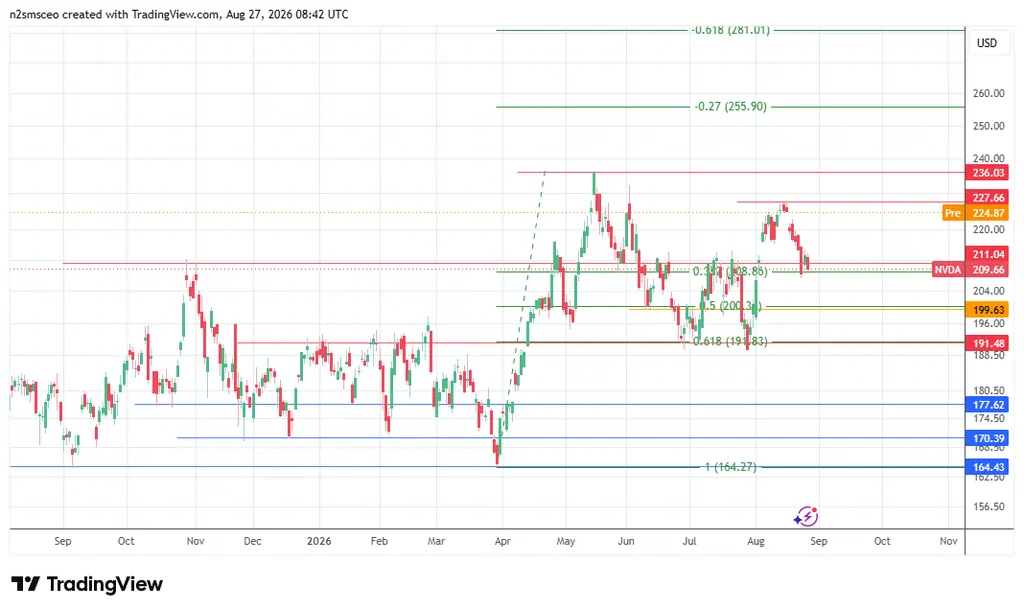
Conversely, a break below the 26,000–26,100 support area will target the next downside zone at 25,404, the former high of 25 May and the lows of late July 2026. A deeper breakdown weakens the bullish structure and produces a further decline towards 24,366, the 38.2% Fibonacci retracement; 23,863 is the 50% retracement and prior low of 15 May 2026, and this level is the next downside target on a deeper retracement.