


Current setup
The Hang Seng index futures have rebounded in the New York session after Wednesday’s 0.1% drop to 24,314. The US Producer Price Index print was hotter than expected. However, the broader market response was choppy, as US bond yields eased further, leaving Fed rate expectations unclear. Despite this recovery, the Hang Seng index remains vulnerable to inherent weakness in the global technology sector. US Treasury yields may have eased, but they remain above 5.00%. Furthermore, uncertainty over China’s economic outlook continues to weigh on the index.
The immediate question is whether Chinese technology stocks can regain momentum despite deteriorating sentiment across Asian equities.
China stimulus + technology recovery → ↑ Hang Seng
versus
Global tech sell-off + weak risk appetite →↓ Hang Seng
Hang Seng: Key Market Drivers
1. China’s Economic Outlook
China’s September producer-price inflation came in at 5.0% year-on-year, well above the consensus 4.5% forecast. Higher producer prices may boost industrial revenues, but as the energy risk premium plays out from Middle East geopolitical tensions, they also signal rising input costs that could compress corporate margins.
The playbook is to determine whether higher producer prices reflect stronger demand for Chinese goods or indicate supply-side pressures. If data indicate rising property activity, improving business confidence, and a boost in domestic consumption, these would be seen as constructive for Hong Kong equities.
2. Technology stocks and AI valuations
Technology shares carry significant weighting for the Hang Seng index. Global AI-related stocks have shown high volatility in recent sessions, which is also driving moves in the index. Recent concerns that revenue or cash flow is not matching some of these stocks’ capex expectations have led to a selloff in these equities, and the Hang Seng has been dragged down as a result. Any recovery in major Chinese internet and technology companies would support the Hang Seng index, but a continued selloff in semiconductor names or AI-related stocks would weigh on the index.

3. US Treasury yields and capital flows
Higher US bond yields discount the future valuations of tech and high-growth stocks. Because the Hang Seng index has a large share of such equities, rising US bond yields make these Hong Kong stocks less attractive than stable, low-risk USD-denominated assets such as US Treasuries. Also, the US-Iran war is a risk-off event, and international portfolio funds have reduced exposure to emerging-market assets.
Forecast scenarios
Bull case: A recovery in technology shares and improved China-related sentiment boost the index. Look for a recovery above 24,500, as this could open the path to upside targets in the 24,800–25,000 range or higher.
Base case: Consolidation between 23,800 and 24,800, as investors balance headwinds from global macro risks with local tech-sector buying if the market sees current levels as cheap enough.
Bear case: Deteriorating Chinese sentiment or a further selloff in tech stocks, along with elevated US bond yields, could push the index below 23,800. This breakdown opens the door to targets below 23,500 and lower.
Technical Outlook
The bulls are pushing for a break above the 24234 resistance. A break of this barrier and the descending trendline would first unlock access to the 24670 resistance. Above this level, the 25083 resistance comes into play, marking the former low of 14 August and the high of 14 September.
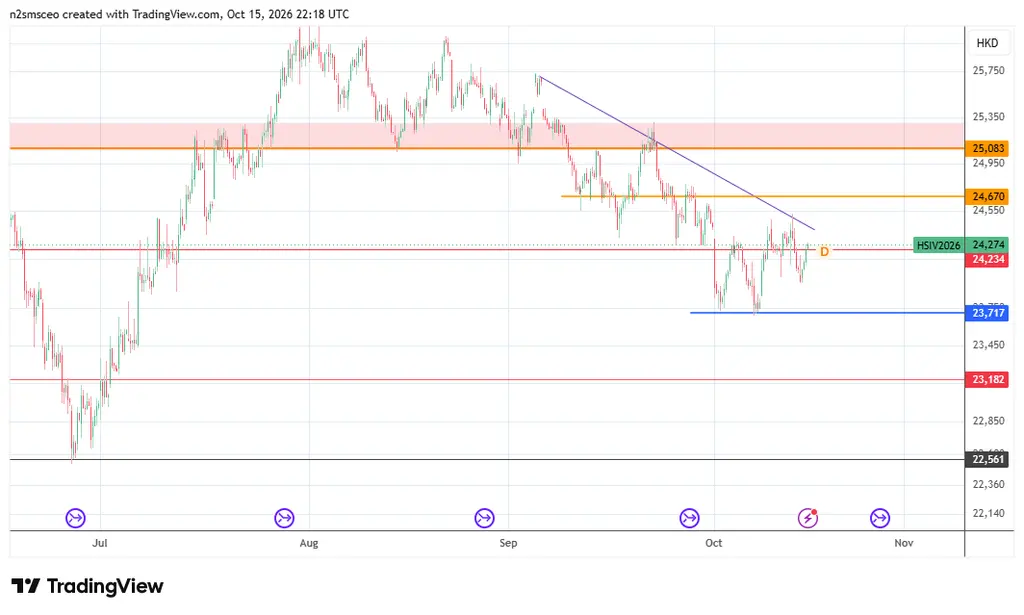
On the other hand, failure to clear these barriers keeps the downtrend bias intact. The breakdown of the 23717 support formed by the prior lows of 2 October and 8 October. If this support is degraded, the downtrend move continues, with the 23182 support and the low of 26 June at 22561 forming the next downside targets.