



- BHEL share price tests ₹431 support as Q2 EBITDA jumps 77%. Explore earnings growth, weak order inflows and key levels shaping the stock’s outlook.
Bharat Heavy Electricals reported a 77% rise in second-quarter operating earnings as stronger sales lifted profitability, but a slowdown in new orders has weighed on its shares. BHEL share price traded near ₹434.35 on Friday, following a retreat from the ₹460 region. The state-owned engineering company’s earnings beat has shifted attention to whether fresh project awards can sustain its growth.
Key Takeaways
- Q2 revenue rose 24% to approximately ₹9,300 crore, while EBITDA increased 77% to ₹1,026 crore.
- New orders slowed to approximately ₹4,000 crore, despite a substantial outstanding order book.
- The stock is testing support near its 20-day moving average at ₹431.29, with resistance around ₹440.
BHEL Q2 Results: Revenue Rises 24% as Margins Expand
BHEL’s revenue from operations increased 23.8% year-on-year in the September quarter, supported by growth across its Power and Industry businesses. EBITDA rose to ₹1,026 crore from ₹581 crore a year earlier. Its EBITDA margin widened to 11% from 7.7%, showing that the company retained more operating profit from each rupee of sales.
Standalone net profit more than doubled to approximately ₹810 crore, compared with ₹368 crore in the corresponding quarter. The Power division remained the largest contributor, with revenue increasing 17% to ₹6,638 crore. Industry revenue grew faster, rising 45% to ₹2,662 crore.
These figures strengthen the case that BHEL’s execution is improving. The challenge is maintaining that earnings momentum as existing projects progress and new contracts enter the pipeline.
Why Is BHEL Share Price Under Pressure After Strong Earnings?
The concern lies in order intake. BHEL secured approximately ₹4,000 crore in fresh orders during Q2, compared with ₹26,700 crore in the preceding quarter, amid a lull in large thermal power awards. Large contracts can make quarterly comparisons volatile. Even so, a prolonged slowdown would raise questions about the pace of growth once the current backlog is executed.
BHEL’s outstanding order book stood at approximately ₹2.58 lakh crore at September 30, up 17.3% year-on-year. That provides substantial contracted work, but investors also need evidence that new business can replenish the backlog.
The earnings improvement and the share-price pullback therefore reflect two different concerns: stronger profitability today and uncertainty over the timing of future orders.
BHEL Share Price Technical Analysis: Can ₹431 Support Hold?
BHEL remains above its rising 20-day simple moving average at ₹431.29, although the pullback from recent highs has left little room above that support. The latest daily candle shows a narrow trading range between ₹431.50 and ₹439.00. Holding the lower end would help stabilise the stock, while a break above ₹440 would provide an initial sign of renewed buying.
Momentum remains positive but is fading. The MACD line stands at 5.20, above the signal line at 4.30, while the shrinking positive histogram suggests the recent upward push is weakening.

The main technical levels are:
- Immediate support: ₹431–₹432. This combines the latest session low with the 20-day moving average.
- Next support: ₹420. A daily close below the moving average would bring this area into focus.
- Deeper support: ₹410, followed by ₹400. These levels mark lower areas of previous trading activity.
- Initial resistance: ₹439–₹440. A sustained break could open the way towards ₹450.
- Major resistance: ₹460–₹464. This is the recent high zone where sellers regained control.
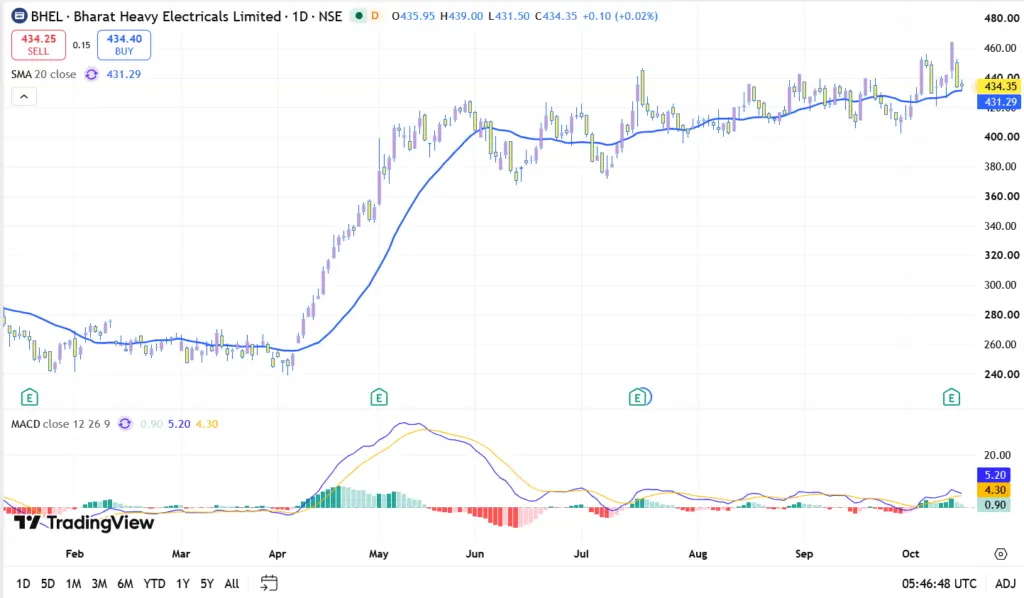
The near-term outlook remains finely balanced. Holding ₹431 would preserve the recovery attempt, but buyers need to reclaim ₹440 to improve the technical picture.
BHEL Outlook Hinges on Fresh Orders and Project Delivery
Fresh thermal power awards are the clearest potential catalyst, alongside opportunities in nuclear equipment, transmission and industrial projects.
BHEL has also approved approximately ₹500 crore in additional manufacturing facilities for thermal and nuclear sets at its Haridwar plant. The investment supports capacity expansion, although its earnings contribution will depend on future orders and utilisation.
For now, the strongest part of BHEL’s results is the improvement in profitability. A recovery in order intake, backed by timely delivery and cash collection, would give investors greater confidence that the improvement can last.
Slower new orders overshadowed stronger revenue and earnings. Investors are watching whether upcoming project awards replenish the company’s existing backlog.
Revenue rose approximately 24% to ₹9,300 crore, EBITDA increased 77% to ₹1,026 crore, and standalone net profit climbed approximately 120% to ₹810 crore.
BHEL’s long-term prospects depend on power-sector investment, new contract wins and profitable execution of its order book. Improving margins support its outlook, but valuation, project delays and uneven order intake remain important risks.
Investors are concerned about slower order intake despite stronger quarterly earnings. BHEL secured approximately ₹4,000 crore in Q2 orders, compared with ₹26,700 crore in the preceding quarter.
BHEL’s outlook rests on converting its substantial order book into revenue, sustaining improved margins and securing fresh business. Thermal power, nuclear equipment and industrial projects offer growth opportunities, although contract timing can make quarterly performance uneven.