



- Gold price today trades near $4,174 in early Friday trading, October 16, as XAU/USD attempts to extend its recovery after three consecutive sessions of losses.
- Falling US Treasury yields and a weaker dollar are supporting gold despite hotter US inflation and uncertainty over Federal Reserve interest rates.
- Gold faces immediate resistance at $4,192–$4,200, while repeated buying near $4,066–$4,103 suggests sellers are struggling to force another breakdown.
Gold prices held near $4,174 during Friday’s Asian session, October 16, as buyers attempted to build on Thursday’s rebound ahead of the London market open. XAU/USD traded around $4,173.90, virtually unchanged on the day, after touching an intraday high of $4,186.35. The precious metal remains below the psychological $4,200 level, leaving traders watching for confirmation that its recent recovery can develop into a sustained rally.
The latest price action follows a sharp reversal in US Treasury yields, which helped gold recover despite unexpectedly strong American inflation figures. Meanwhile, growing concerns about artificial intelligence stock valuations have increased demand for defensive assets.
Gold Price Rebounds as US Treasury Yields and Dollar Retreat
Gold recovered more than 1% on Thursday, ending a three-session losing streak as US Treasury yields declined and the dollar weakened. Spot gold climbed toward $4,153, while US gold futures for December delivery settled around $4,170.
The rebound followed a drop in the benchmark 10-year Treasury yield to a three-week low. Lower yields reduce the opportunity cost of holding gold, which does not generate interest. The US dollar index also declined approximately 0.5%, making dollar-denominated bullion less expensive for international buyers.
Interestingly, the recovery occurred despite stronger-than-expected US inflation figures, suggesting that bond market movements are currently exerting greater influence over gold prices than inflation expectations alone.
US Inflation and Fed Rate Expectations Keep XAU/USD Under Pressure
Gold’s recovery faces an important obstacle: the Federal Reserve’s continuing battle against inflation. September’s US consumer inflation report exceeded expectations, while producer prices recorded their strongest increase in approximately four and a half years. Ordinarily, persistent inflation could encourage additional interest rate increases, strengthening Treasury yields and weighing on gold.
However, markets have become less convinced that the Fed will raise rates immediately. According to CME FedWatch probabilities reported Thursday, traders assigned approximately a 29% chance to an October rate hike. Comments from Federal Reserve officials have reinforced expectations of a cautious approach rather than an automatic response to the latest inflation figures.
Investors are now watching Federal Reserve Chair Kevin Warsh’s remarks at the IMF meetings on Friday for further guidance on the October 27–28 policy decision.
AI Stock Selloff Creates a New Safe-Haven Catalyst for Gold
Gold is also benefiting from uncertainty surrounding the technology sector. Concerns about the sustainability of artificial intelligence investment have unsettled semiconductor and cloud infrastructure stocks, encouraging investors to reassess risk exposure.
The resulting demand for US Treasury bonds has pushed yields lower, indirectly supporting precious metals. This creates an unusual market environment in which gold can recover even while inflation remains elevated.

However, the relationship is not guaranteed. A recovery in technology shares or renewed selling in government bonds could weaken that support.
Gold Technical Analysis: XAU/USD Tests $4,200 Resistance
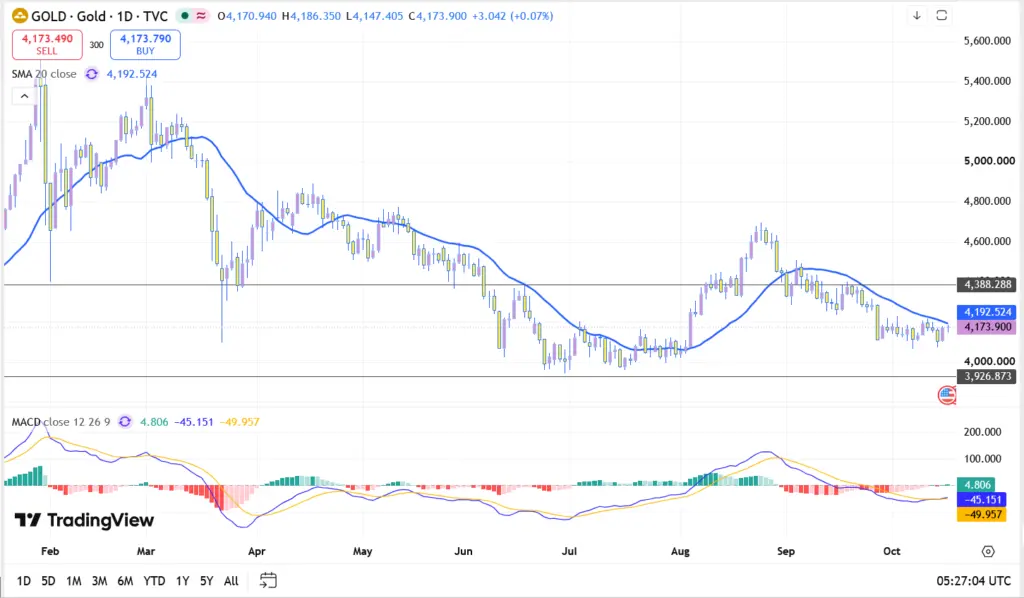
Gold is consolidating near $4,174, with buyers attempting to reclaim the 20-day moving average at $4,192.52. The MACD histogram has turned positive, indicating easing selling pressure, although both MACD lines remain below zero.
A daily close above $4,200 would provide an initial bullish signal, opening the way toward $4,250 and potentially $4,388. A weekly close above $4,200 would strengthen the case for a sustained recovery.
On the downside, immediate support stands at $4,147, followed by $4,103. A break below the recent $4,066 low would undermine the recovery and expose the $4,000 psychological level.
Gold Price Forecast: Is a Bullish Reversal Beginning?
The near-term gold price forecast remains cautiously constructive as long as buyers defend the $4,103–$4,066 support region. Repeated failures to sustain a breakdown below this area suggest selling pressure may be weakening. Nevertheless, gold must reclaim $4,200 before the recovery gains stronger technical credibility.
A successful breakout could bring $4,388 into focus over a broader recovery period. Conversely, renewed dollar strength or hawkish Fed commentary could send XAU/USD back toward $4,103. Friday’s London and New York sessions will be important in determining whether Thursday’s rebound attracts fresh buying or fades beneath resistance.
Gold Price Today FAQs
Gold’s short-term outlook depends on whether prices reclaim $4,200 and maintain support above $4,103. A breakout would improve the bullish outlook, while a breakdown could expose $4,066.
Warsh’s remarks on Friday, October 16, could influence gold prices by changing expectations for the Fed’s October interest-rate decision. Hawkish comments could pressure XAU/USD, while a more cautious stance may support gold through lower Treasury yields.
Gold entered Friday’s session on course for a weekly decline of approximately 1%, despite recovering on Thursday. A stronger finish above $4,200 could improve short-term sentiment, but the broader recovery remains uncertain.
A sustained move above $4,200 would improve the bullish outlook, with $4,250 and the $4,388 resistance area becoming potential upside targets. However, reclaiming $4,200 alone would not guarantee a rally toward $4,400.