


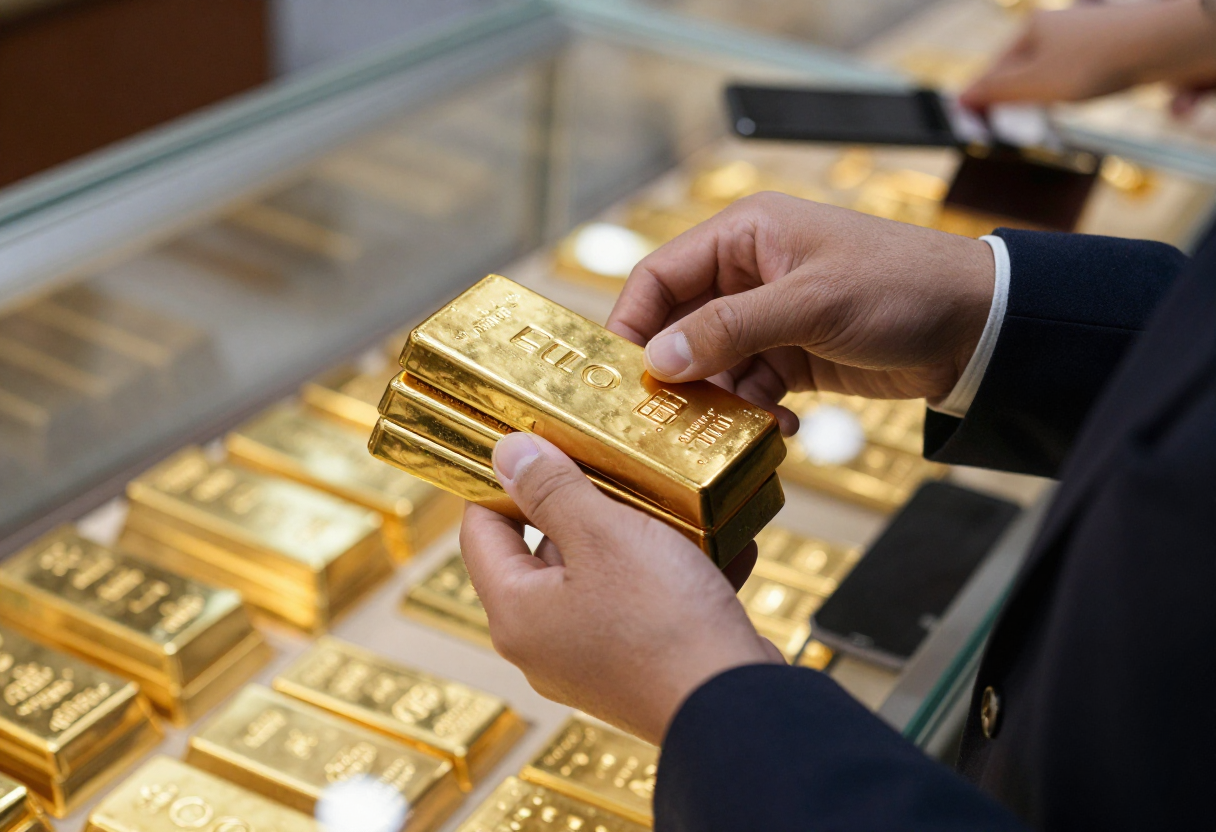
- Gold has fallen to a seven-week low below $4,200, extending its September decline as higher Treasury yields and a stronger US Dollar weigh on XAU/USD. Reuters
- Oil-driven inflation and further Fed rate hikes have become the biggest headwinds for gold, with the Federal Reserve already raising rates in September and markets now pricing roughly a 70% chance of another hike in October. Reuters
- Gold’s next major catalysts are US inflation and labour-market data, including PCE inflation and nonfarm payrolls, which could reshape expectations for the Fed’s October rate decision and determine whether XAU/USD can recover from its September selloff.
Gold experienced a remarkable beginning to 2026, reaching unprecedented levels and surpassing $5,000 in January. However, this upward trajectory has encountered some recent challenges. Since March, the metal has found it difficult to maintain strength above $4,800, going down by about 15% and on a three-month losing streak.
Gold entered the US-Israel war on Iran from a position of extraordinary strength. Toward the end of January, prices shot above $5,500 per ounce, continuing upward movement fueled by strong demand throughout the first months of the year. On January 29, it reached $5,600, an unmatched peak, closing what turned out to be its strongest annual rise since the 1970s.
Following Operation Epic Fury on February 28, an unanticipated market dynamic emerged. Gold prices did not sustain their upward trajectory. Coordinated US and Israeli strikes on Iranian sites initially spurred panic buying across precious metals markets on February 28, driving gold futures up over 2% in one session, from approximately $5,100 to above $5,300 per ounce.
However, this surge proved short-lived, and gold has cracked under pressure from the US dollar.
Originally published in 2024. This article was updated on October 16, 2026 to reflect the latest developments in the gold market and the outlook for August 2026.
Gold Price Crashes to 7-Week Low as Oil Fuels Fresh Fed Rate Hike Bets
The gold price today extended its September decline on Monday, October 16, with XAU/USD sliding to its lowest level in more than seven weeks as rising oil prices, higher Treasury yields and fresh Federal Reserve rate-hike bets hit bullion.
Spot gold fell around 3% to $4,156.45 by 08:14 GMT, after dropping toward the $4,140 area earlier in the session. The move pushed gold below $4,200 and marked its weakest level since August 5. US December gold futures also dropped 3.1% to $4,188.80.
Why Gold Is Falling Sharply at the End of October
The latest gold price selloff is being driven by a renewed jump in oil prices and the inflation implications of higher energy costs. Brent crude climbed after hopes for a US-Iran agreement faded, keeping concerns around the Strait of Hormuz and global energy supply in focus. Higher oil prices can feed into transport, manufacturing and consumer costs, increasing the risk that inflation remains elevated for longer.
That has strengthened expectations for tighter Federal Reserve policy. Markets now see around a 70.3% probability of another Fed rate hike in December, according to CME FedWatch data cited by Reuters. For gold, that combination is particularly negative. Higher interest-rate expectations tend to support the US Dollar and Treasury yields, increasing the opportunity cost of holding non-yielding bullion.
XAU/USD Extends September Losses Below $4,200
The break below $4,200 marks another deterioration in the short-term XAU/USD outlook. Gold had already struggled through much of September as stronger US data and hawkish Fed commentary lifted expectations for additional tightening. The US Dollar recently reached a two-month high, while Treasury yields have remained elevated as markets price a higher-for-longer policy path.
Monday’s decline accelerated that trend, taking XAU/USD from above $4,300 last week to around $4,150. The selloff also spread across precious metals, with silver down nearly 5%, platinum falling 2.4% and palladium losing 2.2% in Monday trade.
Gold Price Outlook Ahead of September PCE and October US Jobs Report
The gold price outlook now turns to fresh US inflation and employment data as XAU/USD trades at a seven-week low. August PCE inflation is due on September 30, followed by the September US nonfarm payrolls report on October 2.
Both releases could reshape expectations for the Fed’s October 2026 interest-rate decision. Strong inflation or jobs data could reinforce rate-hike bets and maintain pressure on gold, while weaker readings could ease Treasury yields and give XAU/USD room to recover.
For now, $4,100 is the next psychological level to watch, while a recovery above $4,200 would be the first sign that selling pressure is beginning to ease.
Text below was updated on October 26,2026
Gold Price in September: XAU/USD Falls Below $4,300 as Fed Rate Hike Bets Surge
- Gold has fallen back to $4,000 in September, reversing an early-month recovery above $4,400 as Treasury yields and the US Dollar strengthened.
- Weak US jobs report reduced the odds of the Federal Reserve interest rate hikes this month.
- Oil’s September surge has complicated gold’s traditional inflation-hedge role, with markets focusing instead on the risk that higher energy prices keep the Fed hawkish.
Gold prices have struggled through the first half of September, with XAU/USD falling below $4,000 as rising Treasury yields, stronger US economic data and growing expectations for a Federal Reserve rate hike overshadowed geopolitical safe-haven demand.
Spot gold traded around $4,000 on Monday, after touching a five-week low during the previous session. The decline leaves bullion well below the $4,400 level it reclaimed earlier this month and marks a sharp change from the strength seen during late August.
September’s gold story has increasingly become an interest-rate story. Stronger US employment and inflation figures have pushed markets toward expecting tighter Fed policy, while the surge in oil prices has lifted inflation concerns and driven US Treasury yields higher.
Gold Price Starts September Under Pressure
Gold entered September on the defensive. On September 1, spot gold fell as much as 1.8% to around $4,369, its lowest level since August 19 at the time, as rising global bond yields increased the opportunity cost of holding non-yielding bullion.
The decline followed an already volatile end to August, when gold had retreated sharply after Federal Reserve Chair Kevin Warsh signalled that policymakers remained concerned about inflation returning sustainably to the central bank’s 2% target.
The yellow metal did manage to recover. By September 3, XAU/USD had climbed back above $4,425 as the US Dollar weakened and Treasury yields eased from their highs.But that recovery proved difficult to sustain.
Strong US Jobs Report Changes the Gold Outlook
The first major setback came from the US labour market. August Nonfarm Payrolls increased by 162,000, far above expectations for a 56,000 increase. The stronger report reduced concerns about the US labour market and strengthened expectations that the Federal Reserve had room to focus on persistent inflation.
Gold subsequently slipped below $4,400. The report was particularly important because expectations for a September rate hike had previously been finely balanced. Following the jobs data, markets raised the probability of a Fed increase to around 58%. That marked the beginning of a much larger repricing that would continue through the following week.
Gold Falls as Oil Prices Fuel Inflation Concerns
Oil has emerged as one of the biggest indirect drivers of the gold price in September. Escalating tensions in the Middle East pushed crude prices sharply higher, increasing concerns that higher energy costs could feed back into inflation. By September 8, WTI crude had climbed above $91 per barrel. A week later, it was approaching $100 and had gained more than 15% month to date. Normally, geopolitical uncertainty and rising inflation can increase demand for gold as a safe-haven asset.
September has been different. Investors have instead focused on what expensive energy means for Federal Reserve interest rates. If higher oil prices keep inflation elevated, the Fed may need to maintain tighter monetary policy. That has increased Treasury yields and strengthened the Dollar, both significant headwinds for gold.
Hot PPI and CPI Push XAU/USD Lower
US inflation data added another layer of pressure. Producer prices increased 0.4% in August, strengthening evidence that underlying price pressures were picking up. Following the PPI report, the probability of a September Fed hike jumped to around 70%, from roughly 62% beforehand. Gold fell more than 1% following the release, briefly reaching approximately $4,324.
The subsequent CPI report reinforced expectations for tighter policy, with monthly headline inflation accelerating and monthly core inflation coming in stronger than expected. By the beginning of this week, markets were assigning close to a 90% probability of a September rate increase, compared with roughly 59% only a week earlier.
That dramatic change in rate expectations helps explain why gold has struggled despite continuing geopolitical uncertainty.
Treasury Yields Become Gold’s Biggest September Headwind
The bond market has arguably become the most important driver of the XAU/USD price this month. The benchmark US 10-year Treasury yield approached 5% on September 14 and subsequently moved above that level as markets prepared for the Federal Reserve decision. Higher bond yields increase the opportunity cost of owning gold because bullion pays no interest.
That relationship has been visible throughout September. Gold recovered when yields retreated early in the month but repeatedly lost momentum as borrowing costs moved higher again. The US Dollar has added to the pressure. The Dollar Index climbed toward 99.6 on September 15, making dollar-denominated gold more expensive for buyers using other currencies.
Hot PPI and CPI Push XAU/USD Lower
US inflation data added another layer of pressure. Producer prices increased 0.4% in August, strengthening evidence that underlying price pressures were picking up. Following the PPI report, the probability of a September Fed hike jumped to around 70%, from roughly 62% beforehand.
Gold fell more than 1% following the release, briefly reaching approximately $4,324. The subsequent CPI report reinforced expectations for tighter policy, with monthly headline inflation accelerating and monthly core inflation coming in stronger than expected. By the beginning of this week, markets were assigning close to a 90% probability of a September rate increase, compared with roughly 59% only a week earlier.
That dramatic change in rate expectations helps explain why gold has struggled despite continuing geopolitical uncertainty.
Treasury Yields Become Gold’s Biggest September Headwind
The bond market has arguably become the most important driver of the XAU/USD price this month. The benchmark US 10-year Treasury yield approached 5% on September 14 and subsequently moved above that level as markets prepared for the Federal Reserve decision. Higher bond yields increase the opportunity cost of owning gold because bullion pays no interest.
That relationship has been visible throughout September. Gold recovered when yields retreated early in the month but repeatedly lost momentum as borrowing costs moved higher again. The US Dollar has added to the pressure. The Dollar Index climbed toward 99.6 on September 15, making dollar-denominated gold more expensive for buyers using other currencies.
Gold Price Forecast for the Rest of September
The gold price forecast for the remainder of September now depends heavily on the Federal Reserve. XAU/USD has slipped below $4,300 after trading above $4,400 earlier in the month, leaving the metal vulnerable as Treasury yields remain elevated.
The $4,250-$4,300 region has emerged as an important area after gold reached roughly $4,253 on September 14. A sustained break below this zone could deepen the September correction. On the upside, reclaiming $4,400 would be an important sign that buyers are regaining control. The Fed’s September decision could determine which direction comes next.
A rate hike accompanied by signals that further increases are likely could keep Treasury yields elevated and extend pressure on gold. Conversely, less hawkish guidance could weaken the Dollar and yields, giving XAU/USD room to recover. For now, September has shifted the gold narrative from geopolitical safety toward interest rates, and that is likely to remain the dominant theme through the second half of the month.
Updated on Aug 13 2026
Gold Price Outlook for August 2026: Can XAU/USD Reclaim $4,100 After July’s Volatile Pullback?
Gold enters August on uncertain footing after one of its most volatile months of the year. The precious metal briefly fell below the psychologically important $4,000 level during July before recovering toward $4,100, as investors swung between safe-haven buying, changing Federal Reserve expectations and rapidly shifting geopolitical developments in the Middle East.
Although bullion finished the month off its lows, the rally has lacked conviction. Investors remain divided over whether gold is preparing for another move toward its record highs or entering a longer period of consolidation.
July 2026: A Month Driven by War, Oil and the Federal Reserve
July was defined by three major themes that repeatedly pushed gold in opposite directions.
The first was the escalation in tensions between the United States and Iran, which initially sparked strong safe-haven demand and helped lift gold above $4,100. However, sentiment shifted sharply after reports emerged that both countries were moving toward renewed negotiations, easing fears of a broader regional conflict.
The resulting decline in crude oil prices reduced immediate inflation concerns, removing one of gold’s strongest fundamental tailwinds.
At the same time, investors closely followed the Federal Reserve’s latest policy meeting. While the central bank kept interest rates unchanged, officials maintained a cautious tone on inflation, refusing to rule out additional policy tightening should price pressures remain elevated. That combination kept Treasury yields relatively firm, limiting gold’s upside despite periods of dollar weakness.
US inflation data added another layer of complexity. Softer consumer and producer inflation readings initially boosted bullion by increasing hopes that interest rates were nearing their peak. However, stronger economic data later in the month tempered those expectations, preventing gold from establishing a sustained move above resistance.
Gold Faces Mixed Signals Heading Into August
The fundamental backdrop remains balanced as August begins.
Demand for traditional safe-haven assets has eased following signs of reduced geopolitical tensions, but uncertainty surrounding the global economy continues to provide underlying support for precious metals.
The US dollar has also become a key driver. Any renewed weakness in the greenback would improve gold’s appeal by making the metal cheaper for international buyers. Conversely, stronger US economic data that revives expectations for higher interest rates could pressure bullion by lifting Treasury yields.
Markets are also watching whether negotiations in the Middle East continue to hold. A lasting reduction in geopolitical risks would likely reduce defensive demand for gold, while any fresh escalation could quickly send investors back into the precious metal.
What Could Move Gold in August?
Several major events could determine gold’s direction over the coming weeks.
The US Nonfarm Payrolls report, upcoming inflation releases and comments from Federal Reserve officials will be closely watched for clues on the future path of interest rates. Investors will also monitor developments in the Middle East, where geopolitical headlines continue to influence both oil prices and safe-haven demand.
Any signs that inflation is cooling without a significant deterioration in economic growth could create a supportive environment for gold by weakening the US dollar. On the other hand, stronger-than-expected economic data may reinforce expectations that the Fed will keep policy restrictive for longer, limiting upside potential for bullion.
Gold Technical Outlook for August 2026
From a technical perspective, gold remains in a broad consolidation after retreating from its record highs earlier this year.
The metal has recovered from July’s lows but continues to struggle below the $4,100 resistance zone, which has repeatedly capped recent rallies. A sustained break above this level would improve the short-term outlook and could allow buyers to target $4,160, followed by the year’s highs.
On the downside, $4,000 remains the most important psychological support. A decisive move below that level would expose $3,950, while stronger long-term support is located around $3,900, where buyers previously returned to the market.
Gold Outlook for August 2026
Gold enters August with momentum gradually improving, but the next major move will likely depend on whether the US dollar weakens further and how expectations for Federal Reserve policy evolve. While easing geopolitical tensions have reduced immediate safe-haven demand, persistent uncertainty over inflation, interest rates and global growth continues to support the long-term bullish case for bullion.
For now, $4,100 remains the key level to watch. A successful breakout could signal the start of another leg higher, while failure to reclaim that resistance may leave gold trading sideways until fresh macroeconomic catalysts emerge.
Updated on Tuesday, August 11
Gold Price Update: XAU/USD Retreats Toward $4,350 After Two-Month High
Gold prices pulled back toward $4,350 per ounce on Tuesday, August 11, retreating from their highest level in more than two months as investors reassessed the outlook for US interest rates. XAU/USD had rallied strongly following the unexpectedly weak July US Nonfarm Payrolls report, but renewed inflation concerns are now limiting further gains. Rising crude oil prices have revived fears that energy costs could keep US inflation elevated, leaving the possibility of another Federal Reserve rate hike on the table and supporting both Treasury yields and the US dollar.

The latest move represents a significant improvement from gold’s position at the beginning of August, when bullion was struggling to establish itself above $4,100. Attention now shifts to this week’s US CPI and PPI inflation reports, which could determine whether gold’s recovery extends toward $4,400 and the $4,500 region or gives way to a deeper correction. Softer inflation could weaken Fed rate-hike expectations and provide fresh support for gold, while a hotter reading could strengthen the dollar and push XAU/USD back toward the $4,300 area.
Why Gold Has Struggled During Middle East War
Gold has traditionally played a distinct role in investor portfolios, often viewed as a hedge against geopolitical turmoil and economic uncertainty. Yet, the metal’s reaction to renewed Israel-Iran fighting this week challenges that notion.
Despite escalating Middle East tensions, gold fell under pressure, dropping to $4,268 per ounce, its lowest level since late March. For an asset class meant to thrive on warfare and instability, this contrast is striking.
This situation highlights that in specific macroeconomic conditions, inflation driven by conflict can outweigh the safe-haven demand that instability typically creates.
What Drove Gold Price Below $5,000
A significant psychological juncture in recent market activity was the decisive dip below the $5,000 threshold amidst the brief period of optimism in early April. The failure to hold the $5,000 level in March was more than just a psychological event.
A significant factor currently influencing gold’s trajectory isn’t necessarily a decline in general interest, but rather the renewed strength of the U.S. 10-year Treasury yield. Given that gold, by its nature, doesn’t generate income like dividends or interest, a rise in Treasury yields, such as the recent move towards or above 4.30%, can make holding gold less appealing.
Market observers suggest that when attractive and secure returns are available in the bond market, investors may be less inclined to pursue gold at its higher valuations. Furthermore, we’ve observed a shift in capital towards alternative assets, notably energy, partly driven by geopolitical developments in the Middle East.
Is the US Dollar Winning the Safe Haven Competition?
The conflict in the Middle East beginning in late February and spilling over to early March has raised gold’s geopolitical risk premium. With the conflict still escalating, the likelihood of a new all-time high in the near time is really high. Also, fears that AI might mess up the economy have led people to pull money out of growth stocks and invest in safer things like gold.
Despite struggling in recent days, gold hasn’t lagged because it lost its appeal when markets get shaky. What’s shifted is how fiercely another haven has stepped up during these times. The U.S. dollar index saw a significant 1.24% jump last week, underlining the green back’s growing attraction. Since gold trades in dollars, that surge lifts prices for buyers holding different currencies. As those costs climb, interest across world markets tends to fade.
Gold faces another challenge, one deeper than most realize. War in the Middle East shifted things oddly. Inflation worries climbed, which has dampened quick Fed interest rate cut expectations. The inflationary fears produced by rising oil prices has led to a rise in US bond yields, shifting flows away from the non-yielding metal asset to US-denominated assets such as Treasuries.
The current correction appears to be exacerbated by investors closing out positions, including notable outflows from gold-backed exchange-traded funds, alongside natural profit-taking following gold’s robust rally. While there is still demand for gold as a safe haven amidst ongoing global uncertainties, these other factors seem to have exerted a stronger influence in the immediate term.
Gold Suffers Safe Haven Squeeze
Gold’s recent struggle amidst a geopolitical storm comes down to a busy economic calendar and a significant shift in U.S. economic data. On June 5, a very strong U.S. labor report completely reshaped market expectations.
The U.S. economy added 172,000 jobs in May, beating Wall Street forecasts of 85,000. This unexpected economic resilience effectively dashed hopes the Federal Reserve would cut interest rates anytime soon.
While initial escalations in the conflict prompted brief price spikes, gold prices have since retreated. Because gold is denominated in U.S. dollars, a strengthening dollar compresses its valuation, creating a challenging environment across multiple asset classes.
Also, retail investors, ETF managers, and short-term traders are all watching yield calculations closely. When short-duration Treasuries approach 4 percent and longer-dated bonds offer similar yields, the opportunity cost of holding non-yielding gold becomes quite substantial. Treasury bonds meet the same defensive needs and generate a reliable return. They become a stronger choice than bullion when yields are high.
How Far Can Gold Rise From Here?
The structural drivers supporting gold remain largely intact. Central banks are still buying a lot of gold, and projections show they might buy around 800 tons by 2026. They’re doing this to diversify their investments, moving away from their usual holdings. Geopolitical uncertainties, fiscal concerns in major economies, and de-dollarization trends provide enduring tailwinds.
A gold price climb to 5,500 or more looked certain in the early part of Q1 2026. However, this now seems a big ask, given the growing change in Fed monetary policy expectations. Some analysts are even calling for a rate hike in Q4 2026, which changes the entire narrative around the XAU/USD.
A Prolonged War Could Favour the US Dollar
If the Israel-Iran conflict drags on, it’d likely bring more volatility, instead of a simple rise in gold price. Short-term spikes remain possible if disruptions to oil supplies intensify or if broader regional instability escalates, and that drives risk aversion.
However, sustained fighting could reinforce the very forces currently weighing on the metal: higher inflation expectations that support elevated interest rates and a robust dollar.
Will Gold Go Above $6,000 Per Ounce In 2026?
The big question on every investor’s mind is whether gold can reach the elusive $6,000 mark per ounce before the year ends. A path to $6,000 requires one of two catalysts: either a peace deal that allows the Fed to cut rates and removes the opportunity-cost headwind, or a prolonged conflict that eventually breaks investor faith in dollar assets altogether. Both scenarios are conceivable, though neither appears to be immediately forthcoming.
The consensus among the top analysts on Wall Street was a resounding “yes” earlier in the first quarter. Citigroup’s analysts had raised their 90-day target to $5,000. J.P. Morgan and Goldman Sachs were a bit more conservative but still optimistic. They all predicted an average of about $5,055 by the end of 2026.
What Will It Take For Gold to Find Its Footing?
Gold could become more appealing compared to the U.S. dollar and Treasuries under specific conditions. A key threshold involves declining real yields and a weakening dollar, scenarios that often emerge if the Federal Reserve shifts toward easing or if fiscal concerns erode confidence in U.S. assets.
This shift might occur if the conflict evolves in ways that damage global growth prospects more severely, prompting aggressive monetary accommodation.
Persistent high oil prices, which makes inflation worse without growth, could also make gold attractive as a hedge against currency losing value. Central banks diversifying their holdings, a trend already underway, offers underlying support
Long-Term Gold Price Forecast: 2026, 2030 and 2040
Gold entered 2026 with a strong momentum overflow from 2025, and the long-term outlook has shifted meaningfully as monetary policy, central bank demand, and global risk cycles evolve. Below is an updated, SEO-optimized long-term gold forecast built around the latest market trends, Fed expectations, and structural drivers shaping XAU/USD going forward.
Gold Price Outlook 2026: What Traders Should Expect Next
Looking ahead to 2026, the outlook remains constructive. Slower global growth, and persistent demand from China and emerging-market central banks all support a long-term bullish narrative. If the dollar weakens further and the easing cycle deepens, gold could extend its multi-year uptrend, with dips increasingly treated as opportunities for accumulation.
Bank of America forecasts that gold could hit $6,000 by spring 2026, because people are losing faith in regular investments. Goldman Sachs predicts gold will end the year at $5,400, as more regular investors start buying in line with the central banks.
Risks to Gold Price in 2026: Is a Reversal Possible?
Of course, no rally goes up in a straight line. The biggest danger for gold right now is the oil shock. A stronger U.S. dollar due to a hawkish shift in Fed expectations will follow an inflationary push. Higher oil prices above $100 could make this happen. This is so far, the greatest headwind to pose a risk to higher gold prices in 2026.
Key drivers for 2026:
- Fed policy transition: If the new Fed leadership decides to act decisively to contain any inflationary pressures from higher oil prices, gold could retest the $4,300–$4,380 levels seen in 2025.
- Central bank accumulation: China, India, Turkey and other EM central banks continue diversifying away from the dollar, providing a long-term floor for XAU/USD.
- Geopolitical rotation: With tariff tensions, global elections and shifting alliances, safe-haven flows are likely to remain elevated.
- Real yields: Any sustained increase in US real yields historically triggers downside moves in gold. If real yields head lower, this is a bull case for gold prices.
2026 forecast range:
- Base case: $4,400–$4,750 as things stand currently in the macro docket.
- Bull case: A break above $5,000 if rate cut expectations accelerate.
- Bear case: $3,700–$3,950 only if oil prices rise above $120 and the geopolitical impasse escalates further.
Gold Price Forecast 2030: What Could XAU/USD Look Like by the End of the Decade?
Long-term gold forecasting is driven less by short-term economic data and more by structural trends that unfold over years: dollar cycles, global central-bank reserves, fiscal deficits, and commodity supply constraints.
Macro themes shaping gold into 2030:
- Persistent fiscal deficits in major economies increase long-term inflation risk.
- A structurally weaker US dollar would support higher gold prices over the decade.
- Central bank diversification away from USD assets is accelerating, especially across emerging markets.
- Slowing mine supply growth and rising extraction costs are tightening the physical market.
- Global uncertainty cycles, US elections, EU fragmentation, China’s long-term growth shift, historically fuel gold demand.
Based on these factors, updated for 2025 conditions, a realistic long-term view is:
2030 forecast range:
- Base case: $5,500–$6,000 per ounce
- Bull case: $7,000+ if the dollar enters a multi-year decline and EM reserve buying accelerates
- Bear case: $4,500–$4,800 if US real yields surge and the Fed keep rates higher for longer.
Most likely scenario:
Gold steadily grinds higher, supported by structural deficits, geopolitical risk cycles and steady central bank buying.
Gold Price Forecast 2040: What Could XAU/USD Be Worth in the Next Global Cycle?
Forecasting gold 15 years ahead requires anchoring on mega-cycles rather than short-term events. These cycles include technological demand shifts, monetary trends, demographic changes and long-term economic realignments.
Factors shaping gold by 2040:
- Declining global trust in fiat currencies as governments run larger and more frequent deficits
- Peak-gold supply concerns, with mining output expected to plateau or decline
- Continued de-dollarization, especially if multi-currency settlement systems expand
- Higher global wealth, particularly in Asia, driving long-term physical demand
- Climate, energy and political instability cycles, which historically increase safe-haven demand
While long-dated forecasts carry uncertainty, the direction of travel is consistent: gold tends to outperform in periods of fiscal instability, geopolitical tension and monetary easing, all of which are likely themes over the next 15 years.
Gold Price History and Long-Term Trend Analysis (1970–2025)
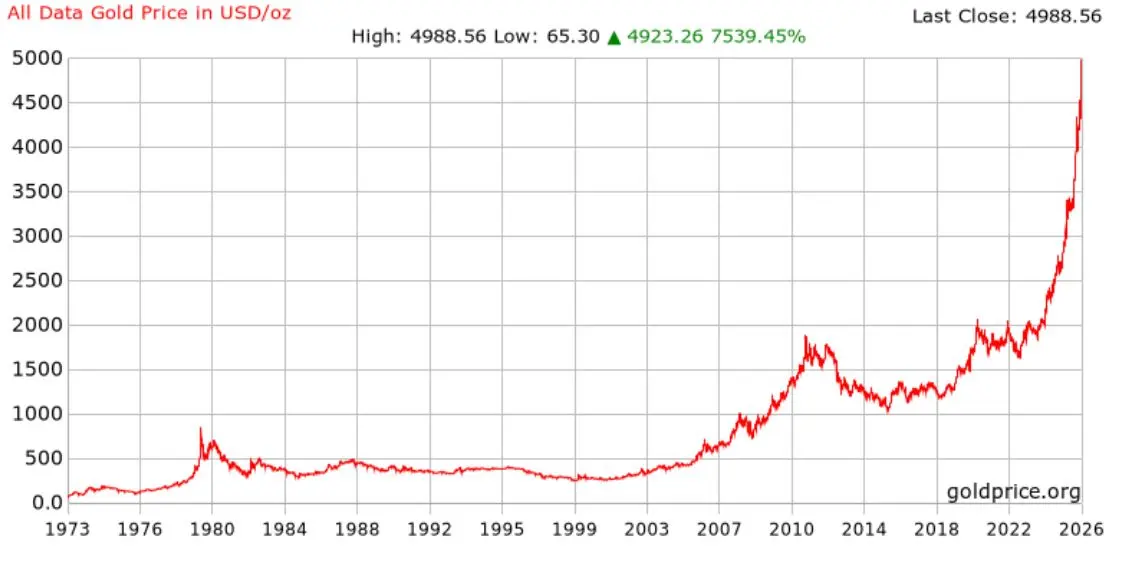
Gold’s long-term trend from 1970 to 2025 shows a steady upward trajectory driven by inflation cycles, dollar weakness, and periods of global uncertainty. Major breakouts in 1980, 2011, 2020, and again in 2025 highlight how gold consistently gains value during economic stress and loose monetary policy. The multi-decade pattern remains intact, reinforcing gold’s role as a reliable long-term store of value.
Gold Price Historical Chart
In August 2020, gold surged to a then-record high of $2,072.85 as the pandemic drove global investors into safe-haven assets. Although prices corrected afterward, the metal held above the $1,600 zone throughout 2021 and early 2022, supported by strong physical demand and persistent macro uncertainty.
Gold briefly dipped toward $1,616 in late September 2022 during the Federal Reserve’s most aggressive rate-hiking cycle in decades. But once inflation began moderating in 2023, XAU/USD entered a steady uptrend, breaking through $2,000 again in early 2024 and accelerating sharply into 2025. By mid-2025, gold had cleared multiple record highs, peaking above $3,700 after the Fed’s first rate cut, and remains elevated above $4,200 as 2025 closes.
Gold Rate In India Today
Gold prices in India continue to reflect strong global momentum, with 24-carat purity rates hovering near record highs. Demand remains robust ahead of the festive season and wedding-related purchases, fueling both retail buying and jewellery demand.
Meanwhile, the weak rupee, pressured by a softer US dollar internationally and firm domestic gold demand, adds an extra layer of strength to local gold rates. For investors and traders watching the gold market, the combination of surging global XAU/USD and favorable currency dynamics makes Indian bullion especially attractive right now.
I’ll keep posting my updated outlook on Gold and other assets in my free Telegram group, which you’re welcome to join.
How To Invest in Gold
One of the viable ways to invest in gold is by buying bullion. It may be in coins or bars, certified with purity and weight have. Then, one can purchase or sell the physical gold to a reputable dealer. However, security reasons often lead some investors to embrace the route of futures and options.
Best gold stocks to invest in
One of the best ways to invest in gold is through stocks. In the past few years, mergers and acquisitions in the sector has led to a significant consolidation in the sector. Today, only a few large companies dominate the industry.
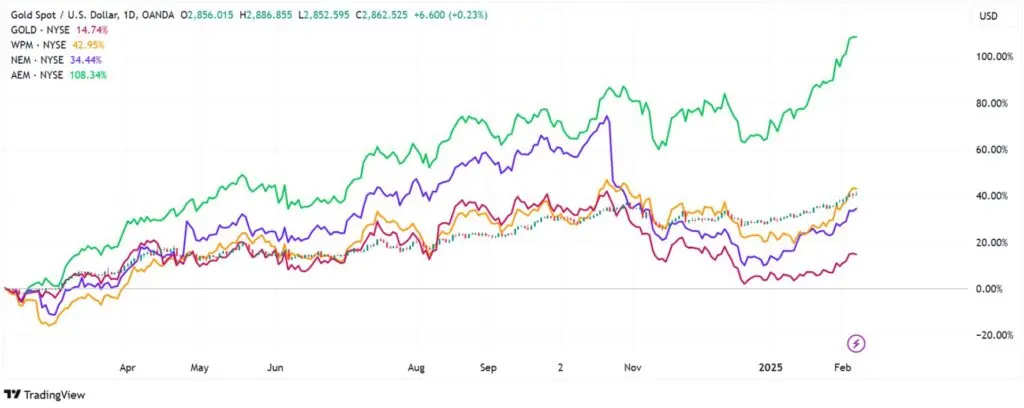
Barrick Gold, a company valued at $30 billion, is one of the best gold stocks to invest in. Its stock has risen by 21% in the last year and is up by dropped by about 8.1% year-to-date. The other excellent stock to buy is Wheaton Precious Metals, which is worth over $28 billion. Unlike other gold companies, Wheaton does not do the real mining. Instead, the company has purchased rights for key gold assets.
The other best gold stocks to invest in are Newmont Corporation, and Agnico Eagle mine. The chart below shows the performance of some of the biggest gold stocks in the industry.
Gold Futures
Futures are contracts in which one agrees to buy or sell the financial asset at the agreed-upon price before the expiry of the contract. For options, the investor has a chance and not an obligation to buy or sell the underlying instrument for as long as the contract is valid. To invest in gold via futures and options, one needs an account with a reputable financial broker. It is possible to trade in gold for a commission through the brokerage account.
Gold ETFs
ETFs and mutual funds are yet another viable way to invest in gold. A share of this financial instrument represents a specific amount of gold. One needs a brokerage account to trade in gold ETFs or mutual funds, like in futures and options.
In addition to the aforementioned ways of investing in gold, an investor can consider buying stocks of gold mining companies like Barrick Gold Corp. (GOLD) or Newmont Corp. (NEM). While the share price is usually correlated to gold price, the firm’s fundamentals are also influential.
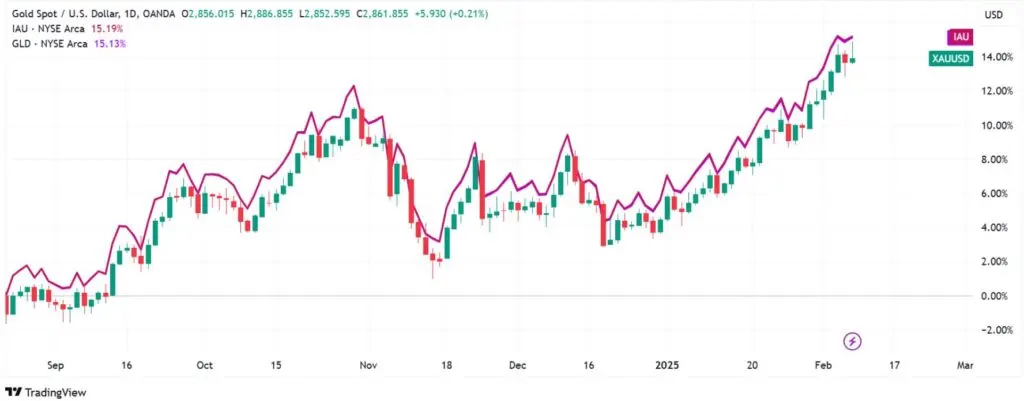
The chart below shows two of the most popular gold ETFs, the iShares Gold Trust and SPDR Gold Trust. As you can see, these ETF tend to move in sync with gold prices.
Gold Price FAQs
The crash was triggered by the nomination of Kevin Warsh as the new Fed Chair. His hawkish stance bolstered the US Dollar and sparked massive profit-taking after gold hit a parabolic peak of $5,595.
Central banks, with China in the lead, are buying gold to reduce their reliance on the US Dollar. J.P. Morgan says these banks are likely to buy about 755 tons in 2026, which should support gold prices.
Most forecasts expect gold to climb further in 2026 as central banks continue buying, US rate cuts deepen, and global uncertainties persist.
Most people are very optimistic about gold. Wells Fargo and J.P. Morgan predict prices will go above $6,000 per ounce. They believe that the value of regular currencies is decreasing and that global political problems will keep pushing gold prices up.
This article was originally written in December 2024 and is regularly updated to reflect the latest gold market trends and price action