



Archived Article This article was published more than 5 months ago. The market data, prices, forecasts, and analysis were accurate at the time of publication but may have changed since then. Please use this article for historical reference only and refer to our latest content for current market information.
- Microsoft share price is on course to register its first monthly gain since November 2025, up by 14% in April
- The restructuring of revenue model with OpenAI is seen as a positive but also indicates that the partnership has not yielded as much as Microsoft had hoped for in financial terms
- The forthcoming earnings call on April 29 will create a clearer picture of returns on heavy AI investment and influence Microsoft stock price trajectory
Microsoft stock has staged a notable recovery in April 2026, climbing approximately 14% and posting its first monthly gain after a prolonged downtrend that began in late 2025. The stock is presently trading in the $422–$424 range, representing an approximate 19% recovery from their March low of $356.28. Investors are now contemplating if this signals a true shift in trajectory or merely a temporary uplift prior to the upcoming earnings report.
What Sparked the Surge?
The catalyst that gave the rally real legs was a string of positive developments on the AI infrastructure front. CEO Satya Nadella announced that the company’s Fairweather data center in Wisconsin came online ahead of schedule.
The facility is described as the most advanced AI data center in the world, connected to a similar installation in Atlanta via a dedicated high-speed network designed to handle large AI workloads. Markets responded enthusiastically. Microsoft posted one of its strongest three-day performances since 2020, gaining roughly 10% in just three sessions.
However, relying solely on infrastructure announcements may not fully account for a 14% monthly gain. A more profound factor is the robust fundamental course Microsoft has charted. During its fiscal second quarter of 2026, the company reported a 17% year-over-year revenue increase, reaching $81.3 billion, alongside a 21% rise in operating income. Non-GAAP EPS saw a notable 24% jump.
Azure, Microsoft’s cloud computing platform, led the charge with 39% growth, cementing its position as the go-to partner for building and deploying AI models. These numbers gave investors confidence that the underlying business remains structurally healthy, even as the stock drifted lower through the first quarter.
Is the Momentum Sustainable?
Sustainability of the momentum hinges on the upcoming earnings report and forward guidance. Analysts project fiscal Q3 revenue around $81 billion, with EPS near $4.05, reflecting continued double-digit expansion. Azure is expected to grow in the mid-to-high 30s percent range in constant currency. Strong beats on cloud metrics, clearer commentary on backlog quality, and evidence of Copilot monetization traction could extend the rally.

Adding another dimension, Microsoft and OpenAI recently restructured their partnership. Under the new arrangement, Microsoft will stop paying revenue shares to OpenAI, although OpenAI’s payments to Microsoft will persist through 2030.
Notably, OpenAI’s contribution to Azure revenue has already fallen below the 20% mark. While this development is presented in a favorable light, it also suggests that the financially significant OpenAI partnership may be yielding less revenue than initially projected.
Microsoft Stock Price Prediction
Microsoft stock RSI has climbed to 63.54, indicating strong bullish momentum. The next major hurdle is the $430 level. Beyond that, the 200-day EMA at $441.70 level will act as a significant ceiling. The immediate floor has moved up to $415, aligning with the 10-day EMA. A secondary, long-term support zone exists at $410.
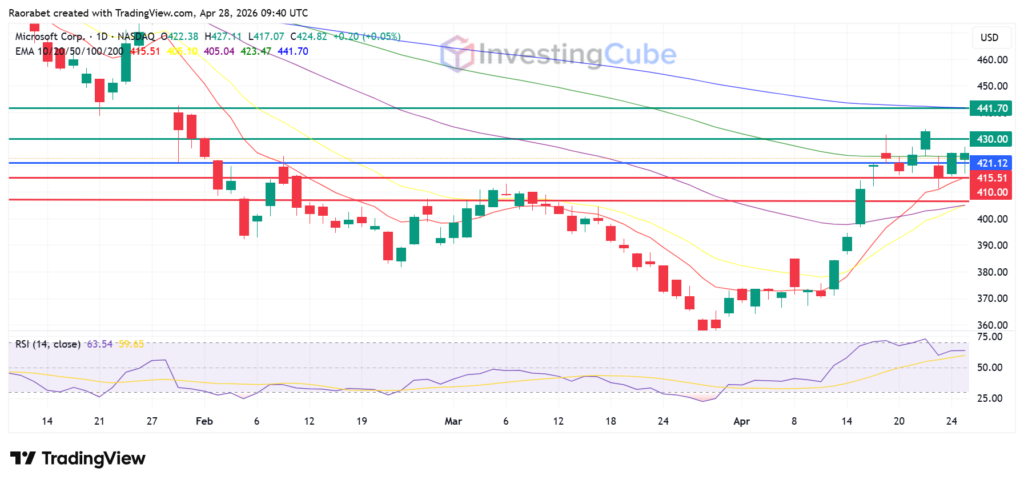
Microsoft stock price on the daily chart on April 28, 2026 with the key support and resistance levels. Created on TradingView
The earnings call on April 29 will determine if the company is sustainable. If Azure growth is more than 38% and Copilot adoption shows a clear path to making money, the rally could go extend.
It is mixed. Microsoft reduces its revenue-share costs, which aids margins. But OpenAI’s share of Azure’s revenue has already dropped below 20%, which means that the partnership wasn’t as big of a deal for revenue as investors thought it would be.
Analyst reassurances on AI capex timing, combined with signs of resilient Azure demand and a broader software sector recovery, sparked buying interest. Positive notes from analysts eased earlier worries about spending, helping shares rebound from March lows.