



Archived Article This article was published more than 5 months ago. The market data, prices, forecasts, and analysis were accurate at the time of publication but may have changed since then. Please use this article for historical reference only and refer to our latest content for current market information.
- Sun Pharma will acquire Organon for $11.75 billion at $14 per share, subject to regulatory approval
- The acquisition will give it to key markets besides the United States such as China and South Korea
- There are concerns that Organon's $8.6 billion in debt could weigh down on Sun Pharma net-positive history
On April 26, 2026, Sun Pharmaceutical Industries (NSE: SUNPHARMA) announced that it had reached an agreement to buy Organon & Co. for $11.75 billion in cash, with Organon stockholders getting $14.00 per share.
This is one of the biggest acquisitions of a foreign company by an Indian pharmaceutical company. The transaction is expected to close in early 2027, but only if both companies get the necessary approvals from regulators and shareholders.
As of April 28, 2026, the market has reacted with electric enthusiasm. After weeks of trading in a sideways-to-downward drift, Sun Pharma’s stock ignited, gaining over 7% in a single session to trade near ₹1,766.
What Is Being Acquired and Why?
From Sun Pharma’s perspective, the strategic rationale appears compelling. This acquisition is poised to elevate the company‘s combined revenue to $12.4 billion, positioning it among the leading 25 global pharmaceutical enterprises. Furthermore, it is expected to increase the proportion of innovative medicines from 20% to 27% of the total revenue.
This represents a substantial structural evolution for a company traditionally known for its generics portfolio. Moreover, this transaction could position Sun Pharma as the seventh-largest biosimilar player globally and a top-three entity in worldwide women’s health. Critically, the acquisition also facilitates Sun Pharma’s entry into the markets of China and South Korea, marking a significant strategic expansion.
Sun Pharma plans to fund the deal through internal cash resources and committed bank financing. Post-transaction, the combined company is projected to have a net debt to EBITDA ratio of around 2.3x, with Organon contributing robust 30% EBITDA margins.
The Elephant in the Room that Is Organon’s Debt
Here is where the consensus narrative deserves a challenge. Much of the coverage has framed this as an unambiguously positive transformational deal. The reality is more complicated. Organon carries $8.6 billion in debt, against just $574 million in cash.

Sun Pharma, a company historically known for being net-cash-positive, is now absorbing a heavily leveraged balance sheet. The projected post-deal net debt-to-EBITDA stands at 2.3x. That is manageable, but leaving little room for error.
Furthermore, Organon’s core business operations have not demonstrated significant growth. Since its spin-off from Merck, its sales have remained largely consistent, fluctuating between $6.2 billion and $6.4 billion over the past four years.
For instance, its key product, the skin cream Vtama, recorded $128 million in revenue in 2025, which was below its internal target of $150 million. Investing $11.75 billion in a business characterized by stable revenues and significant debt implies a reliance on future integration efficiencies and synergistic benefits, rather than existing growth momentum.
Sun Pharma Share Price Forecast
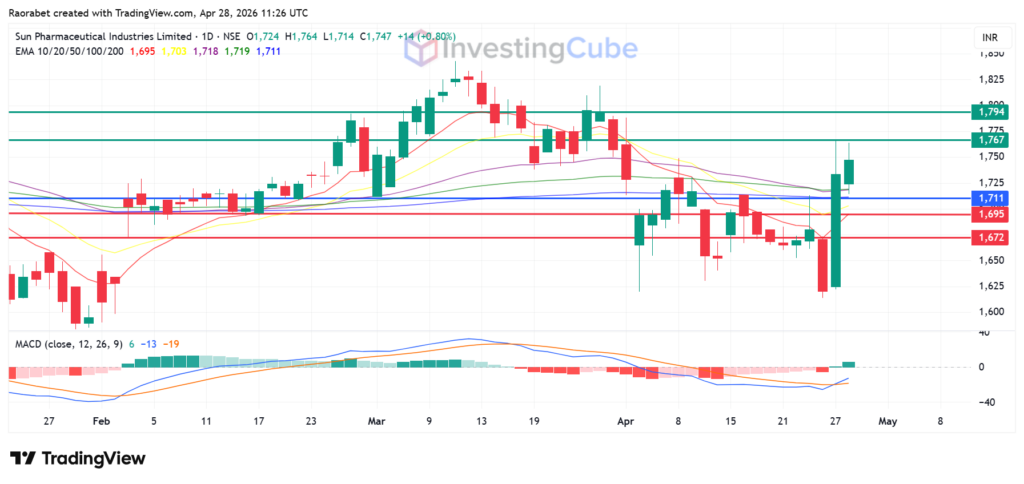
Sun Pharma share price on the daily chart with key support and resistance levels. Created on TradingView on April 28, 2026
The deal will be funded through a combination of Sun Pharma’s available cash reserves and committed bank financing.
It transforms Sun Pharma from a generics-dominant player into a diversified global pharmaceutical company.
One major benefit is that Organon already has a strong presence in China and South Korea, which are two new markets for the company. This helps Sun Pharma move away from relying too much on the U.S. and Indian markets.