




- Lloyds Bank share price declined by 2.8% in the last five sessions and broke below the 100p mark
- The downward pressure is primarily from profit booking ahead of this week's earnings report and a re-emergence of concerns over motor vehicle financing compensation
- UK economy's performance and BoE's interest rate decisions could also have a significant influence on the stock's performance in the coming weeks
Lloyds Banking Group (LSE: LLOY) experienced a notable increase in its share price during the first half of April, moving from the mid-90s and briefly surpassing the 100p threshold. This upward movement appeared to be supported by a general sense of domestic optimism and the broader resilience of the FTSE 100.
However, the subsequent five trading sessions have served as a rather clear illustration of market realities. Lloyds Bank share price went down by 2.8% in the last that period.
Why Lloyds Stock is Falling
Understanding the current downturn requires considering recent trading history. After reaching a peak of 112.6p in early February, the stock experienced a significant drop, coinciding with rising geopolitical tensions, eventually falling to 90.44p by late March.
The subsequent rebound from these lower levels was largely propelled by a sense of clarity regarding regulatory matters and a wider recovery across UK equities. Nevertheless, the upward trajectory has found it challenging to maintain momentum since then.
Another contributing factor often observed is typical pre-earnings repositioning. Lloyds plans to announce its Q1 2026 results on Wednesday, April 29. Following a period of relatively rapid gains, it’s quite common for institutional traders to adjust their holdings, potentially realizing profits before the financial figures are publicly released.
Furthermore, the continuing uncertainty linked to the Financial Conduct Authority’s (FCA) motor finance redress scheme plays a role. Although Lloyds confirmed its £1.95 billion provision on April 2, reports emerged on April 22 indicating that consumer advocacy groups are preparing to advocate for greater compensation from the FCA.
This development has rekindled concerns that the overall financial obligation, potentially a multi-billion-pound sum, might escalate. Such a prospect could impact the bank’s potential for share buybacks, particularly at a time when investors might have begun to feel more reassured.
Can Lloyds Return to 100p in the Near Term?
The immediate outlook appears to largely depend on the Q1 2026 results expected on Wednesday. Chief Financial Officer William Chalmers is scheduled to present these Q1 figures on April 29 at 9:30 am. Should the bank report stronger-than-expected net interest income or offer an encouraging update concerning the motor finance provision, it could provide a significant positive impetus for investors.
Management has previously indicated expectations for a resilient performance, bolstered by a structural hedge designed to mitigate the impact of declining interest rates. Short-term movements will likely be influenced by the wider market’s appetite for risk. Favorable surprises in economic data or a reduction in geopolitical tensions might encourage a swift recovery towards 100p psychological mark.

Conversely, any renewed signs of weakness in UK growth forecasts or less-than-favorable earnings results could postpone such an upward shift. It is also worth noting that Lloyds Bank has substantial exposure to the UK economy and currently does not benefit from significant international diversification.
Key Factors to Watch in the Coming Weeks
Investors should monitor several elements closely. First, the Bank of England’s policy stance remains critical. With the base rate held at 3.75%, any signals of prolonged higher-for-longer rates due to sticky inflation could aid net interest margins but risk damping loan demand.
Secondly, the credit quality metrics included in the Q1 update will offer valuable insights. An increase in impairments, whether stemming from a weaker economic environment or elevated borrowing costs for households, could potentially impact market sentiment. Given Lloyds’ significant presence in the UK mortgage and consumer markets, it is notably susceptible to these trends.
Thirdly, both competitive dynamics and any new information regarding motor finance redress provisions warrant careful attention. While previous provisions have been accounted for, the potential for additional costs or aggressive pricing strategies from competitors could lead to a reduction in overall returns.
Lloyds Bank Share Price Forecast
Lloyds Bank share price RSI has retreated from an overbought 71 to 47.89, suggesting the intense selling pressure. The immediate safety net is at 96.96p. A daily close below this level would signal a move toward 95p. The psychological 100p level remains the primary barrier. A breakout here is required to re-establish the bullish trend. An extended control by the buyers in the near-term could test 101.30p.
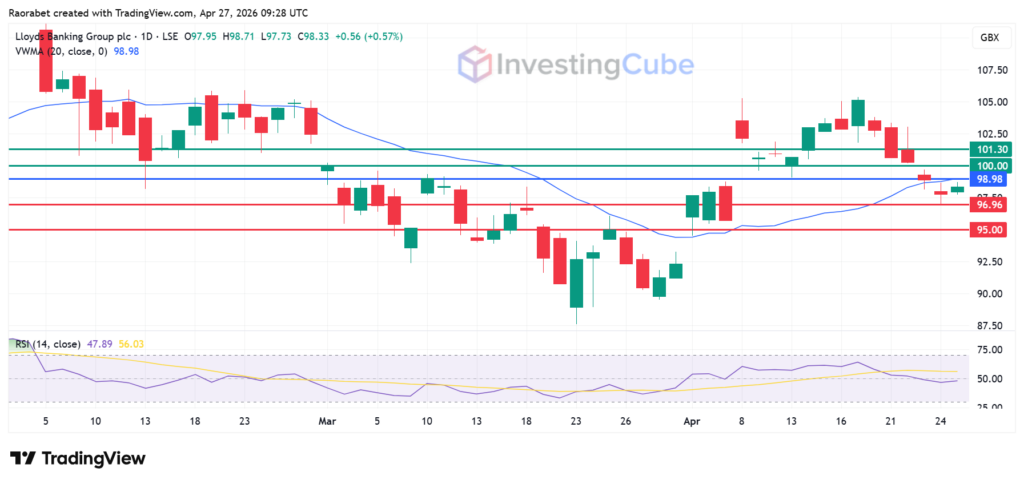
Lloyds Bank share price action on the daily time frame with key levels of support and resistance on April 27, 2026. Created on TradingView
The decline is driven by pre-earnings profit-taking ahead of the April 29 report and renewed legal concerns regarding the car finance scandal, which could potentially lead to higher compensation payouts.
It is the most critical event for the stock this quarter. Attention turns to how big the impairment charges are, also whether the bank lifts its funding for the motor finance payout beyond £1.95 billion.
The bear case focuses on Lloyds’ total exposure to the UK retail economy. Should energy prices push the economy into downturn, Lloyds stock could face pressure.