




- The Sensex and Nifty stock markets remain vulnerable as crude oil prices stay above $100 on geopolitical restiveness.
Current setup and Live Chart
Indian equities are typically listed on the Sensex and the Nifty stock markets. They are all highly sensitive to crude oil and geopolitics. Usually, crude oil trades like any other asset, with prices reflecting demand and supply. But given the restive nature of the production belts, crude oil prices are typically linked with the geopolitical climate in those areas.
Indian companies listed on the Sensex and Nifty stock markets are particularly vulnerable to sharp changes in oil prices, as India is the world’s third-largest importer of crude oil. Furthermore, the presence of a large foreign portfolio investment base in the Sensex and Nifty markets makes these companies much more vulnerable, as these funds do not hesitate to exit during periods of risk aversion.
So when Brent crude is above $100 per barrel, markets are trading under the influence of inflationary pressures, a weaker rupee, earnings downgrades, and a flight of foreign portfolio investment.
For companies listed on the Sensex and Nifty, the recent backdrop of positioning has been a record outflow of foreign portfolio funds. Reuters reports more than $12 billion in foreign portfolio funds that have exited the Indian Sensex and Nifty stock markets. Domestic funds have been unable to cushion this drop.
BSE Sensex and Nifty Price Catalysts for this Week
1. Brent >$100: the overriding price catalyst for the week remains oil prices and their macro impact as a form of tax on India’s growth and the performance of its stock markets. If Brent crude stays above $100, it is negative for the Sensex.
2. INR stability: The rupee is weakened by higher oil prices and global risk-off sentiment. A weaker Rupee makes Indian stocks cheaper to buy for foreign portfolio investors, but it will only benefit them if they get in at the start of a major turn in the oil and war fundamentals.

3. Earnings downgrade cycle: Watch out for any earnings or growth downgrades, given the earlier explicit warning by HSBC that higher crude prices would force revisions lower.
BSE Sensex and Nifty Stock Markets: Forecast Scenarios
Base case: the Sensex will remain range-bound, but there will be fragility. The previous week ended on a risk-averse note, forcing the Sensex off its weekly highs. Therefore, if oil stays bid and foreign portfolio interests maintain selling momentum, rallies on the Sensex will fade.
Bull case: The bull case will only unfold if geopolitical tensions in the Middle East de-escalate. This will cool oil prices, restore foreign portfolio flows, and compress the overall risk premium. This is where dip-buying occurs.
Bear case: If fresh Middle East escalation occurs, oil prices will stay above $100, and the INR will continue to face pressure, forcing broader de-risking in financial stocks. This is the perfect setup that favours more selling from foreign portfolio funds as they seek to protect the value of their investment by clearing out, changing Rupees into US Dollars and seeking other safe-havens.
BSE Sensex Technical Outlook
The recent decline came off a rejection from the 79825 resistance and the trendline. This puts the 75442 support under pressure. If this support collapses, focus shifts to the 71550 support formed by the prior lows of 7 April 2025 and 30 March 2026. This support can be seen as the neckline of the double top of 16 September 2024 and 1 December 2025. A breakdown of this neckline aims to complete the measured move at 63593 (23 October 2023 low), which must take out the 67771 intermediate pivot to be complete.
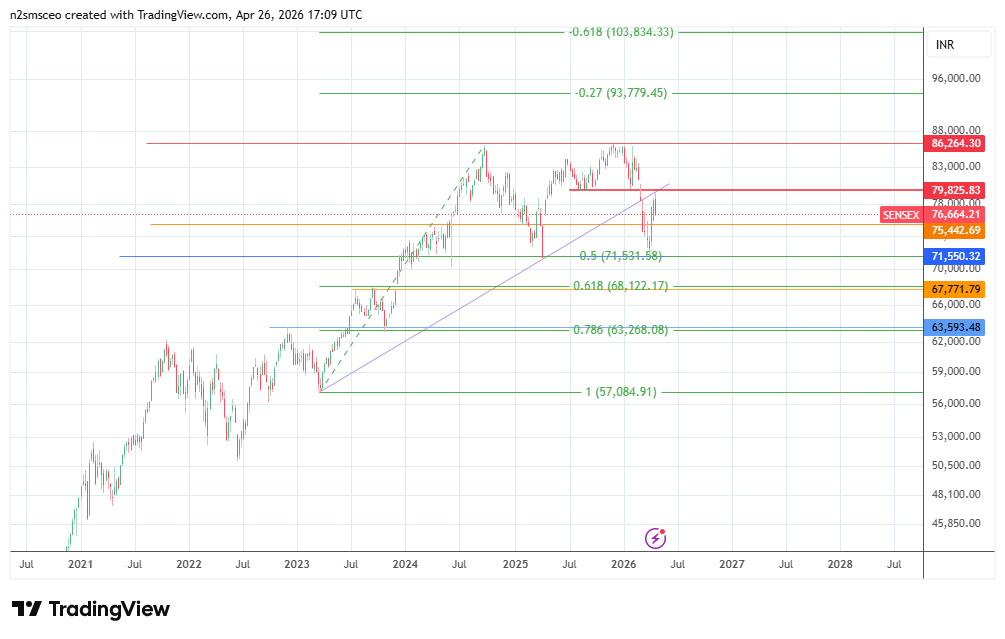
On the flip side, this outlook will face invalidation if the bulls uncap the 79825 resistance. This will allow for a potential reclaim of the all-time high at 86159, last seen on 1 December 2025. If this barrier is uncapped, the 93779 price mark and 27% Fibonacci extension of the 20 March 2023 and 1 December 2025 upswing becomes the potential new upside target in the medium term.