



- The USD/INR looks set to notch 5 days of gains after a worsening of geopolitical tensions puts the Rupee on the back foot.
Current Setup and Live Chart
The USD/INR remains one of the currencies most sensitive to the current oil shock, given the greenback’s role as a safe-haven currency and net exporter of crude oil, and the Rupee’s position as the currency of the 3rd-largest oil importer.
The USD/INR forecasts continue to be shaped by the high-volatility, oil-shock regime. With an escalation in the geopolitical situation on Wednesday night, Thursday brought a renewed surge in oil prices, sending the Rupee reeling under renewed pressure.
However, as previously noted, the Indian Rupee operates under a form of managed float, where the apex bank (Reserve Bank of India) takes steps to prevent a free fall of the currency through managed interventions. Therefore, we also see the USD/INR trading within the context of RBI smoothing in response to oil spikes. The USD/INR is currently trading at 94.22, according to live charts and Reuters reports.
Presently, the market sees the Rupee as undervalued. A Reuters report indicates that RBI data shows the 40-currency Real Effective Exchange Rate (REER) falling to 92.72, the lowest level in more than 10 years. On a trade-weighted basis, this indicates significant undervaluation.
There has to be a significant escalation in the geopolitical situation for us to see USD/INR above 96.00. The major move for traders right now will depend on whether crude prices stay elevated or calm down a bit.
USD/INR: Near-term Macro Drivers
1) Oil shock remains the dominant driver
As the currency of the 3rd-largest importer of crude globally, the Rupee serves as a barometer of energy-import stress. Brent crude has surged 16% this week and continues to trade above $100. This scenario is fueling inflation fears and worsening concerns about India’s external balance. Both situations are deemed INR-negative, hence the 5-day losing streak.
2) Global Risk Aversion
The risk-averse environment feeds a flight to safe-haven assets such as the US Dollar. It also triggers selloffs in stock markets, driving flows to US bonds. As bond yields rise, so does the US Dollar, and this also drives more flows from emerging-market FX currencies into the US Dollar.
3) Portfolio outflows
As foreign investors sell their holdings and exit the Indian stock markets due to risk aversion, they also drive rupee weakness. This is because they need to convert the funds into foreign currency for exit, increasing dollar demand and pressure on the Rupee.

4) RBI smoothing
Today’s decline has been cushioned by RBI intervention, in the same way the apex bank has managed other declines. This is to prevent the local currency from suffering from an outsized weakness. This provides a managed depreciation that smooths the currency’s decline, as opposed to an outsized, wild move.
USD/INR Price Catalysts for Next Week
Oil pathway and Geopolitical headlines: The bias for the USD/INR to push higher will remain if Brent crude stays above $100. A retreat in crude prices allows the INR to stabilize. Whether oil prices go up or down will depend on the headlines around Hormuz and the blockade situation.
RBI intervention: The scale of the RBI’s interventions will play a role in determining how rapidly the Rupee declines in the event of further oil price shocks.
Foreign flows/Nifty 50 sentiment: Traders will need to watch the Nifty 50 index, as it provides a clue to the scale of any selloffs engineered by foreign portfolio funds. If the equity tape weakens and outflows continue, this will keep the USD/INR supported.
USD/INR Forecast Scenarios
Base case: the pair to consolidate, with an upside bias. Elevated oil prices and a fragile risk environment keep the USD/INR supported, though this is counterbalanced by RBI intervention.
Bull case: The USD/INR pair will trade much higher if oil prices extend further above $100, global risk aversion increases, or foreign portfolio funds continue to exit. The pace of the upside will overwhelm RBI interventions.
Bear case: Expect INR relief if oil prices cool dramatically, and risk-on sentiment returns. Given the heavy undervaluation of the Rupee as revealed by the REER, this relief rally could be very sharp.
USD/INR Technical Outlook
The double bottom pattern checkmated the pair’s pullback, and the upside resumption now looks set to reclaim the 95.22 all-time high. A break of this level targets the 27% Fibonacci extension of the price move from the 24 October 2025 swing low to the 30 March 2026 swing high, at 97.40.
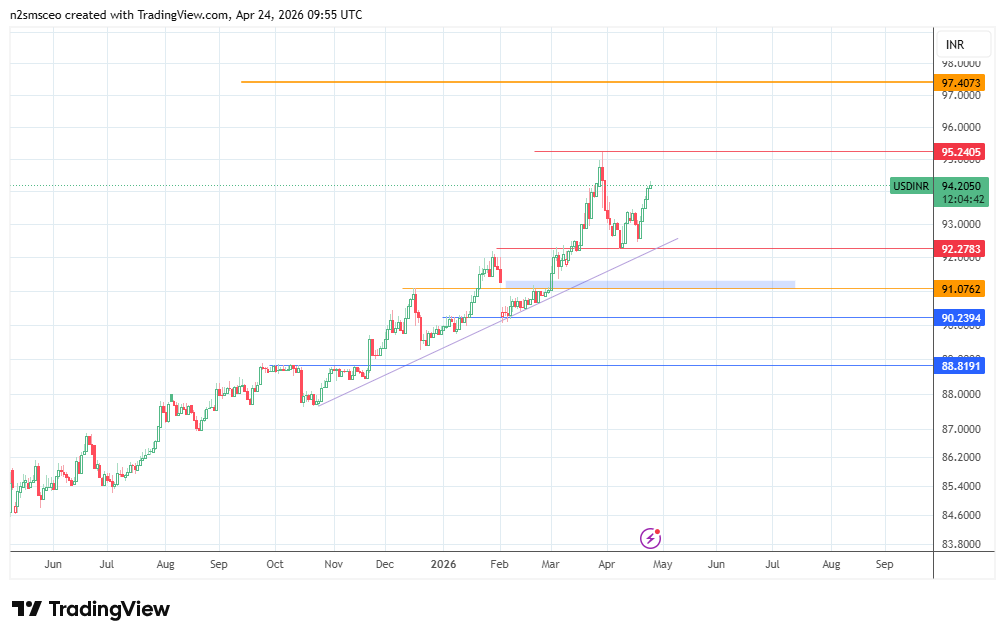
On the other hand, the bears would need to break the 92.27 support and the 8 April low to initially target the 91.07 price mark and the prior high of 16 December 2025. A further decline could allow a reclaim of the 90.23 support and the low of 4 February 2026.