



Archived Article This article was published more than 5 months ago. The market data, prices, forecasts, and analysis were accurate at the time of publication but may have changed since then. Please use this article for historical reference only and refer to our latest content for current market information.
- USD/INR remains supported by higher oil prices and a firmer US dollar.
- Middle East tensions are adding pressure on the Indian rupee.
- RBI actions may slow volatility; they may not fully reverse the trend.
- Key support is seen near 92.50-92.60, while 92.80 is the near-term upside level.
Oil, Dollar, and Geopolitics Keep USD/INR Biased Higher
Given the current macroeconomic environment, USD/INR continues to represent one of the more dynamic Asian currency pairs since the cross-rate is positioned right at the confluence of three major trends:
- Global crude oil prices
- Broader USD dynamics
- Geopolitical tensions in the Middle East region
Given the current state of affairs in financial markets, USD/INR seems likely to find some buyers at dips despite the ongoing efforts by the Reserve Bank of India to moderate the rate of rupee depreciation. In other words, there might not be any explosive breakout momentum behind USD/INR right now, but the pair does seem predisposed to move firmer or higher.
Latest Market Background
In terms of its immediate influence, the factor of primary importance today is the growing nervousness in oil markets. According to Reuters, the Indian rupee started trading somewhat firmer, but the scope of its potential gains was clearly limited by the external background.
In particular, Reuters explained that the Indian rupee began the day higher, but it remained capped by Iran ceasefire uncertainty (Reuters, April 20, 2026).
This seems reasonable enough, as India imports a lot of crude. This means that an upsurge in the price of oil is likely to be harmful to the INR on multiple fronts, as well as cause increased dollar buying by companies hedging the risks associated with importing. In other words, a strong oil price will typically mean that USD/INR is supported structurally by fundamentals.
Reuters also stated that there was some selling of dollars in smaller amounts from foreign banks, which provided temporary support to the Indian currency. Yet, the rupee did not manage to build momentum from this due to the continued interest in dollar purchases among importers. It should be remembered that when exporter or foreign banks are selling dollars to importers buying, USD/INR becomes a range-bound currency on the day.
Why the U.S Dollar Still Matters
The final reason behind this phenomenon relates to a larger dollar pattern. According to Reuters, the U.S. dollar gained after Middle Eastern tensions flared up, pushing the dollar index to the edge of a one-week high level and sending Brent crude up sharply as well (Reuters, April 19, 2026).
This makes sense in relation to USD/INR:
- Dollar strength alone has traditionally been an unfavorable factor for many emerging currencies.
- When dollar strength is combined with rising oil prices, the problem is exacerbated.
In other words, this is one situation where USD/INR is unlikely to behave like some other Asian pairs in geopolitically volatile periods. While countries that export raw materials might be profiting from increased oil prices, India is not one of those nations. Therefore, USD/INR may underperform despite calm domestic market conditions.
The RBI Factor: Limiting Panic, Not Reversing the Trend
One of the reasons that USD/INR hasn’t become even more chaotic in nature is due to the fact that the RBI, in its most recent moves, appears to have successfully managed to curtail speculation about the demand for dollars.
According to Reuters, the latest actions by the RBI have contributed to easing some of the pressure that was exacerbating the downward momentum of the currency. This factor serves as a vital source of stabilization.
Nevertheless, that doesn’t necessarily imply that USD/INR is expected to fall precipitously. While the RBI can mitigate volatility and manage panic, it won’t be able to reverse the macro picture of expensive oil and a strong US dollar.

Practically speaking, the efforts of the RBI will contribute to slowing down the upward momentum of USD/INR, yet they cannot negate the overall bullish trend just yet. This is why the movement can currently be seen as more of a grind than a breakout.
USD/INR Price Prediction and Today’s Bias
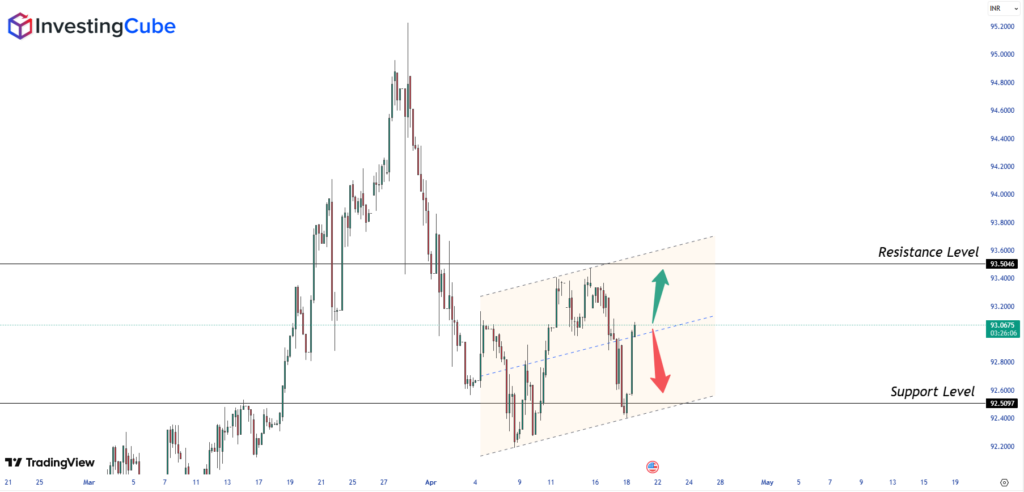
USD/INR was seen consolidating around the 92.56-92.78 range, although Reuters noted the broader weekly band as being in the 92.50-93.50 territory. This range provides some valuable context:
- The lower section includes areas which should be supported by central bank intervention smoothing, exporter sales, or reduced risk sentiment globally.
- The upper side includes concerns about the outlooks for oil and the dollar remaining high.
As for today’s short-term outlook, USD/INR is seen retaining a slight bearish bias. Should oil prices continue to hold up and dollar sentiment be driven by the Middle Eastern geopolitical tensions, there would probably be some upside pressure towards the 92.80 mark and possibly higher. A breakout above that level would likely need further upside in oil or in the dollar generally.
Otherwise, in case of improved geopolitical sentiment or a drop in oil prices off of their intraday peaks, the pair could ease back towards the 92.50-92.60 territory. Nonetheless, even this outcome is expected to represent merely a temporary correction without any substantial change of the underlying trend direction.
Point of View
The baseline scenario is that the USD/INR pair will hold up its gains in any retracements from current levels, rather than suffer a sharp drop. The support for the pair is coming through just the sort of dynamics that usually weigh the most on India’s currency:
- Energy concerns
- Risk-averse markets
- A return to the dollar-buying trend
Even RBI policy actions can stabilize the market, but without a clear reversal in oil prices, it will be tough for the rupee to sustain any significant strength. In other words, the USD/INR pair will likely continue to trade within a strong range bias to the upside.
Conclusion
In the light of recent news developments, it is safe to conclude that USD/INR still operates within the domain of external pressure and not domestic relief. The headline from Reuters about the continuing uncertainty that “caps upside” on the rupee sums up the prevailing sentiment well.
While the additional development about the “dollar rebounding” amid rising tensions in the Middle East region helps explain the ongoing support on USD/INR, all in all, the short-term view on the pair remains bearish, but cautiously so.
Key levels to watch:
- Supports around 92.50-92.60
- Resistance at 92.80 and above
Frequently Asked Questions
Because higher oil prices, a stronger US dollar, and Middle East tensions are supporting the pair.
Higher oil prices usually hurt the Indian rupee because India imports a large amount of crude.
The RBI can reduce volatility, but it may not fully reverse the broader upward pressure.