




Archived Article This article was published more than 5 months ago. The market data, prices, forecasts, and analysis were accurate at the time of publication but may have changed since then. Please use this article for historical reference only and refer to our latest content for current market information.
- The DAX index has surged more than 2% this Friday as traders focus on the Middle East de-escalation and falling oil prices.
Current Setup and Live Chart
The DAX index is an export-heavy macro indicator and a measure of business conditions in the industrial-heavy European belt. The DAX index is therefore placed between intermittent changes in risk sentiment and the current oil shock regime, which has sparked inflationary fears in the Eurozone. The latter is the reason why there are expectations of an upcoming tightening of financial conditions in Europe by the European Central Bank (ECB).
Germany’s Xetra DAX40 index has posted strong gains this Friday amid broader cautious sentiment across European bourses. It is currently up by 2.55% and is now testing the 8 September highs at 24779.
DAX Index Forecasts: Macro Drivers
Given the strong upsurge in Friday’s trading, one has to ask: what is behind the strong showing on the day, and how will this impact DAX index forecasts for the incoming week?
1. Energy shock/German growth/inflation:
The energy shock has a direct impact on the industrial-heavy German economy. Higher energy prices directly raise production costs across industries, as reflected in the producer price index. Higher production costs ultimately seep into the value chain, raising inflationary fears and concerns that the ECB may act hawkishly to curb rising inflation. This also slows growth, leading to lower growth forecast guidance.
The reason for the Dow’s resurgence is that recent war headlines are pointing towards a de-escalation. The strikes have reduced significantly as the various ceasefires appear to be holding. This has led to lower energy prices and brought back dovish ECB expectations to the table.
2. Germany growth forecasts/inflation expectations
Germany has cut its growth forecasts and raised inflation expectations due to the overall impact of the oil shock, as per a Reuters report. This combination tends to lead to real income and company margin compression, increasing the likelihood of “higher-for-longer” interest rates.
3. Government relief measures
While this in itself does not remove the oil risk premium, Germany’s recently-announced temporary fuel-tax cut aims to cushion households and the economy. The $1.9 billion fuel tax relief is only expected to boost the market sentiment temporarily, but given the previous negative sentiment, any kind of boost is a plus to the index.

4. Trade policy/tariffs
Tariffs may not be a topical issue at the moment, but if the focus shifts back to tariffs and the market weighs on the existing tariff regime, the DAX is likely to underperform given Germany’s export-oriented economy.
DAX Index Forecasts: Catalysts for Next Week
1. US-Iran “peace prospects” headlines: Next week’s tone for European equities will be tied directly to de-escalation prospects. That is where the markets are now focused, according to recent headlines. Therefore, any deterioration will trigger a sharp repricing of the risk premium, hitting cyclicals/industrials hard. For the DAX, this could lead to an immediate downside push. If de-escalation remains on track and oil prices keep falling, expect a further recovery.
2. Germany macro revision narrative: Is the oil shock pushing inflation into sticky territory, or is it driving weaker industrial activity for the industrial stocks on the DAX? Watch out for headlines around these.
3. Tech, Energy, Travel, and Defense: Key Sectors to Watch
The key movers in Europe are tech, travel, defense, and energy stocks. Travel is directly tied to the oil shock. Check out which sectors are impacted by the headlines for a hint at the DAX’s direction.
DAX Forecast Scenarios
Base case: expected headline volatility amid a range-trading index. Rallies will be capped until there is more clarity on the oil/geopolitics situation and growth-risk premia fade.
Bull case: With the markets now focused on the current de-escalation headlines and falling energy prices, a continuation of Friday’s recovery could follow if there is further progress in this regard. ECB policy relief measures will also be a supporting factor.
Bear case: any deterioration in the Middle East de-escalation process, followed by sharp spikes in oil, is an immediate basis for the selloff to resume, especially if German bond yields also surge.
DAX Index: Technical Outlook
The double bottom recovery from the 22204 support continues, with the upsurge of 17 April now testing the resistance at 22779 formed by the prior high of 9 October 2025. A break of this barrier would allow the bulls with clear skies to reclaim the 25507 resistance and the current record high.
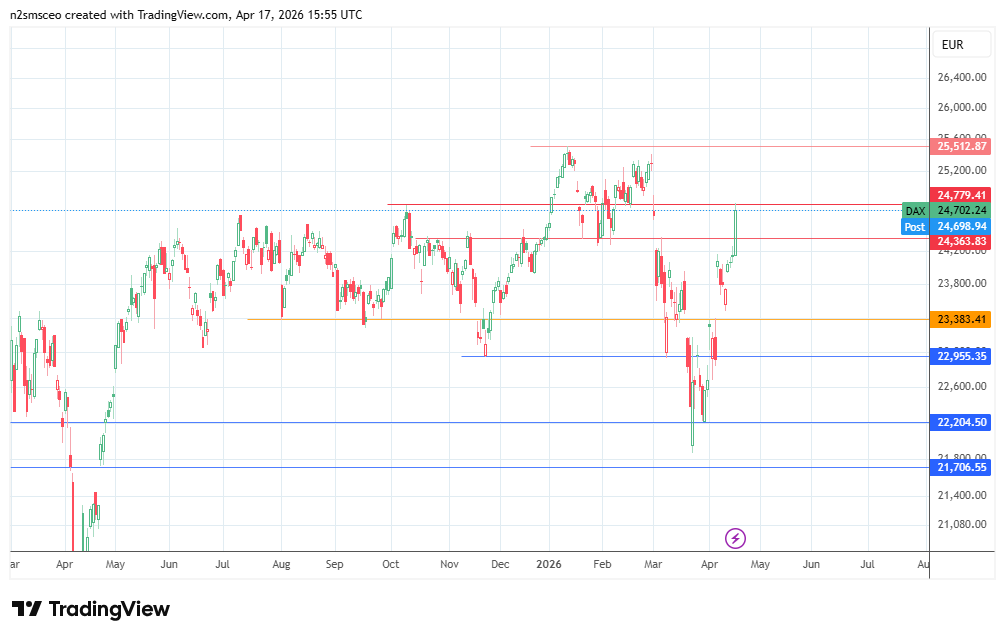
On the flip side, rejection at 22779 makes a case for a retreat to the 24363 pivot (early February 2026 lows), with a potential for a further correction towards 23383 (1 August and 26 September 2025 lows) if the 24363 pivot crumbles under bearish pressure.