



- Rolls-Royce stock has lost nearly 5% of its value in the last two sessions after gapping up in early April
- An attack at a key aluminium production facility in Qatar signals an imminent disruption of jet engines
- A forthcoming AGM decision on ex-dividend and kerosene supply disruption are also bringing headwinds. However, the company's structural stability is healthy
Rolls-Royce shares began April with significant upward momentum, reaching new highs and sparking discussions about a potential move towards the 1,400p level. However, after what appeared to be strong upward movement, the past two days have seen a noticeable decline, with the stock losing nearly 5% of its value. This article seeks to make this make sense and assess the chances of a recovery.
Why the mood shifted so quickly
The rally, however, has run into a wall of new concerns. An attack at a key facility in Qatar has sent aluminium costs surging, and that is impacting Rolls-Royce outlook because the metal is a key input for building jet engines. Word is the damaged operation may stay shut more than a year.
At the same time, concerns about potential kerosene rationing across Europe and Asia have heightened the possibility of additional flight disruptions. Significantly, this scenario could lead to delays in engine maintenance schedules, directly affecting Rolls-Royce’s high-margin long-term service agreement revenues. Furthermore, a shareholder vote on a proposed £24 million CEO pay package is scheduled for the April 30th Annual General Meeting, adding another layer of near-term uncertainty.
Can the stock recover in the near term?
Despite these challenges, market sentiment largely remains positive. Many analysts highlight the Power Systems division, particularly its role in providing power for AI data centers, as a significant future growth driver. They suggest this offers a degree of stability, even if the aviation sector experiences a slowdown.
Additionally, an upcoming ex-dividend date on April 23rd, awaiting AGM approval for a 5.0p final dividend, could draw buyers focused on income before the record date. As noted by The Motley Fool UK, the shares have shown substantial appreciation over the past five years. Therefore, long-term investors might see the current price dip as an attractive entry point into a business undergoing structural improvements.

Moreover, the February 2026 financial results already indicated strengthening margins and robust cash generation. This supports a £2.5 billion share buyback planned for 2026, representing a notable commitment that provides a solid valuation reference.
Rolls-Royce Share Price Forecast
Rolls-Royce stock pivots at 1,260p and the RSI at 51 and falling signals a takeover by sellers. Immediate support is found at 1,232p. A breach here could see the stock slide toward the more significant 1,204p level, corresponding to the Volume Weighted Moving Average (VWMA). The primary hurdle is at 1,281p. The stock needs a daily close above the psychological round figure 1,300p level to regain its bullish trajectory.
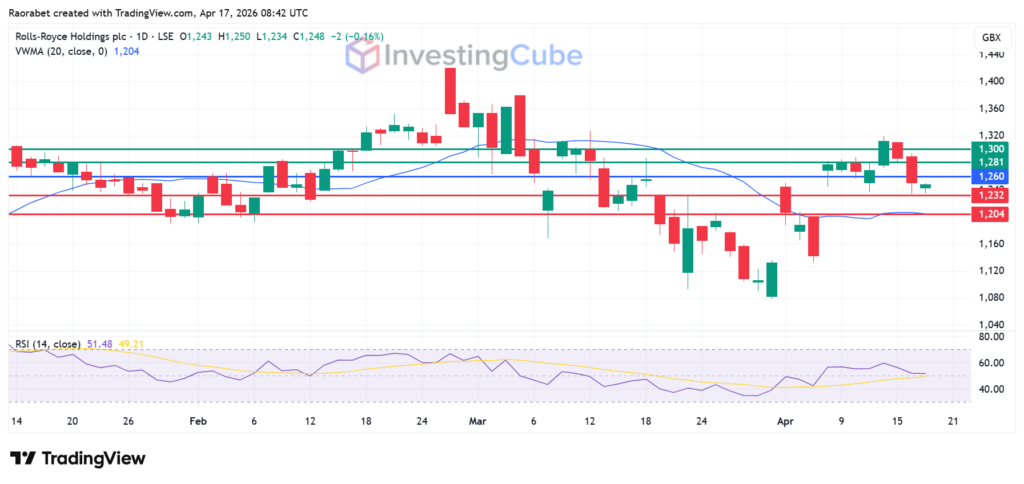
Rolls-Royce share price shown on the daily chart with the key levels of support and resistance on April 17, 2026. Created on TradingView
A US-Iran ceasefire on 8 April eased oil prices and reopened key shipping lanes. Simultaneously, the £2.5bn share buyback launched 1 April provided structural demand support, while significant short-covering amplified the upward move.
Increased aluminum prices, stemming from an incident at a Qatari facility, have led to concerns regarding manufacturing costs. Additionally, apprehension about kerosene rationing and a debated £24 million CEO pay package, ahead of the April 30th AGM, have influenced investor sentiment negatively.
While the buyback does establish a steady institutional demand for the shares, its capacity to entirely counteract selling pressure driven by broader market factors is limited. The buyback serves more effectively as a long-term valuation support rather than a short-term buffer during times of significant market fluctuation.