


- Rolls-Royce stock is currently primarily impacted by external forces than company-specific setup
- The US-Israel vs Iran war has interfered with aviation operations, but Rolls-Royce has a substantial guaranteed minimum flying hour service contracts
- April 30 could be a turning point for the stock as the company will be holding its AGM with share buyback dividend up for a vote
Following a strong start in early April, during which Rolls-Royce shares approached the 1,320p level, the stock has recently faced considerable market resistance. Over the past five trading days, the stock has seen a decline of more than 4%, settling at approximately 1,230p at present. Rolls-Royce share price was down by 1.1% at the time of writing, extending the losses incurred on Monday.
Sources of Recent Headwinds
After a strong show in mid-April, the recent headwinds are mostly coming from outside, and they are caused by the changing risk-off sentiment in the FTSE 100. Even though the UK government signed a historic SMR contract on April 13, investors are becoming more concerned about the ongoing conflict in the Middle East.
Key concerns revolve around escalating energy costs and the potential for diminished consumer expenditure. Should airlines scale back their flight schedules as a consequence of rising fuel prices, Rolls-Royce’s vital Large Engine Flying Hours revenue, which underpins its service-led business model, could experience a notable impact.
Consequently, market participants are beginning to assess the company’s ability to maintain its revised operating profit guidance of £3.1bn–£3.2bn amidst an inflationary economic landscape.
Reuters reported a decline in UK stocks on April 20, as investors closely observed developments in US-Iran negotiations prior to the ceasefire’s expiration. Given its substantial involvement in both civil aerospace and defence sectors, Rolls-Royce has demonstrated a clear susceptibility to these broader economic and geopolitical shifts.
Nevertheless, Rolls-Royce’s power-by-the-hour contractual agreements incorporate minimum guaranteed flying-hour thresholds. These provisions help to mitigate potential revenue reductions should flight routes be cancelled.
It is also worth noting that current constraints appear to be in capacity rather than demand, indicating that airlines are not broadly disengaging from aviation but are instead making tactical decisions to manage operational costs.

Is 1,200p threatened?
The 200-day moving average is positioned at roughly 1,155p, a level the stock has successfully maintained during earlier periods of selling pressure this year. With shares trading near 1,240p, there is approximately a 3% buffer before reaching the 1,200p mark. This margin, while not exceptionally wide, is significant considering the observable depth of buying interest at these price points.
The AGM on 30 April, at which the buyback and dividend will be formally approved, is the next significant catalyst.
Rolls-Royce Share Price Forecast
Rolls-Royce ADX reading is low at 11.83, confirming the absence of strong trend direction. The pivot is at 1,257p and the price is currently below that level, signaling control by sellers. The immediate safety net is the 50-day MA at 1,218p zone. However, the second support at 1,200p offers a more critical technical floor. Resistance sits at 1,285p, with the stock needing a daily close above the second barrier at 1,310p to signal renewed bullish direction.
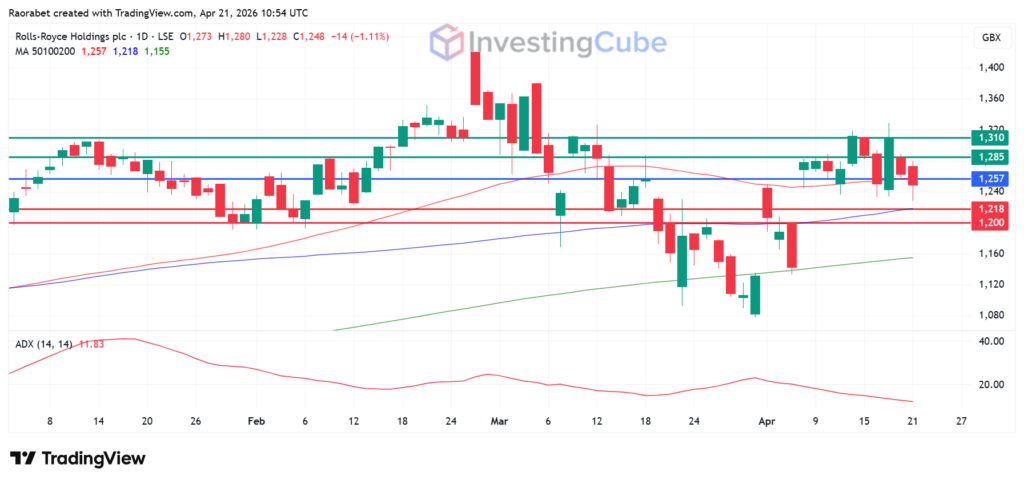
Rolls-Royce share price action seen on the daily chart with the key levels of support and resistance shown. Created on TradingView
Meaningfully, but with contractual floors. Its power-by-the-hour model links revenue to engine usage, but minimum guaranteed thresholds in long-term service agreements limit the downside. That is a nuance that the current market reaction appears to underweight.
Investors should focus on operating margins in the Civil Aerospace sector and any changes to the free cash flow guidance, as these are the primary drivers of the company’s ongoing transformation.
Currently, the stock is holding above 1,220p. However, technical indicators suggest that if the current bearish momentum continues, a retest of the 1,200p support zone is highly likely before the end of April.