


- Rolls-Royce share price shot up nearly 12% on April 8 following news of US-Iran ceasefire talks, but gains have been marginal since
- On the one hand, the Middle East war favours the company's defense revenue, but on the other, it has disrupted civil aviation routes
- The 1,300p level is a key psychological mark and holding above it is key to sustaining upward momentum
For Rolls-Royce shareholders, April 8 presented a clear picture. The stock saw a significant surge, rising approximately 12% in a single trading session, reaching levels not observed since mid-March. This movement was directly attributed to a straightforward cause: the announcement of a US-Iran ceasefire.
But after that big jump, the engine seems to have gone into economy mode. Recent data from the London Stock Exchange shows that marginal gains of 0.14% or 0.17% have become the new normal, which is frustrating.
Why the Sudden Calm in Buyer Interest?
The strong opening on April 8 was largely driven by expectations for increased demand in military engines and associated aftermarket services, especially given the ongoing conflict. Despite this, subsequent buying activity has been limited.
It seems that investors have chosen to secure their profits after the sharp upward movement. This is particularly relevant as civil aerospace revenues, which still represent a substantial part of the company’s business, remain sensitive to reduced flying hours caused by disruptions to routes.
Is the 1,300p Breakthrough Imminent?
The 1,300p level stands as a notable psychological barrier. While the general sentiment among analysts leans towards a Moderate Buy, there is a significant degree of tension in the market. On one hand, a substantial £7-9 billion buyback program provides a strong underlying support for the price. Conversely, as Hargreaves Lansdown has pointed out, the stock is currently trading at a forward P/E ratio approaching 39x, a figure considerably higher than its ten-year average.
Yet, the primary concern might not be related to the aviation recovery itself. Instead, it centers on what could be termed an “Execution Premium.” Rolls-Royce’s current valuation seems to factor in a scenario of perfect operational turnaround. Any prolonged period of geopolitical instability in the Middle East could quickly diminish this positive momentum. For instance, if the cycles for engine servicing face delays, or if the costs for specialized alloys within the supply chain experience significant increases, that 39x valuation could quickly turn into a vulnerability.

Recent Israeli actions in Lebanon have already created strain on the existing truce, and Iran’s strategic influence over the Strait of Hormuz remains considerable. Should the conflict escalate once more, Rolls-Royce could not only forfeit the gains observed on April 8 but might also revisit the 1,108p lows experienced in late March. While the £2.5 billion buyback offers a fundamental price floor, it is unlikely to withstand a sustained geopolitical shock.
Rolls-Royce Share Price Forecast
Rolls-Royce stock has its RSI at 57.68, indicating bullish conditions. The price action is above the pivot point at 1,280p . Resistance levels include 1,300p psychological high and the second one will likely be at 1,310p YTD high. The first support sits at 1,270p and action below that will inavalidate the upward narrative, opening the path to test 1,259p.
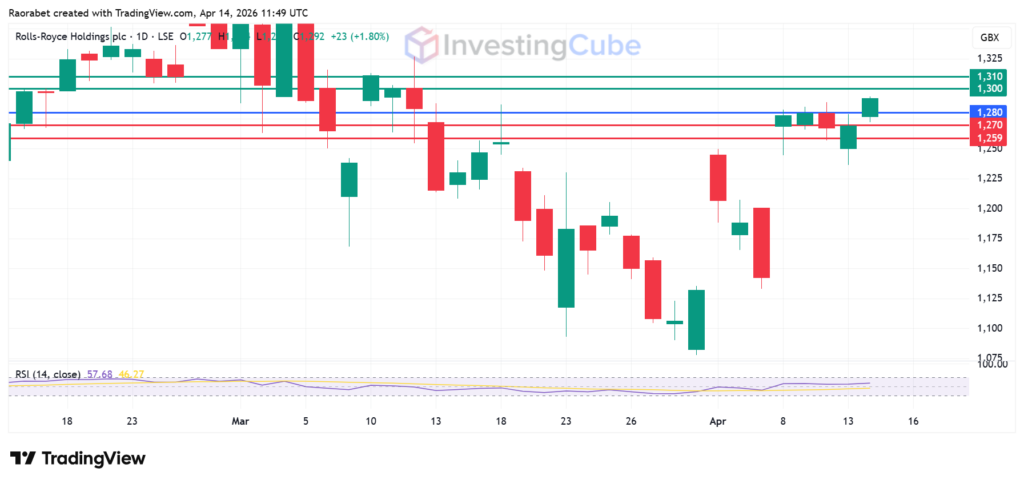
Rolls-Royce share price action on the daily time frame with the key support and resistance levels on April 14, 2026. Created on TradingView
While the long-term trend is bullish, a break past 1,300p requires a fresh catalyst. Without a significant new contract or positive macro data, the stock may continue to trade sideways.
The £2.5bn share buyback programme provides a structural price floor. Defence division revenues, bolstered by increased NATO spending and new MoD and US contracts, also offer a counter-cyclical hedge to any civil aerospace downturn.
A downward movement is possible if the conflict de-escalates quickly or civil revenues disappoint; consensus may underestimate the drag from the civil segment in a lower-tension scenario.