


- Stay ahead in the market with our detailed technical outlook on Rolls-Royce stock. Identify crucial levels to watch.
Rolls-Royce’s recent decline comes down to a mix of fundamental and market-driven factors. The latest trading update raised concerns about slowing momentum in its civil division. Therefore, rising costs and supply chain issues continue to pressure profit margins, which is something investors are particularly sensitive to in a high-interest-rate environment.
At the same time, weakness across the broader aerospace sector, especially challenges facing major manufacturers like Boeing, has created a ripple effect that weighs on suppliers such as Rolls-Royce.
Rolls-Royce is not an independent company. It is a vital part of the aircraft building chain. It supplies engines to wide-body aircraft. When a company like Boeing or Airbus is unable to produce aircraft as quickly as intended, fewer aircraft are produced. Fewer deliveries, less demand for Rolls-Royce engines. This also pushes future servicing revenues out. These engines only generate long term revenue if they are used. In other words, Rolls-Royce’s growth is highly linked to aircraft production cycles. This makes it very sensitive to any disruptions in the industry.
On top of that, the stock had previously seen a strong rally, making it vulnerable to profit-taking once momentum began to fade. Ongoing geopolitical uncertainty has kept overall market sentiment mixed, encouraging investors to shift toward safer assets and reduce exposure to cyclical industrial stocks. Together, these factors help explain why the stock has come under pressure despite a broader recovery in the aviation sector.
Rolls-Royce Stock Technical Outlook:
Rolls-Royce’s stock price action made a head-and-shoulders pattern and started its bearish direction, confirming a change in momentum after failing to hold the previous uptrend.
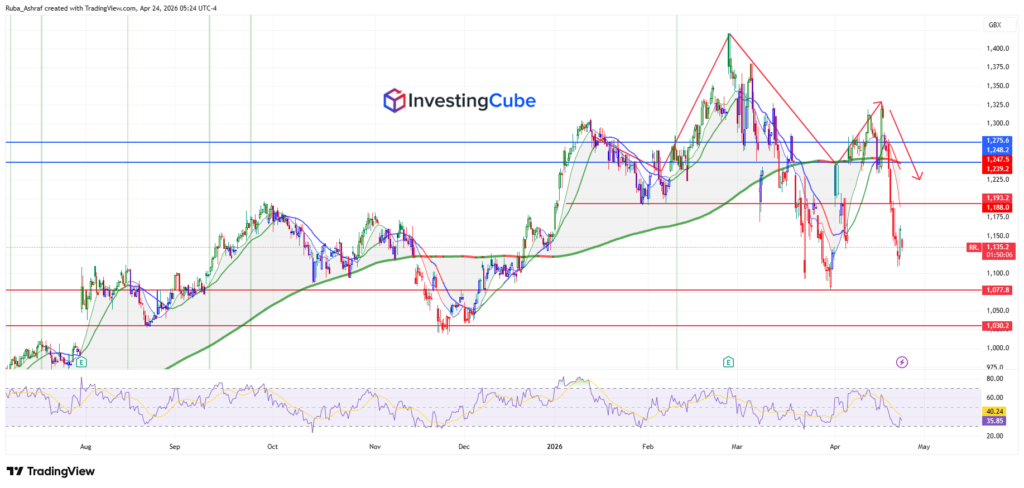
The price action already broke below the neckline of the formed pattern. This breakdown reflects the initial bearish move, which aligns with the sharp sell-off seen afterward. This suggests that buyers lost control and sellers began to dominate the market.
Looking at the moving average, the short-term averages have crossed below each other and are now sloping downward. This indicates increasing bearish momentum in the short term. The price is also trading below the thicker long-term moving average, reinforcing the idea that the broader trend is weakening. Attempts to reclaim this long-term average have failed, turning it into dynamic resistance.

The RSI is struggling to hold above the mid-level (50) and is currently drifting lower. It indicated that buyers’ pressure is weakening. In terms of key levels to watch:
- Immediate resistance is around 1,248 – 1,275, where price was rejected recently and the right shoulder was completed.
- The stronger resistance level stands near 1,300, aligning with previous highs and the upper shoulder.
- On the downside, 1,193 is a key support level. A break below it opens the door toward 1,077, followed by 1,030.
Potential Scenarios:
The more likely scenario for now is the bearish one: If the price fails to break above and hold the 1,248-1,275 resistance zone, it would suggest continuation to the downside. A break below 1,193 would confirm further weakness, potentially targeting 1,077 and even 1,030.
Bullish correction scenario: if the price manages to reclaim the 1,248 level and hold above it, we could see a short-term recovery toward 1,275-1,300. But unless the price breaks and holds above the head/major resistance zone, this would likely stay a corrective bounce within a larger bearish trend.
The cautious outlook is permitted and confirmed by the combination of the head and shoulders breakdown, bearish moving averages, and weakening RSI. The downside risks are still dominant unless the key resistance levels are reclaimed.
Rolls-Royce differs from traditional manufacturers, who earn their money by selling products, in that the majority of its revenue comes from long-term service agreements. Airlines get paid for every hour their engines are airborne. So even if plane orders are steady, a slowdown in global travel or engine groundings due to maintenance problems like the recent supply chain delays is hitting the company’s core cash flow and future earnings guidance.
Rolls-Royce has a lot of legacy debt from the pandemic. If rates stay “higher for longer,” the cost of servicing that debt remains high, taking a bite out of the net profit available for shareholders. Also, Rolls-Royce is a big export. A strong pound due to higher interest rates makes its products more expensive for overseas buyers and could result in fewer new contracts being won.