


Archived Article This article was published more than 5 months ago. The market data, prices, forecasts, and analysis were accurate at the time of publication but may have changed since then. Please use this article for historical reference only and refer to our latest content for current market information.
- Intel stock price uptick on Friday drove it above $85, making the psychological $100 mark become the more a realistic target for 2026
- The rally is backed by exceptional Q1 earnings and landmark foundry contract from Tesla
- There has been growing confidence that Intel is "back" after its recent performance, but key metrics show that its yet to cement a profitable path
If you had checked your portfolio on the morning of April 24, 2026, you might have done a double-take. Intel (NASDAQ: INTC), the long-suffering titan of the chip world, didn’t just climb, but it launched.
During a remarkable pre-market session, the stock saw a 28% increase, trading above $85. This surge builds upon a robust run in the last month, where the stock appreciated by 53%, representing a substantial recovery within semiconductor markets.
What Ignited the Pre-market Explosion?
The earnings report released on Thursday presented compelling figures. Intel’s official Q1 2026 results indicated revenues of $13.6 billion, reflecting a 7% year-on-year increase and exceeding analyst expectations. A particularly impactful metric was the non-GAAP EPS of $0.29, significantly surpassing the consensus estimate of $0.01. This performance represents a substantial positive deviation from profitability forecasts.
Non-GAAP gross margin reached 41%, exceeding guidance by 650 basis points. This outcome was primarily driven by increased volumes and the enhanced pricing capabilities Intel is demonstrating within the server CPU market.
But the real shocker came from the Foundry division. Intel announced that Tesla has become the initial major external customer for its advanced 14A manufacturing process, to be housed at the new Terafab facility. For a foundry operation that has predominantly served internal requirements, securing Tesla as a key external client for its upcoming generation node indicates a growing external market confidence in its capabilities.
Is Intel Back to its Former Glory?
It is important to consider the broader context. The stock has seen a 235% increase over the last 12 months, reaching levels not observed since the dot-com era, as noted by Bloomberg. However, achieving “former glory” would necessitate a return to consistent profitability, which has not yet materialized.
Intel’s GAAP net loss expanded to $4.28 billion in Q1, up from $887 million in the prior year, primarily attributed to the costs associated with foundry expansion. The Intel Foundry segment reported an operating loss of $2.4 billion, with external foundry revenue standing at only $174 million. This figure is notably modest when compared to TSMC’s quarterly revenue of $35.9 billion.

Some folks are cheering Intel’s comeback, yet the business isn’t what it once was, and is still a fragile entity. That 41% non-GAAP gross margin seems high until you notice Q1 got a boost from clearing old stock plus and an advantageous product mix.
Management has specifically indicated a Q2 gross margin of approximately 39%, anticipating increased costs associated with the 18A ramp-up. From a financial perspective, an enterprise reporting a GAAP loss of $4.28 billion quarterly, while generating $174 million in external foundry revenue, is still in an earlier stage of its recovery. This period represents a significant investment phase for the company’s strategic transformation.
Is $100 a Viable Target in 2026?
With the stock approaching $85 in pre-market trade, $100 represents roughly 18% additional upside from current levels. This target appears achievable, contingent on specific market dynamics. For example, HSBC recently adjusted its price target to $100. The market is increasingly recognizing Intel’s capacity to optimize its internal foundry resources during periods of global chip scarcity, a distinctive strategic advantage.
Nevertheless, the Q2 guidance, projecting revenues between $13.8–14.8 billion and $0.20 non-GAAP EPS, while still strong, implies a potential moderation compared to the unique advantages observed in Q1.
Intel Stock Price Forecast
After rising to $85, Intel stock price will likely encounter primary resistance at $90. Beyond that point, the next major hurdle is the $95 level. Clearing this would pave the way for the $100–$105 zone. The RSI is in the overbought territory above 70, which could trigger a consolidation. Immediate support has formed at the $75 level. A stronger psychological floor sits at $70.55.
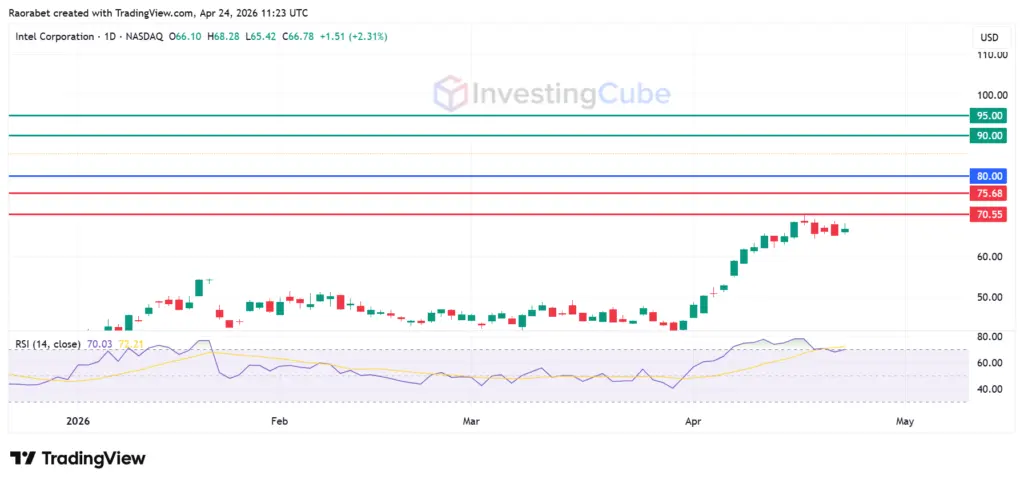
Intel stock price daily chart with the key support and resistance levels for April 24, 2026. Created on TradingView
It is strategically important, but at commercially early-stage. External foundry revenue was just $174 million this quarter. Tesla’s commitment to the 14A process reinforces confidence in Intel’s technological roadmap, though it is not expected to substantially contribute to revenue before late 2027.
Yes. HSBC recently raised its target to $100, citing massive upside in server CPUs. Should Intel sustain its 30% growth projections for the Foundry segment, a triple-digit stock price could be a realistic aspiration.
The primary risks are execution delays on the 18A/14A ramp-ups and the high cost of domestic manufacturing.