


Archived Article This article was published more than 5 months ago. The market data, prices, forecasts, and analysis were accurate at the time of publication but may have changed since then. Please use this article for historical reference only and refer to our latest content for current market information.
- The Dow Jones Industrial Average has risen in April, with the market seemingly offsetting pressure from rising oil prices via tech stocks
- A retest of 50,000 has been a challenge, but strong performance by tech companies including high AI capex is boosting confidence
- The market's current slowdown is potentially a result of investors readjusting for the impact of higher-for-longer energy prices
The Dow Jones index has seen an increase of over 6% this month, effectively recovering most of the declines experienced following the “Iran shock.” However, as the index once again nears the 50,000 milestone, it appears to be encountering notable resistance.
Many investors are now contemplating whether this period represents a temporary consolidation before a significant upward movement or signals the potential for a more substantial market downturn.
The Duel Between AI and Oil
The driving forces behind the April recovery appear to be distinctly divided. On one hand, the significant influence of the AI Supercycle is clearly evident. Major components of the Dow have benefited from substantial capital expenditure initiatives by tech companies, with the likes of Nvidia and Amazon setting the pace for advancements in chips and robotics. This forward momentum is extending its positive impact to more established sectors, including industrials and financials.
Conversely, the older economy faces persistent challenges from inflationary pressures. Although the prospect of a lasting US-Iran ceasefire has somewhat alleviated immediate market anxieties, energy costs continue to be structurally elevated. Crude oil prices are largely fluctuating within the $90-$100 per barrel range, effectively imposing a cost burden on the large industrial companies that hold significant weight within the Dow.
The index currently reflects a dynamic tension. Optimism stemming from technological advancements is providing upward pressure, while concerns about inflation, particularly driven by energy prices, are holding it back.

What Next?
The industrial foundation of the Dow is under pressure from sustained crude oil prices above $100, a factor that current earnings projections may not have entirely incorporated. What appears to be a market pause could be indicating that the market is commencing a re-evaluation to account for a more prolonged period of elevated oil prices. That scenario is one that that prevailing market consensus might be structurally underestimating.
Unlike the S&P 500, which is top-heavy with growth, the Dow is price-weighted. When high-priced names such as Goldman Sachs or UnitedHealth see profits shrink due to higher shipping expenses, their weight drags down everything else. We aren’t seeing a pause before continuation, but more of a re-evaluation of reality.
Dow Jones Index Forecast
Dow Jones Index’s RSI at 64 signifies control by buyers with more room for gains before becoming overbought. The 50,000-point mark followed by the all-time high of 50,499 reached in February remain the key resistance levels. The immediate floor is established at 48,790. A breach below this could trigger a bearish slide toward 48,240.
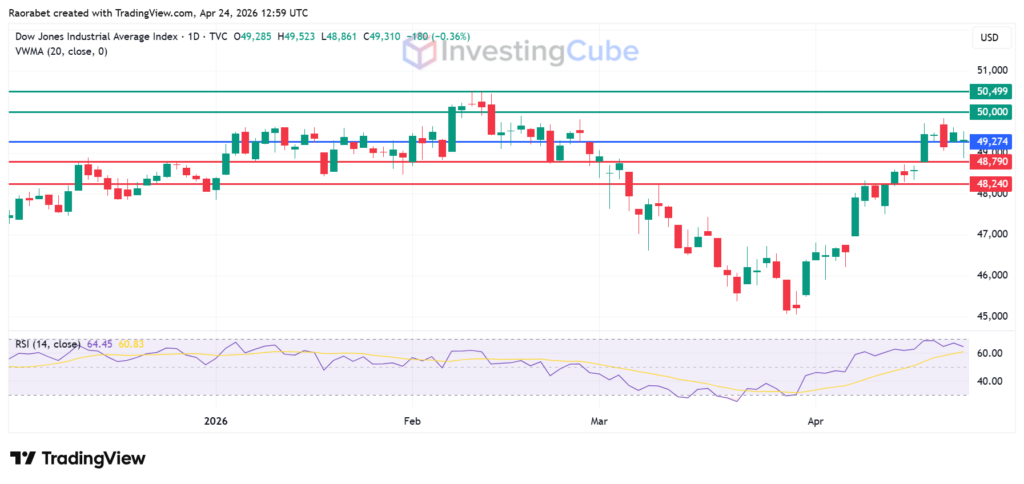
Dow Jones Index on the daily chart on April 24, 2026 showing the main levels of support and resistance. Created on TradingView
While the Dow briefly crossed 50,000 in February, it is struggling to retest it due to persistent energy costs and high valuations that make investors cautious about buying at record peaks.
The conflict pushed the Dow into a 10% correction in March. Although April saw a recovery on ceasefire hopes, any headline noise regarding the Strait of Hormuz remains a major volatility trigger
A durable US-Iran peace agreement reopening the Strait of Hormuz fully. Oil would collapse toward $85–90, relieving inflation fears, reducing pressure on the Fed, and directly boosting the industrial and consumer names that dominate Dow weighting.