



Archived Article This article was published more than 5 months ago. The market data, prices, forecasts, and analysis were accurate at the time of publication but may have changed since then. Please use this article for historical reference only and refer to our latest content for current market information.
- The FTSE 100 index has benefited from the reduced war rhetoric between the US and Iran following commencement of ceasefire talks
- Giants like Unilever and Shell have been resilient due to exposure to markets outside the UK
- The Bank of England (BoJ) is likely to keep interest rates elevated, and that could limit growth
Midway through April 2026, the FTSE 100 has steadied after a rough March shaped by rising tensions in the Middle East alongside oil prices jumping past $100 again. The index has been on an upward trend in April, climbing close to 3%. Because of that rise, it clawed back earlier setbacks while holding position just beyond the psychological threshold at 10,000 points. While uncertainty still hums beneath global markets, London’s leading stocks show signs they can hold ground.
A significant turning point occurred on April 8. Following President Trump’s announcement that the United States would suspend military action against Iran for a two-week period, the market’s response was immediate.
What Has Changed?
Two key developments are particularly noteworthy. First, a degree of relief from the intense period of geopolitical strain has helped alleviate pressure on commodity markets. Brent crude prices moderated after briefly exceeding $110, which lessened immediate concerns about inflation that had previously weighed on investor sentiment in March. This shift supported the stabilization of energy and mining shares, providing a lift to some of the index’s most influential components.
Second, the corporate earnings season has begun to provide encouraging indicators. Major companies such as Tesco, Barclays, and BP are scheduled to report throughout April, and initial updates have highlighted robust cash flows and commitments to capital returns. Furthermore, the FTSE’s largest companies are demonstrating resilience. As noted by IG Research, firms like Shell and Unilever are effectively serving as defensive bulwarks within the market.
Additionally, recent economic data has offered further impetus. On April 16, 2026, the London Stock Exchange reported that February’s GDP growth surpassed expectations, driven by solid performance in the services and construction sectors. This domestic resilience, combined with a significant 7% gain year-to-date, suggests that the Blue Chip rally may have sustainable momentum.
What Could Derail the Upturn?
The risks are real. On April 13, talks between the US and Iran broke down because Tehran wouldn’t give up its nuclear ambitions and Washington’s language got stronger. That day, the FTSE dropped 0.4%, and banks and travel stocks fell right away. At the time of writing, the ceasefire that caused most of April’s gains is in danger of falling apart.

Adding to these concerns are the limitations posed by monetary policy. UK inflation currently stands at 3.0% CPI, with energy prices having surged 82% since the start of the year. The Bank of England maintained rates at 3.75% at its March meeting and is not anticipated to implement a cut before April 30. The Bank of England faces constraints due to inflationary pressures, which limits a key support mechanism for UK equities during a period of volatility.
Current market perspectives point to the Bank of England (BoE) maintaining higher rates for an extended period to counter 3.5% inflation as the primary risk to the FTSE. Most analysts are anticipating the potential impact of an extended period of elevated rates on the market.
FTSE 100 Index Forecast
The RSI on FTSE 100 is at 58, signifying control by the buyers. The first resistance is at 10,660, and the second one will likely be at 10,700 points. If the index flips that into a support, it above there would put 11,000 squarely in view. Strong immediate support lies at 10,480. A failure here could lead to a retest of the 50-day SMA at 10,430 floor.
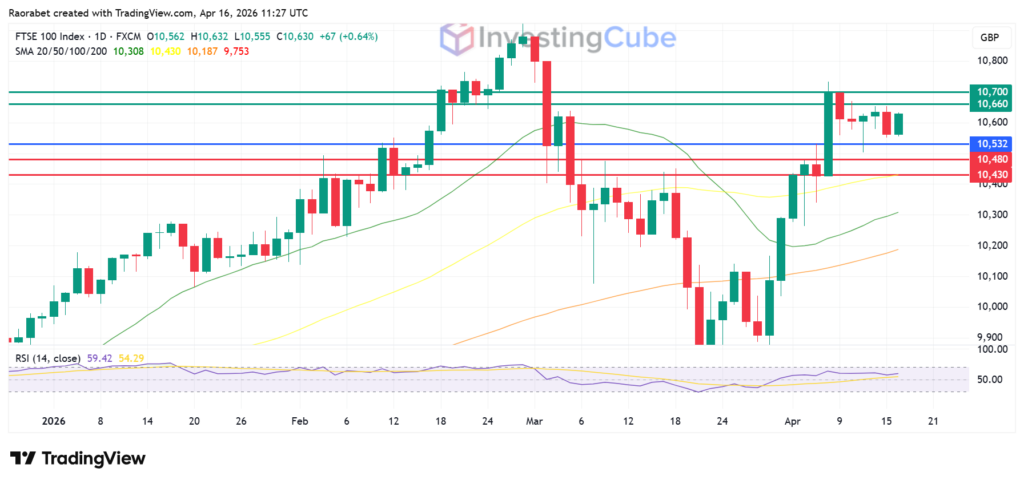
FTSE 100 shown on the daily chart on April 16, 2026 with the key levels of resistance and support. Created on TradingView
The recovery was driven by robust corporate earnings from energy and consumer giants, combined with better-than-expected UK GDP data showing 0.5% growth in services, which offset the geopolitical jitters of March.
Yes, provided the earnings resilience pillar holds. With roughly 80% of revenue coming from overseas, the FTSE 100 is more a play on global growth and commodity prices than just the domestic UK economy.
Yes, as long as the earnings resilience pillar stays strong. The FTSE 100 is more about global growth and commodity prices than just the UK economy because about 80% of its revenue comes from outside the UK.