



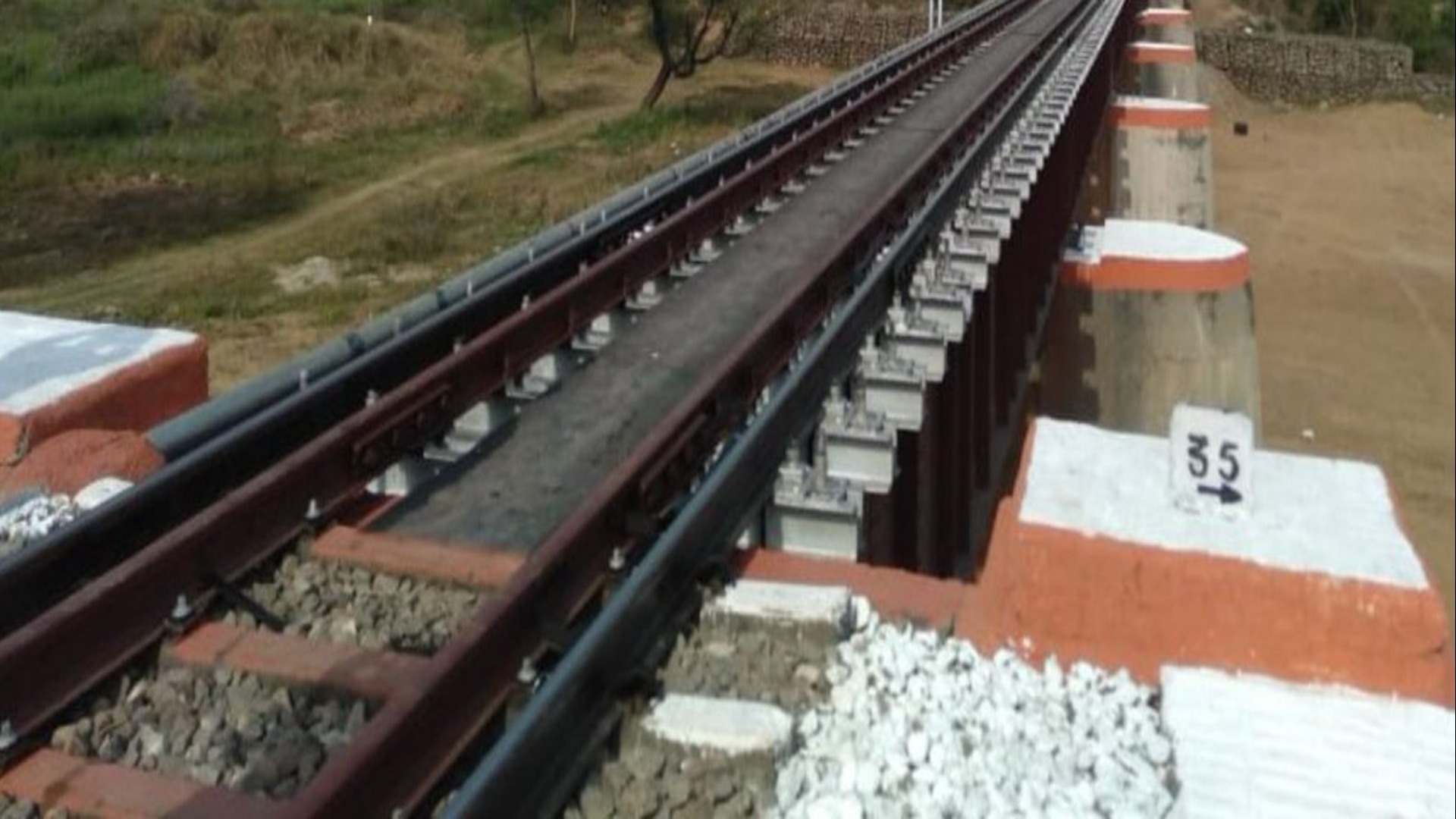
- RVNL share price declined for three successive months at the start of the year, but is on course to register its first monthly gain of the year
- The April upturn is supported by government announcement of a ₹1,530 billion railway infrastructure investment
- RVNL has a large order book valued at ₹930 crore but high valuation and execution risks could pose a challenge
Early 2026 brought tough days for those holding shares in Rail Vikas Nigam Limited (NSE: RVNL). Following years of strong growth, the share price dragged downward throughout January, February, and March, making some question whether the railway rally was over. Yet everything shifted once April arrived. The state-owned enterprise’s stock has surged ahead, climbing nearly 17% so far this month, now hovering around ₹292.
What drove the Q1 slide
The first quarter’s dip was not an isolated event. As reported by Indmoney, the broader railway sector largely saw reduced market interest for much of the year, with RVNL and its contemporaries, including IRCON, IRFC, and RailTel, all showing negative year-to-date performance. This occurred even as the Nifty 50 achieved approximately 9.6% returns over the same period.
The sector’s weaker performance stemmed from several factors, including modest profit margins, project implementation delays, and a market sentiment that had already factored in considerable optimism from the 2024 public sector unit rally. The company’s own finances show that revenue has dropped for two quarters in a row, going from ₹5,350 crore to ₹4,990 crore, which is an average quarterly drop of 6.8%. That is a sign that you should pay attention to, even though most market commentators have ignored it.
₹1.5 Trillion Catalyst
The most immediate spark for the April surge was the government’s announcement of a historic ₹1,530 billion investment package for railway expansion, as reported by Equitymaster. For a company like RVNL, which serves as the execution arm of the Ministry of Railways, this is pure oxygen.
Specifically, on April 15, 2026, RailTel Corporation disclosed securing a ₹608 crore contract from RVNL. This agreement involves implementing advanced tunnel communication and safety systems across approximately 70-80 km of railway tunnels, with completion projected by April 2028. Although this specific contract directly benefits RailTel, it underscores RVNL’s active role in awarding significant sub-contracts, signaling ongoing movement within its own extensive project pipeline.
Q2 2026 Presents Opportunity and Caution in Equal Measure
The second quarter of 2026 offers notable prospects for RVNL. With its upcoming earnings release scheduled for June 1, 2026, market observers will be keen to assess if new project revenues can offset the decline experienced in Q3 and Q4 of FY26.

Should there be a demonstrable acceleration in order execution, particularly within high-speed corridor initiatives and electrification programs, this could substantiate existing positive sentiment and potentially drive the stock towards the ₹370-380 resistance level.
The common market perspective labels RVNL as a reliable choice, attributing this to its substantial ₹90,000 crore order book and its status as a Public Sector Undertaking. It is frequently suggested that continued government investment in railways will positively influence RVNL’s trajectory.
RVNL Share Price Forecast
RVNL share price pivots at ₹290 and the RSI at 58 signals a likely continuation of the upward movement if action stays above that level. The stock faces a psychological hurdle at ₹300. A sustained close above this level could trigger a rally to ₹311, aligning with the 100-day SMA level. Strong immediate support is established at ₹278. A secondary support sits at ₹267, which corresponds to the 20-day SMA.
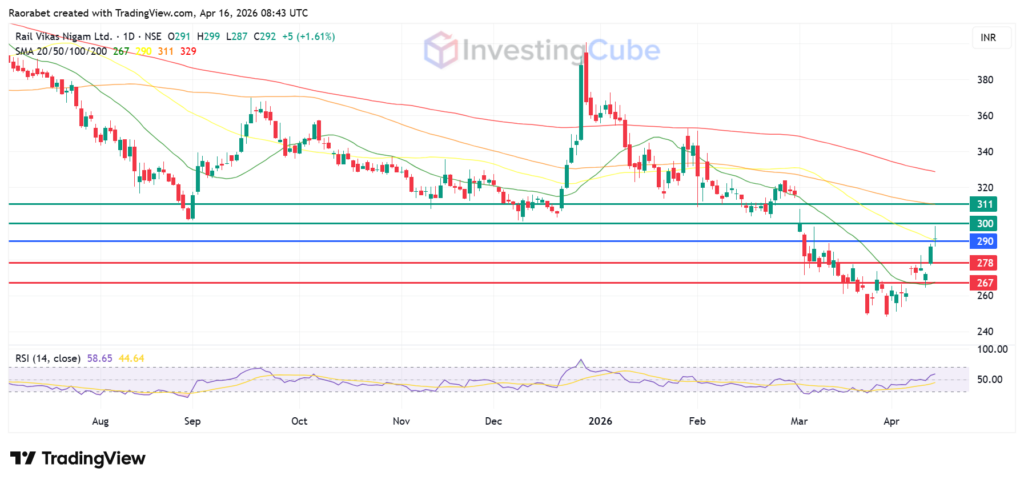
RVNL share price daily chart showing the key support and resistance levels on April 16, 2026. Created on TradingView
The broader sector’s decline was primarily attributed to valuations that had become elevated following the 2024 PSU rally, rather than a deterioration of fundamental strengths. RVNL’s premium PE and contracting revenues gave investors reason to rotate out, even as the long-term infrastructure thesis remained sound.
This recovery was notably spurred by a substantial ₹1.5 trillion government initiative dedicated to railway modernization, alongside a series of new contract awards. These developments collectively helped rebuild investor confidence following a challenging first quarter.
The company maintains a strong order book, valued at approximately ₹90,000 crore.