



- LIC share price has been on the upward trajectory since April 6 and the bonus issue just added fuel to the fire
- The company reported a 50% jump in Annual Premium Equivalent (APE) in its most recent quarterly financials, Q3FY26
- The bonus issue does not translate to dishing out free money, but increases liquidity inasmuch as it has its downsides
Following a period of subdued performance in March, which saw the stock experience considerable pressure within various portfolios, April has presented a renewed sense of optimism for Life Insurance Corporation of India (LIC). Since April 6, the share price has demonstrated a consistent upward trajectory, culminating in a significant “gap up” on April 13, 2026. This notable movement occurred subsequent to the board’s approval of its initial 1:1 bonus issue.
The Fundamentals Powering the Recovery
The underlying financial figures supporting LIC’s recent share price movement warrant careful consideration, moving beyond simply attributing the gains to the bonus issue announcement. On a consolidated basis, LIC reported a year-on-year net profit increase of 17.46%, reaching ₹12,930.44 crore in Q3FY26. Concurrently, total income saw a 15.74% rise year-on-year, amounting to ₹2,36,776.30 crore.
However, the most compelling data point emerges from the quality, not just the volume, of new business. LIC experienced a robust quarter, with its Annual Premium Equivalent (APE) growing by approximately 50% year-on-year in Q3FY26. This expansion was influenced by a comparatively lower base in the prior year and strong demand linked to GST implementation.
The Value of New Business (VNB) saw a substantial increase, approximately 65% year-on-year. This was further supported by an expansion of roughly 180 basis points in VNB margins, bringing them to around 21%. For an institution that has often faced criticism for its perceived low-margin, volume-driven strategy, this improvement in margin trajectory represents a significant strategic affirmation.
Why a Bonus Matters
While a bonus issue does not inherently alter the intrinsic value of an investor’s holdings, market participants often interpret this as an event that enhances liquidity. Furthermore, it can communicate management’s confidence in the company’s retained earnings, without requiring cash outflow, and might facilitate more efficient future government stake sales by improving the stock’s tradability.
Nonetheless, from a broader strategic viewpoint, this bonus issue could be seen as a calculated optical adjustment designed to pave the way for additional government stake divestments. Given that the government currently maintains approximately a 96.5% ownership in the company, the public float remains notably limited.

By effectively doubling the share base at this juncture, the government retains the flexibility to divest a smaller proportional stake from the expanded total shares later while still achieving its divestment targets. This strategy could potentially mitigate the risk of a substantial supply shock that might otherwise occur at a higher price level.
For those considering an investment primarily for the bonus, it is prudent to recognize that this action could precede an Offer for Sale (OFS), which might constrain upward momentum in late 2026.
LIC Share Price Forecast
The RSI on LIC share price is at 61.81, signaling control by the buyers. The pivot is at the upper Bollinger Band level at ₹825, while the primary hurdle sits at ₹840, followed by a psychological barrier at ₹850. The immediate floor is at ₹815, which would result in filling the gap and the second one is psychological at ₹800. A breach below ₹815 would invalidate the current bullish setup.
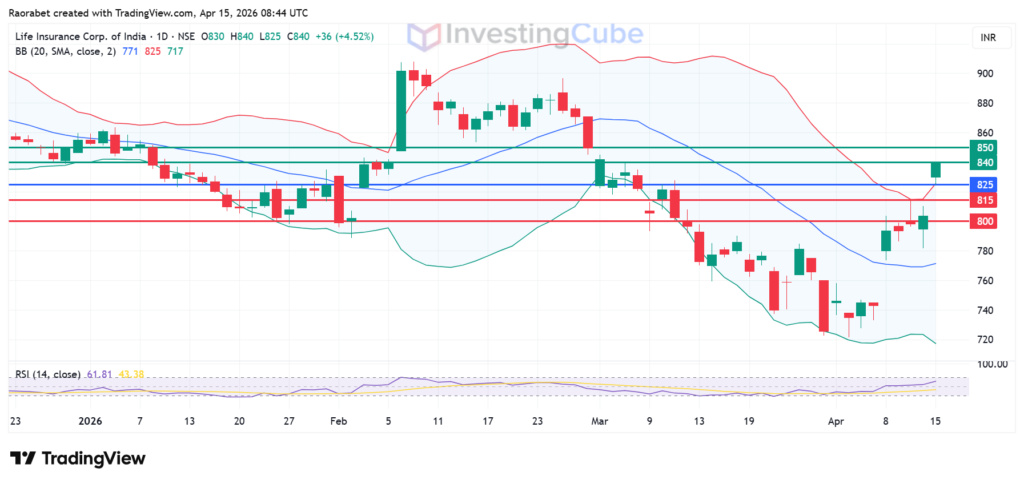
LIC share price performance on the daily chart with the key support and resistance levels on April 15, 2026. Created on TradingView
The gap up was triggered by the board’s approval of a 1:1 bonus issue, which will double the share count for eligible holders by capitalising ₹6,325 crore from its reserves
No. While you receive one additional share for every one held, the stock price adjusts downward proportionately. The real benefit is increased liquidity and the psychological affordability that often attracts more retail buyers.
The primary risk is a potential government stake sale (OFS). The bonus increases the share base, which can make it easier for the government to divest its 96.5% stake, potentially creating supply pressure.