



Archived Article This article was published more than 5 months ago. The market data, prices, forecasts, and analysis were accurate at the time of publication but may have changed since then. Please use this article for historical reference only and refer to our latest content for current market information.
- Reduced safe haven demand for the Japanese yen amid Japan's exposure to high oil prices is adding to rate differentials to spur AUD/JPY upwards
- The Bank of Japan is in a delicate position, with rate hikes likely to be gradual due to the current global geopolitics, pressuring the yen further
- A return to risk aversion could help the yen gain some strength due to safe haven demand
The AUD/JPY currency pair has certainly captured market attention this month. From early April 2026, the Australian dollar has strengthened over 3.5% against the Japanese yen, presently hovering around the 113.50 mark. This movement goes beyond typical market volatility; the pair is now nearing levels not observed in more than three decades.
Where’s AUD Getting Its Fuel From?
The Australian dollar’s strength largely stems from the Reserve Bank of Australia’s hawkish monetary policy stance. In March, the RBA increased its cash rate by 25 basis points, reaching 4.10 p%, attributing this decision to ongoing inflationary pressures. That has been exacerbated by rising energy costs, as stated in their official communication. Market expectations now point to further rate increases in both May and June, with futures suggesting a 60 percent likelihood of a move to 4.35 percent in the upcoming month.
Why the Japanese Yen Continues to Weaken
Conversely, the yen confronts inherent challenges due to the Bank of Japan’s cautious monetary policy. While there was some market conjecture regarding a rate hike in April, with subsequent indications suggesting a more gradual path towards policy normalization. BoJ Governor Kazuo Ueda has highlighted economic uncertainties, including broader geopolitical shifts, which has led markets to anticipate only limited tightening measures.
The yen continues to be pressured by persistently low real interest rates and its attractiveness for carry trades. Furthermore, there is a reduction in safe-haven demand, following the de-escalation of tensions in the Middle East. Japan’s significant dependence on imported energy also intensifies this dynamic whenever oil prices experience volatility.
Is a New All-Time High on the Horizon?
Considering the pair is already challenging multi-year high points near 113.50, and nearing its 52-week high of 114.04, the possibility of establishing a new record certainly comes into focus.

Should the RBA indeed proceed with further tightening and if downward pressure on the yen continues, sustained upward momentum might propel AUD/JPY towards 114.50 or even higher. Nevertheless, any unforeseen hawkish shifts from the Bank of Japan or a wider turn towards risk aversion in the market could well limit these advancements.
AUD/JPY Forecast
The RSI on AUD/JPY at 67 shows control by buyers but with the risk of becoming overbought. The first key resistance will likely be at 113.70, beyond which multi-decade high of 113.96 will be the next target. A daily close above 114.00 would suggest clear blue skies toward 115.00. Immediate support is found at 112.96. A breach below that level would test 112.56.
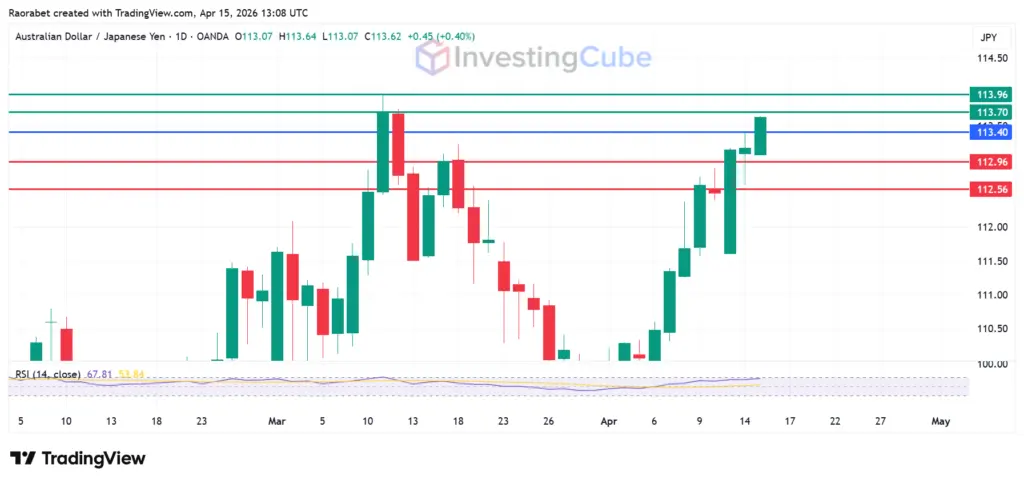
AUD/JPY daily chart with the key levels of support and resistance on April 15, 2026. Created on TradingView
The rally is happening because the market is in a “risk-on” mood after tensions between countries eased and commodity prices, especially gold and copper, went through the roof. This is good for the Australian economy, which relies heavily on commodities.
The BOJ’s hikes are perceived as too slow compared to global inflation. Additionally, as a safe-haven currency, the yen loses value when global tensions ease and investors move money into higher-yielding assets like the AUD.
It remains the dominant driver, yet consensus may overstate its permanence. Potential BoJ adjustments or external shocks could narrow the gap faster than markets anticipate.