



- The red-hot Non-farm Payrolls report shows a resilient US labor market, diminishing Fed rate easing expectations and strengthening the USD.
The US Non-Farm Payrolls report for May has just been released, and it indicates that the US labor market continues to show resilience despite the Fed’s interest rate expectations, which have begun to shift toward the hawkish end of the spectrum.
According to data released by the US Bureau of Labor Statistics, the Non-Farm Employment Change came in at 172,000 jobs, which beat the market expectation of an addition of just 85,000 jobs. This was not far below the upward revision of the prior number to 179,000. The Unemployment Rate stayed steady at 4.3% while the Average Hourly Earnings edged up from 0.2% before 0.3%, matching market expectations.
NFP Report Boosts the US Dollar in the Short Term
From a fundamental perspective, the NFP report is USD-positive in the near term. The US Dollar has strengthened in the immediate period after the data release. It is currently up against the Euro, British Pound, Gold, and Silver. The Dollar has also surged against the Japanese Yen. Still, USD/JPY saw an immediate pullback from the critical 160.00 psychological resistance, the level at which Japanese financial authorities intervened in May.
The response by US equities is expected to be mixed. On the one hand, the stronger-than-expected NFP print could support US indices, as it reinforces the recent wave of strong corporate earnings. However, it could also work against any Fed easing expectations and keep the Fed tilting hawkish in response to energy-price-driven inflationary pressures, reinforced by the growth in Average Hourly Earnings from 0.2% to 0.3%.
The US Labor Market Remains Resilient
The US labor market continues to buck economists’ expectations. Economists had expected tighter financial conditions to lead to a slowdown in hiring. However, the NFP report shows hiring remains strong despite higher borrowing costs. The NFP report is also in line with other employment data, such as the JOLTS Job Openings and ADP Employment Change reports, which beat market expectations and indicate a resilient labor market.
The upbeat employment data support US consumer spending and boost the economy. It also reinforces the recent wave of strong corporate earnings and staves off recessionary fears. However, it also poses a new dilemma for the Fed, as stronger labor market conditions are a recipe for inflationary pressures from increased consumer spending and rising wages. This keeps the “higher for longer” narrative around interest rates intact and will lead to a mixed response in US Indices.
The Hot NFP Print and Fed Rate Expectations
The NFP report strengthens the case for a “higher-for-longer” interest rate environment. Softer economic data would have been a sign of a weakening US economy, which would have made a case for the Fed to shift towards its dovish stance. However, the NFP data surprise may have put paid to those expectations.
A strong NFP such as the one witnessed today, 5 June 2026, is a sign that:
- The US labor market remains in a strong position.
- The US economy remains robust and resilient.
- Inflation risks remain, even as energy prices still hover around $100.
- Rate cut expectations presently have very little to stand on.

Market Impact on Specific Assets
a) Impact on the US Dollar
The US dollar has surged broadly against gold, the Euro, the Pound, and the Yen. The upbeat employment data show an improved outlook for the US economy relative to its peers, and also strengthen US bond yields as the “higher for longer” narrative plays out. Higher yields on US Treasuries attract demand for the US Dollar as investment flows pour into USD-denominated assets. Furthermore, the reduced Fed easing expectations are USD-positive.
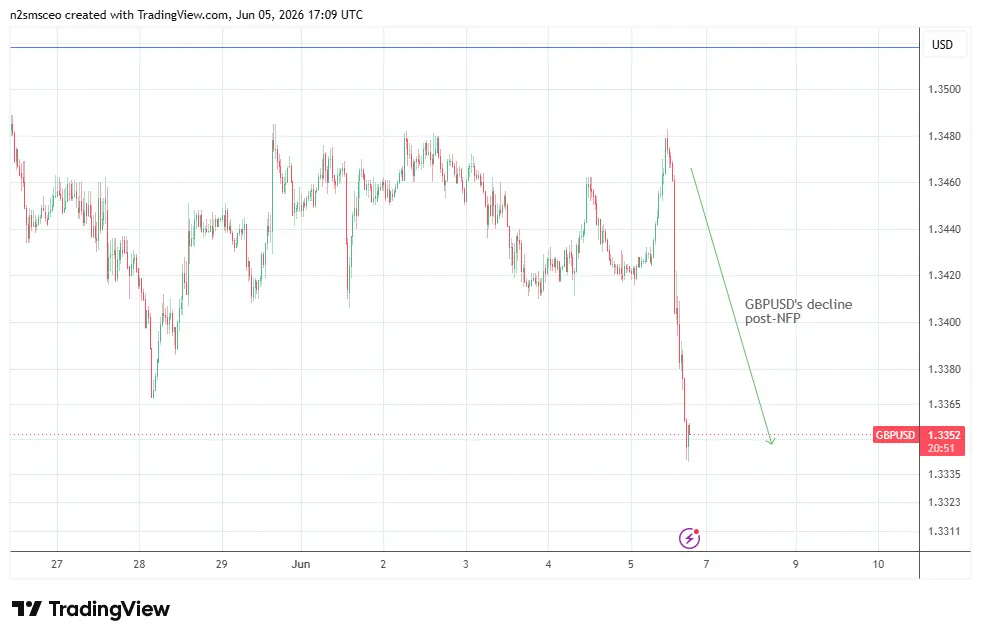
The US 10-year Treasury note’s yield is a benchmark indicator of broader market sentiment toward the US economy and US Dollar demand. It is expected to be the anchor for USD strength, which has been seen broadly post-NFP.
b) Impact on Gold
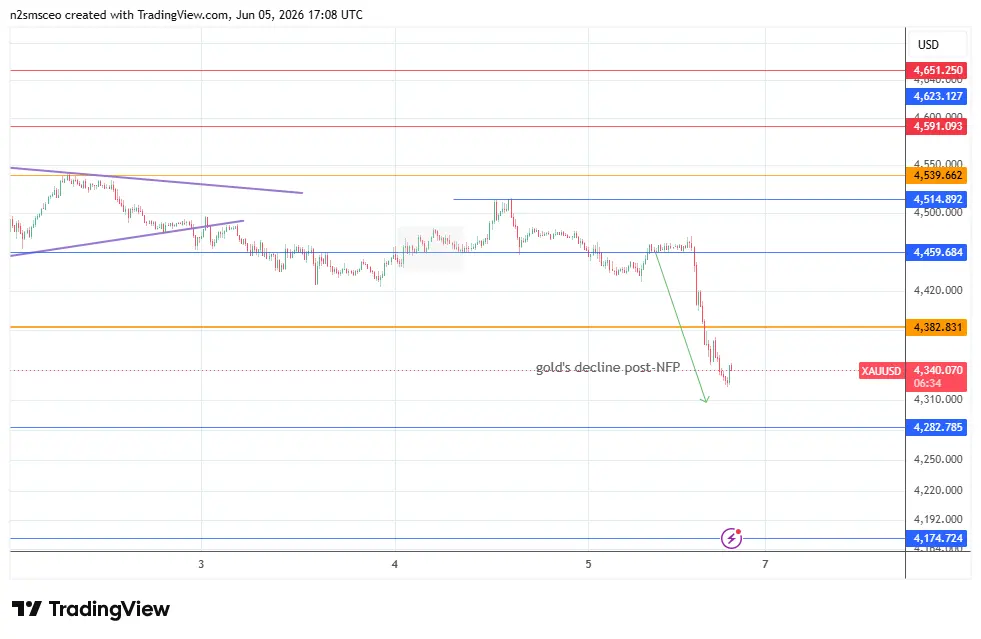
The strong NFP report has moved investment flows away from the non-yielding yellow asset and into the in-demand US Dollar. The XAU/USD pair declined steeply post-NFP, with price slowly inching towards the $4300 mark after trading as high as $4514 in Thursday’s session.
c) Impact on US Indices
The impact on US indices is not expected to be as straightforward as the USD pairs and the metal assets. This is because of the various nuances that the data print could produce.
The Dow, S&P 500, and the Nasdaq are all trading sharply lower. A stronger-than-expected NFP usually signals positive sentiment toward the US economy and strong corporate performance. If the market leans towards this perspective, the US indices should have been lifted by the data print.
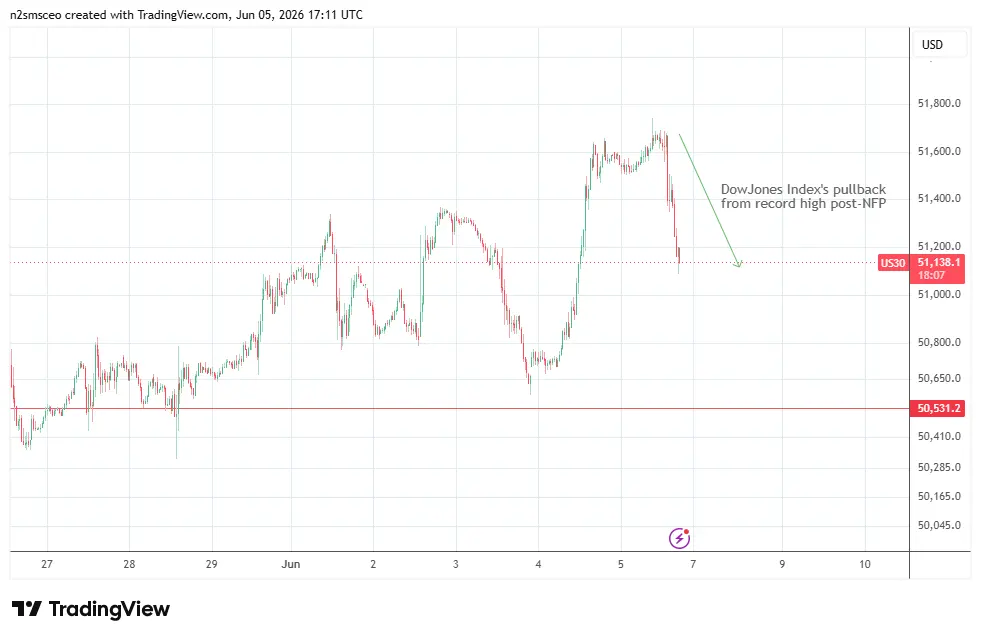
However, today’s report has a firm anchor with inflationary expectations, a sound labor market that does not need Fed support via loose financial conditions, and higher US bond yields. The markets leaned towards this perspective, which is largely negative for stock indices. Higher bond yields divert investment flows from equities to bond markets. Furthermore, expectations of tighter financial conditions are usually negative for equities, as higher borrowing costs can compress margins. These are the reasons behind today’s selloff in the US indices.
Takeaway
The labor market is still healthy, allowing the US to avoid the hard landing that many market watchers feared heading into the report, especially as the Fed no longer has a dovish leaning. The market action post-NFP sends a message: traders are now pricing in a more hawkish Fed and are positioning themselves for this eventuality.