


- Short-term trap: Last week's US-Iran escalation spiked oil and inflation, forcing the Kevin Warsh-led Fed to abandon rate cuts and look toward rate hikes, which strengthens the US dollar and crushes gold’s short-term upside.
- Long-Term Floor: While retail traders panic-sell because gold pays zero interest, global central banks continue to buy physical gold at a historic pace as a permanent shield against surging sovereign debt.
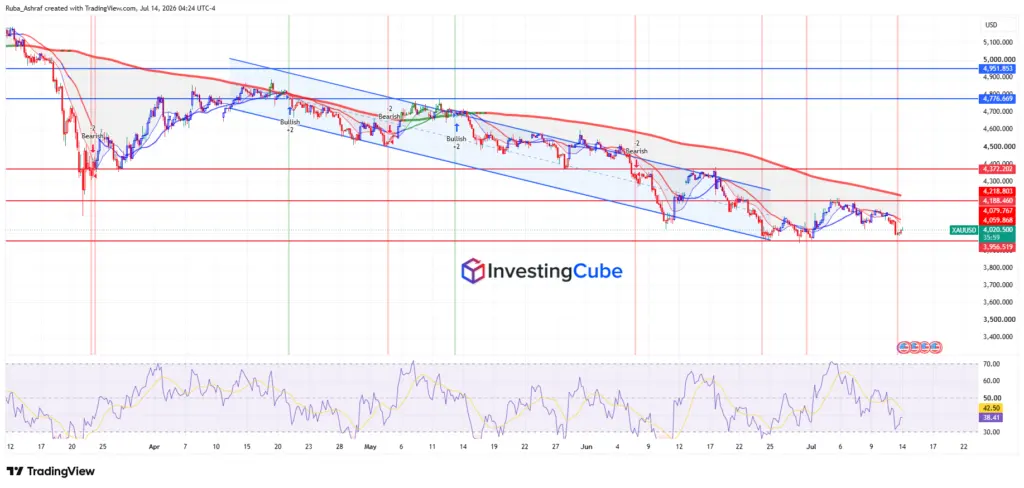
Gold price action continues to reflect a well-established bearish trend with consistent formation of lower highs and lower lows. After breaking below the descending channel, gold attempted several recovery rallies. But each was capped by key resistance levels, confirming that sellers remain in control.
The long-term 200-period moving average is still sloping downward well above the current price. This reinforces the broader bearish outlook and suggests that the primary trend has yet to reverse.
In the short term, gold recently rebounded from the $3,956 support zone and recovered toward the $4,100-$4,188 resistance area. However, the latest candles show that bullish momentum is fading. The moving averages also support the bearish bias. The short-term moving averages have started to roll over after a brief bullish crossover, and the current price has slipped back below them. Unless gold can reclaim and hold above the $4,100 and $4,188 resistance levels, the recent rebound is likely to remain a corrective move rather than the beginning of a sustained recovery.
A decisive break below the $3,956 level could expose the next downside target near $3,780, extending the broader downtrend. On the upside, the first resistance stands at $4,100, followed by $4,188. A sustained break above these levels would improve the short-term outlook, although stronger resistance remains near $4,228 and the descending 200-period moving average, where selling pressure may re-emerge.

The primary catalysts driving the gold market fall into two distinct categories:
- The near-term pressure headwinds:
- Hawkish Fed Repricing & “Higher-for-Longer” Rates: The dominant driver crushing gold’s short-term momentum is the shift in monetary policy expectations under the new Fed Chair, Kevin Warsh. Stubborn inflation, which reached 4.2% year over year in May, has forced the Fed to abandon its easing bias completely.
- Energy Inflation & Geopolitical Grag: While geopolitical tensions usually boost gold prices, the breakdown of the US-Iran peace deal has acted as a double-edged sword. Because the escalation directly choked energy supply lines, pushing crude oil prices up, sparking inflation fears. In return, this forces the Fed to keep the rate higher for a longer time. This supports the US dollar, which holds a strong negative correlation with gold.
- Long-Term Structural Bullish Supports:
- Relentless Central Bank Accumulation: Even as retail and speculative money dump gold, central banks are buying the dips at a historic pace. For example, the People’s Bank of China (PBOC) added 14.93 tonnes to its reserves in June, marking its 20th consecutive month of accumulation. A World Gold Council survey revealed that 89% of global central banks expect official gold reserves to increase, creating an institutional “buy wall” that prevents a full-scale market collapse.
- Rising Government Debt Supports Gold Demand: Government debt in major economies continues to reach record levels, with U.S. national debt now exceeding $39 trillion. This has encouraged long-term investors to increase their holdings of physical gold as a hedge against currency depreciation and fiscal uncertainty. Since these structural risks are unlikely to disappear quickly, gold continues to benefit from strong long-term demand.