




- Gold remains under short-term pressure as expectations for higher U.S. interest rates and easing geopolitical tensions reduce demand for safe-haven assets. However, continued central bank buying and growing concerns over rising global debt continue to provide strong long-term support.
The gold price experiences an incredibly volatile macroclimate. Spot gold pulled back from its historic highs seen earlier in the year. At the time of writing, gold dips -1.07%, or -44.51 points, as of Monday, 29 June 2026, at 16:24 GMT+3. Currently, XAUUSD is consolidating within a critical floor near the $4,100-$4,200 range.
The key catalysts driving gold’s current consolidation in the red include:
- The hawkish shift from the Federal Reserve that’s capping gold’s upside direction, strengthening the US dollar.
- Gold’s premium safe-haven bid has faced pressure following the de-escalation of geopolitical shocks.
- De-dollarization remains supporting gold’s long-term macro floor by institutional buying.
Before delving into more details of these catalysts, let’s see how the gold price is reacting to these ongoing developments:
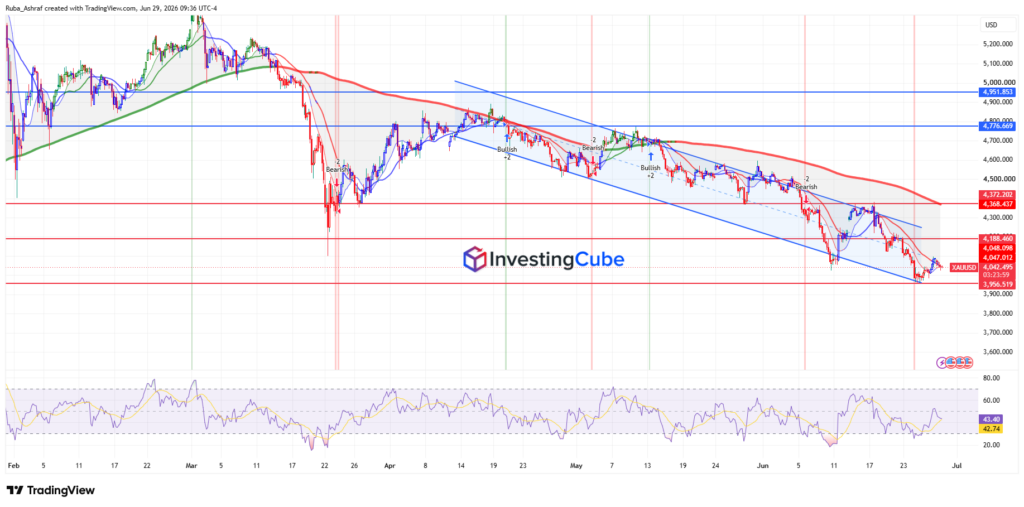
The 4-hour XAUUSD chart shows that the price action has a well-established bearish trend, while the price continues to trade within a descending channel. Moreover, the price remains trading below the long-term moving average, reinforcing the negative outlook.
Although gold recently rebounded from the lower boundary of the channel near the 3,956 support level, the recovery lacked strong bullish momentum and quickly encountered selling pressure. The shorter-term moving averages are also positioned below the long-term average, indicating that sellers still dominate the market despite the recent bounce.

The first key resistance zone is $4,048-4,188, followed by 4,363, which aligns with the major long-term moving average. It acts as a stronger barrier for any sustained upside move. On the downside, immediate support remains at 3,956, and a decisive break below this level could expose the market to another leg lower. Meanwhile, the RSI has recovered from oversold territory and is hovering around the neutral 40–45 region, suggesting that bearish momentum has eased but has not yet shifted into bullish territory.
Hawkish Fed vs. Central Bank Buying: The Forces Shaping Gold Volatility:
- Gold continues to face pressure as expectations for tighter U.S. monetary policy strengthen. Sticky inflation, particularly in the core PCE data, has reinforced market expectations that the Federal Reserve could keep interest rates elevated for longer. The CME FedWatch Tool is now reflecting nearly a 50% probability of another rate hike from the current 3.75% benchmark.
At the same time, major institutions such as Goldman Sachs have abandoned their near-term rate-cut forecasts, reinforcing the higher-for-longer narrative.- As a result, the US Dollar Index (DXY) has climbed to fresh yearly highs, increasing the opportunity cost of holding non-yielding assets like gold and limiting the metal’s upside potential.
- Gold’s traditional safe-haven appeal has weakened as geopolitical risks in the Middle East continue to ease. The establishment of a formal peace framework between the United States and Iran has significantly reduced fears of a broader regional conflict. This is prompting crude oil prices to retreat toward pre-conflict levels.
- As risk sentiment improves across global markets, investors have shifted capital away from defensive assets and back into higher-risk investments. In return, this reduces demand for gold as a safe-haven hedge.
- Despite recent price weakness, gold’s long-term outlook continues to be supported by strong central bank demand. Many central banks are steadily increasing their gold reserves as part of their strategy to reduce reliance on major reserve currencies and strengthen portfolio diversification. China remains one of the largest buyers, with continued purchases helping to keep global demand well above historical averages.
- This sustained institutional buying provides a solid foundation for gold prices and helps limit deeper declines over the longer term.
- Despite short-term pressure from interest rate expectations, gold continues to benefit from strong long-term structural demand. Rising global debt levels, particularly government borrowing, have increased concerns about fiscal sustainability and the long-term value of major currencies. As a result, many institutional investors are allocating more capital to gold as a reliable store of value that is not tied to any government or financial institution.
- This growing demand for portfolio protection continues to support gold’s long-term outlook, even during periods of short-term price weakness.