




- Gold remains caught between two competing forces: easing geopolitical tensions that reduce safe-haven demand and growing expectations of lower interest rates that support prices.
- The WGC survey shows that central banks remain highly bullish on gold, with a record share planning to increase their reserves as they seek protection against geopolitical uncertainty, inflation risks, and long-term reserve diversification.
In my analysis of XAU/USD four days ago, the price was trading around the yellow-highlighted circle. At that point, we expected that any signs of easing tensions between the United States and Iran could support gold prices, as investors would become less concerned about inflationary risks that could keep interest rates elevated.
However, we also noted that improving geopolitical conditions would likely encourage a risk-on mood across financial markets, limiting the upside potential for gold. That is largely what we are seeing now.
XAU/USD successfully broke above the key resistance level at 4,286, which has since turned into support. However, the rally has so far been capped by resistance at 4,363, as traders await further details regarding the proposed peace deal and its broader implications for global markets.
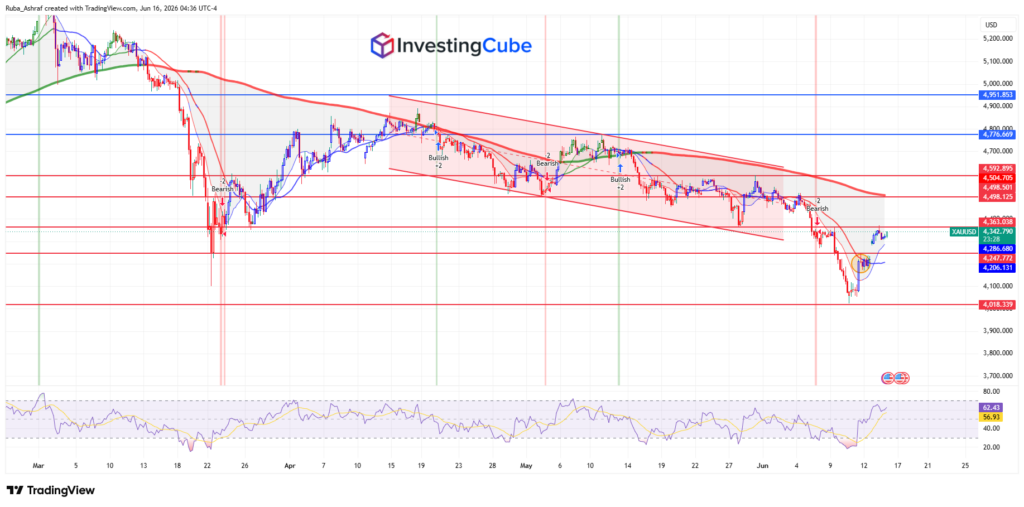
Despite the recovery uptick, the broader trend remains bearish. The chart shows that gold is still trading below the lower boundary of the descending channel. The price is trading below the longer-term downward-sloping moving averages. This suggests that the recent advance is currently a corrective rebound rather than a confirmed trend reversal.
The RSI is hovering around 62, indicating strengthening bullish momentum. The indicator has moved decisively above its signal line but away from its oversold territory. This confirms that buyers have regained control in the near term. On the other hand, RSI is approaching overbought territory. This suggests that the pace of gains may begin to slow unless a fresh catalyst emerges.

Potential Scenarios for the XAU/USD:
- Bullish scenario: If buyers regain control and manage to break above 4,363 decisively, this would pave the way toward the next upside targets, which could emerge at 4,498, 4,505, and 4,593, respectively. Breaking above 4,363 would signal that the market is becoming comfortable with the idea that lower interest rates may arrive sooner.
- Bearish scenario: On the downside, failure to break above 4,363 could trigger profit-taking and a renewed pullback.
- The first support remains at 4,286. A break below this level would expose the following:
- 4,248
- 4,206
If sellers regain control beneath these support levels, attention could shift back toward the major low around 4,018, which remains the key bearish target on the chart. For now, gold is between two competing forces. On one hand, easing geopolitical tensions are reducing safe-haven demand and encouraging investors to move toward riskier assets. On the other hand, expectations that lower oil prices and reduced geopolitical risks could ease inflationary pressures are supporting hopes for a less hawkish Federal Reserve. As a result, traders are focusing on the 4,286-4,363 range, with a breakout from either side likely to determine the next directional move.
Key Findings on Gold Reserves by the World Gold Council Survey:
- According to the WGC, 45% of central banks surveyed expect to increase their own gold holdings over the next 12 months, up from 43% last year.
- 89% of respondents believe that global central bank gold reserves will continue to rise over the coming year.
- Central banks cited three main reasons for holding gold:
- Performance during periods of crisis.
- Long-term store of value.
- Portfolio diversification.
- A record 90% of respondents said gold’s performance during crises is a key reason for owning it, while many emerging-market central banks emphasized its role as a hedge against geopolitical risks.