


- The market is currently debating whether the Fed may need to keep rates elevated for longer or even consider another hike. Therefore, Thursday's PCE report is the single most important release for gold this week.
- A softer inflation reading could trigger a rebound toward resistance levels, while a hotter reading would likely strengthen the dollar and increase downside pressure on gold.
Gold prices rebounded as crude oil declined, driven by easing geopolitical tensions. Progress in US–Iran talks has reduced fears of potential oil supply disruptions. Meanwhile, the Federal Reserve’s hawkish stance continues to keep investors cautious. As a result, capital is rotating out of oil and other risk assets into gold, supporting its upward movement.
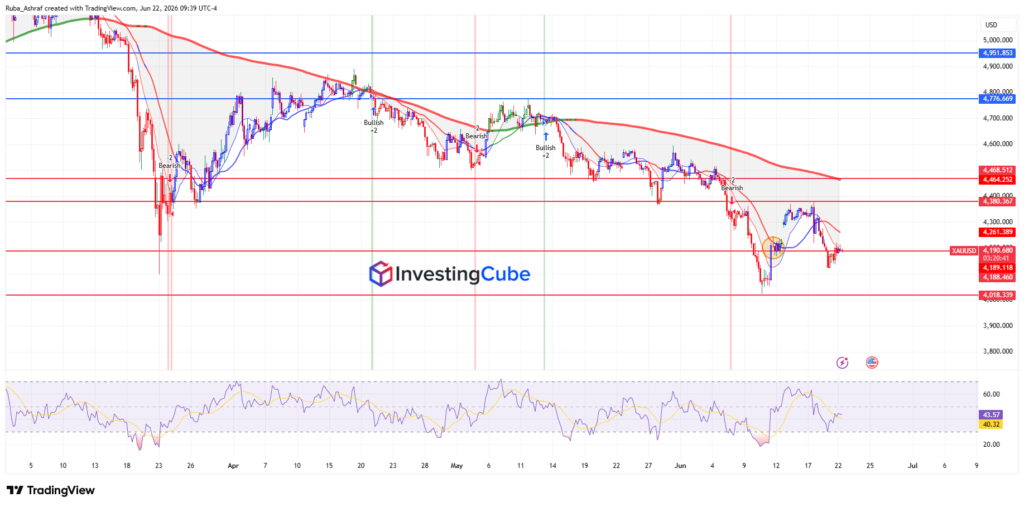
Gold’s price action shows that the broader trend remains bearish despite the recent rebound from June lows. The price is consistently trading below the long-term moving averages, continuing to slope downward, and confirms that sellers still control the larger trend.
Since the price accelerated lower and traded below the key support zone around 4,380-4,470, this area has turned into resistance. The highlighted yellow circles show the latest recovery attempt. Then, the price failed to establish sustained bullish momentum and has already started pulling back toward the 4,190-4,200 support region. That’s exactly what we had anticipated in last week’s gold technical outlook.
The moving averages provide additional confirmation of the bearish structure. The shorter-term averages remain below the longer-term trend indicator. Additionally, every rally towards these averages has attracted fresh selling pressure. Unless gold can reclaim and hold above 4,266 and then 4,380. In this case, buyers are likely to remain defensive while sellers continue to view rebounds as opportunities to re-enter the market. The RSI is currently hovering around the mid-40s, suggesting that bullish momentum remains weak.
The immediate support lies around 4,188, followed by the major support at 4,018. A break below 4,188 would likely expose the June low and increase the probability of another leg lower toward the 4,000 area.
On the upside, resistance is seen at 4,195, then 4,244, with a stronger barrier around 4,380-4,466. Only a decisive break above these resistance levels would suggest that the current rebound is evolving into a broader recovery.
Upcoming Data to Watch for Gold Price Anticipation:
For gold traders, this week’s economic calendar becomes increasingly important starting Tuesday, with Thursday as the key volatility day.

- Tuesday, June 23: US Flash Manufacturing PMI & Services PMI
- Stronger-than-expected PMIs would reinforce the narrative of a resilient US economy and could support the US dollar, weighing on gold.
- Weaker readings would support expectations of future Fed easing and could benefit gold.
- Wednesday, June 24: US New Home Sales
- Usually a second-tier event, but a major surprise could affect Treasury yields and the dollar.
- Gold’s reaction is typically limited unless the data significantly deviates from expectations.
- Thursday, June 25 (High-Impact Day):
- Core PCE Price Index (Fed’s Preferred Inflation Gauge)
- Headline PCE Inflation
- US GDP Final Estimate (Q1)
- Durable Goods Orders
- Weekly Jobless Claims
- Personal Income & Spending
The Core PCE Price Index is the most important report because it is the Federal Reserve’s preferred inflation measure. A lower-than-expected reading could boost gold by increasing expectations for future rate cuts, while a higher reading may pressure gold by supporting a higher-for-longer interest rate outlook.
Strong economic data, such as robust GDP growth, healthy consumer spending, and a resilient labor market, can reduce the likelihood of Federal Reserve rate cuts. This tends to strengthen the US dollar and Treasury yields, making non-yielding assets like gold less attractive to investors.