


Archived Article This article was published more than 5 months ago. The market data, prices, forecasts, and analysis were accurate at the time of publication but may have changed since then. Please use this article for historical reference only and refer to our latest content for current market information.
- The FTSE 100 climbed to 10,633 on Tuesday as easing oil prices and renewed US-Iran peace talk hopes lifted sentiment, but the index has since pulled back to hover near 10,587.
- BP signalled an "exceptional" Q1 for its trading division, while stronger-than-expected UK retail sales added support, though traders remain wary of headline risk from the Middle East.
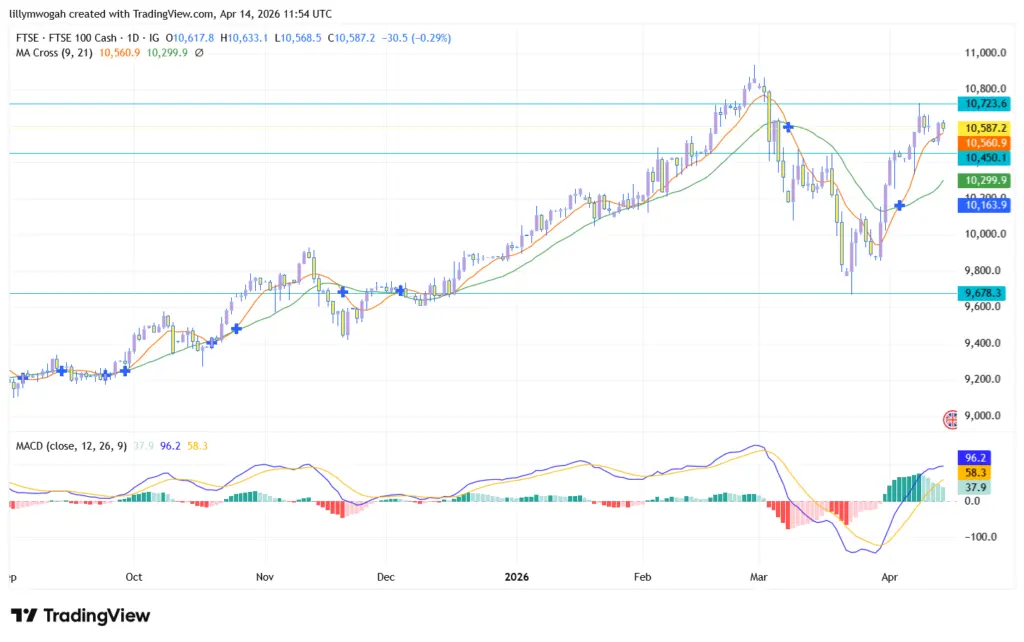
- The chart shows the FTSE recovering above its moving averages, but momentum is cooling as price approaches a key decision zone near 10,723
The FTSE 100 tried to rally on Tuesday. It didn’t quite stick.
After touching an intraday high of 10,633 on the back of softer oil prices and renewed hopes for US-Iran diplomacy, London’s benchmark index has drifted back toward 10,587. Brent crude pulled below $100 a barrel, offering relief to an inflation-sensitive market, but traders aren’t ready to commit heavily to the upside. Not yet.
Here’s what happened, what the chart says, and where the FTSE 100 is heading next.
Why is the FTSE 100 moving higher today?
The market is pricing in a “less bad” scenario on energy. Over the weekend, headlines suggested diplomatic channels between Washington and Tehran remained open despite the ongoing blockade of the Strait of Hormuz. President Trump noted that 34 vessels transited the strait yesterday, the highest level since the conflict began. That gave the market permission to breathe.
- Oil prices eased to around $98 per barrel, down from recent spikes above $100. That’s a direct tailwind for the FTSE 100, which is packed with consumer-facing and industrial names that suffer when energy costs climb. Airlines, retailers, and banks are all benefiting from the reprieve.
- BP added a company-specific boost. The energy major signalled that its trading division is set for an exceptional first quarter, capitalising on the very volatility that has rattled broader markets. However, BP also warned that net debt would rise to $25–27 billion as more cash gets tied up in day-to-day operations. Shares dipped slightly as oil prices eased, but the broader message is clear: volatility is a double-edged sword.
- UK retail sales provided the fundamental anchor. March food sales jumped 6.8%, well above February’s 2.9% growth, helped by an early Easter. Shoppers showed more resilience than expected, and supermarket shares moved into positive territory. The question is whether that holds if fuel prices stay elevated.
FTSE 100 technical breakdown
The chart setup shows the FTSE 100 recovering from the April correction near 9,678, with buyers pushing price back above the 9-day and 21-day moving averages. However, momentum indicators are showing early signs of fatigue as the index approaches a key supply zone.
Key technical levels for FTSE 100 today:

- Immediate resistance sits at 10,633, the intraday high from Tuesday’s session. Price must reclaim this level to challenge the more significant ceiling at 10,723, which represents the recent breakout high and the first real test of bullish commitment.
- Critical support rests at 10,560, which aligns with the 9-day moving average. A sustained daily close below this level would signal that the recovery is losing steam, opening the door for a pullback toward 10,450 and the 21-day moving average at 10,300.
- Market outlook: The index is oscillating near 10,587 as traders recalibrate for a prolonged period of geopolitical uncertainty and supply chain risk. As long as the FTSE holds above 10,560, dips may continue to attract buyers. A break above 10,723 would likely accelerate gains toward the record high at 10,935.
Will FTSE 100 go up or down this week?
That depends entirely on headlines coming out of the Gulf.
Bullish scenario (needs momentum): If the FTSE 100 can close above 10,633 and hold above 10,560, buyers will target 10,723. A clean break of that level opens the door to the record high at 10,935. This scenario requires sustained calm in oil markets and no fresh escalation from the Strait of Hormuz. BP’s trading update suggests energy volatility is here to stay, but as long as oil stays below $100, the FTSE can grind higher.
Bearish scenario (more likely if talks stall): The blockade of the Strait of Hormuz remains in place. Iran and the US are still far apart on nuclear restrictions, with Washington pushing for a 20-year halt and Tehran offering only five. If headlines turn negative, expect oil to rip back above $100 and the FTSE to test 10,560. A daily close below that level would target 10,450, then 10,300.
FTSE 100 speculative range for the week: 10,300 – 10,723.
What traders must watch for FTSE 100 this week
- Headlines from the Gulf: This is the only driver that matters right now. Any news on ceasefire talks, blockade status, or Iranian retaliation will move the index more than any economic data point.
- Thursday’s BoE commentary: Governor Andrew Bailey is due to speak. Markets have priced in up to two rate hikes for 2026, but Bailey has cautioned that expectations may be too aggressive. A less hawkish BoE would support the FTSE by reducing pressure on consumer-facing stocks.
- Oil inventory data: Any surprise build or drawdown in US crude stocks will amplify or reverse today’s easing trend. Watch Wednesday’s EIA report closely.
FTSE 100 risk management for the next 48 hours
In a headline-driven market, chasing breakouts is a losing game. Ensure you have 4-hour candle confirmation before entering positions and maintain tighter-than-usual stop-losses. The FTSE 100 remains highly sensitive to Middle East developments, and a single news alert can reverse the entire session’s move. Adjust your risk tolerance accordingly.
The index opened higher because oil prices eased below $100 a barrel following reports of renewed diplomatic engagement between the US and Iran. President Trump noted that 34 vessels transited the Strait of Hormuz yesterday, the highest level since the conflict began, suggesting the blockade may be less restrictive than feared.
BP also signalled an exceptional Q1 for its trading division, adding company-specific support. The FTSE had closed Monday near 10,587 and touched an intraday high of 10,633 on Tuesday before pulling back.
The primary risk is the escalating conflict in the Strait of Hormuz, which remains the dominant driver of market volatility. While oil has eased below $100, the blockade is still in place, and US-Iran talks remain stalled on key issues like the duration of nuclear restrictions.
Traders should also watch Thursday’s comments from BoE Governor Andrew Bailey, as any hawkish surprise on rates would pressure consumer-facing FTSE names. But make no mistake: headlines from the Gulf will move this index more than any central banker this week.