




- The EasyJet share price is now facing a major resistance after the recent price surge on takeover news and valuation re-rating.
Current Setup and Live Chart
The EasyJet share price is currently a function of the market response to the oil shock risk premium, counteracted by the stock’s demand resilience. As with most travel stocks, EasyJet’s share price has faced challenges as the company battles rising aviation fuel costs, even as it aims to maintain its budget airline status.
With lower ticket margins than its peers, which charge much more for tickets, the airline is heavily exposed to the current jet fuel cost and availability crisis. However, with the lead-up to the holiday travel season already underway, the company is in a strong market position to benefit from its presence across major European airports and the expected boost in business this holiday season.
Macro Drivers for the EasyJet Share Price
The current market attention remains focused on the oil shock risk premium driven by Middle East geopolitical tensions, summer booking trends, which are currently weaker-than-expected, takeover speculation, and the company’s holiday package as a potential profit driver.
The current macro drivers of the EasyJet share price are as follows:
1) Fuel costs
Rising aviation fuel costs due to the geopolitical situation in the Middle East remain the biggest macro driver at the moment. The company’s recent earnings report showed a £552 million loss in H1 2025, with cautious forward guidance due to slower bookings and elevated fuel costs.
Although the company has a substantial fuel cost hedging allowance, the hedges cannot fully offset the impact of a prolonged increase in fuel costs. EasyJet recently reported that its fuel hedges covered 70% of summer fuel requirements, which has helped to cushion the impact of elevated energy costs.
2) EasyJet Holidays: a major strength
The rapid growth of EasyJet Holidays, the company’s holiday travel package, has been a major success story that could increase margins sufficiently to offset the impact of rising fuel costs. EasyJet Holidays hit its previous profit targets well ahead of schedule, prompting the company to set more ambitious profit targets for the enterprise. EasyJet Holidays continues to set the standard by providing a diversification channel that amplifies the company’s earnings beyond its traditional airline operations.
3) Takeover Speculation

A valuation debate has ensued following recent reports of a potential acquisition of the company by investment firm Castlelake. The company currently boasts of a modern Airbus fleet, choice positioning at airports in London, Geneva, and Paris, and valuable flight slots at these airports. This has put the company in a position where the market is starting to believe it is undervalued relative to its key assets.
Near-term Price Catalysts
1) Jet fuel prices remain the biggest variable. Europe is a net fuel importer, and European airlines are heavily exposed to the crisis in the Middle East. The sharp spike in aviation fuel prices has radically increased the operating costs of EasyJet and other European airlines. The EasyJet share price would benefit from a decline in these prices in the near term.
2) Summer bookings: Booking momentum against the upcoming summer holiday season is going to be closely watched by investors. The airline’s management has indicated that travelers are now tending to book closer to departure dates, which clouds the revenue visibility from the holiday travel season. Watch out for last-minute booking demand, as this could be the deciding factor between an improved earnings expectation and a poor one.
3) Industry response to the fuel crisis: Airline executives from around the world are due to meet this week to discuss the impact of the oil shock on the pricing and profitability of their business. The market will look to the wording of any statements released at the end of this meeting to see how airlines intend to offset the sudden increase in the aviation business’s cost profile due to the energy shock.
EasyJet Share Price: Forecast Scenarios
Base case: EasyJet’s share price will remain range-bound, with a neutral to mildly bearish bias, especially after the sharp spike following news of a possible takeover by Castlelake. Also, the potential for strong last-minute travel demand is currently counteracting the impact of the energy shock. Any further upsides will be capped until fuel cost pressures ease, most likely after the US-Iran war ends and the Strait of Hormuz reopens.
Bull case: a stronger summer booking profile and a significant lowering of jet fuel prices will be the triggers for the bull case scenario. When the impact of these triggers has worn off, investors will be able to focus on other core fundamentals, such as the strength of EasyJet Holidays’ division and the attractive positioning the company has in Europe’s core airports, which ultimately brings a valuation boost. Speculation about a takeover is also a supportive factor.
Bear case: additional spikes in jet fuel prices and weak holiday travel demand could spark a sharper selloff. Airline margins are already under pressure from the sharp rise in fuel prices. If holiday bookings prove weak, this will trigger near-term corrective selling.
Takeaway
Fundamentally, EasyJet is still a travel stock with a good valuation potential. However, rising fuel costs are a significant headwind that the stock must overcome to achieve medium-term realization. The stock has good medium- and long-term potential, but the outcome of the US-Iran war and the holiday-season booking momentum will determine the near-term outlook.
EasyJet Share Price: Technical Outlook
The sharp spike in price following the breakout of the 404.5 neckline resistance has allowed for completion of the double bottom’s measured move at 472.0. Any further advance has to follow the uncapping of this barrier, which unlocks new targets to the north at 522.2 (19 August 2025 and 7 January 2026 highs) and 590.6, the 11 June 2025 high.
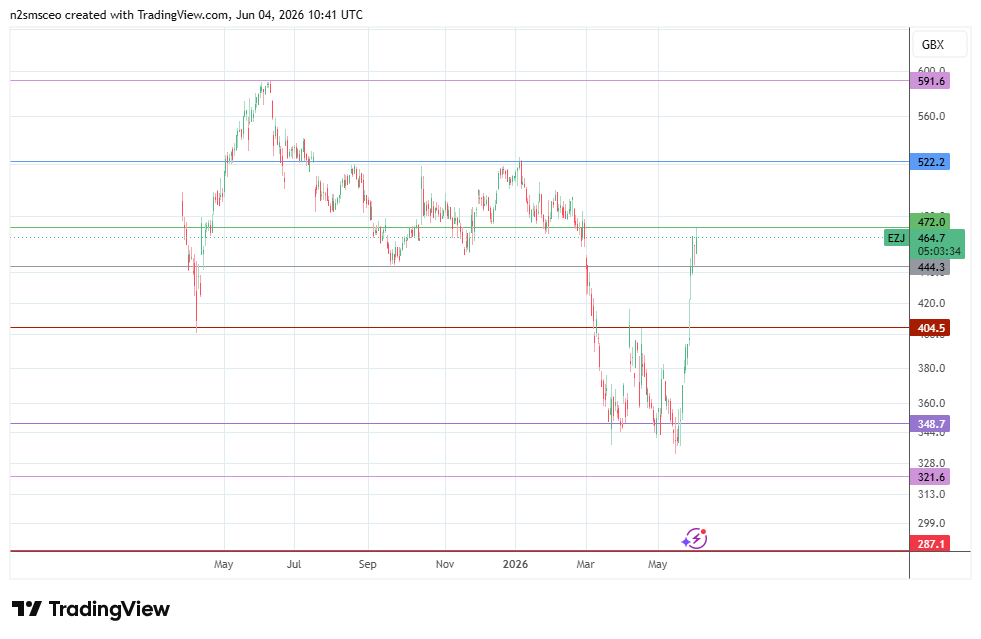
On the other hand, rejection at 472.0, followed by a pullback, will retest lower targets at 444.3 (initially), the 22 September 2025 low, and subsequently the neckline at 404.5, which now acts as support.