



- easyJet share price started April on a high, riding on ceasefire hopes, but Strait of Hormuz closure and profit warning have brought pressure
- The company has hedged about 70% of its fuel requirements for summer travel but the 30% exposure could result in £40 million in additional operational costs in the second-half of the year
- easyJet's operating model, characterized by its low-cost structure means it could rebound faster than competitors with a higher pricing structure once oil prices stabilise
Budget carrier easyJet started April with a spectacular tailwind, gaining nearly 10% in a single “gap-up” session on April 8. However, by mid-April 2026, the sentiment has clearly evolved. The stock has now given back a substantial portion of those earlier advances, including a significant 5% decline in the most recent trading period, placing its value close to the 370p level. So what has changed and what does this mean for the stock?
Why the easyJet Share Price Is Falling Again
On April 16, easyJet told shareholders they’re likely facing a pre-tax loss between £540 million and £560 million for the half-year through March 31, as reported by CNBC. The Middle East conflict alone added £25 million in extra fuel costs in March, and an additional £30 million in net additional legal provisions compounded the picture.Signs now point toward softer customer interest. For the third quarter, bookings sit at 63%, which trails last year’s figure by two percentage points, while prices per seat have dipped slightly.
While easyJet has secured 70% of its summer fuel requirements through hedging at $706 per metric tonne, establishing a considerable protective measure, the remaining 30% remains subject to the fluctuations of volatile spot prices. A change of $100 per tonne in oil price, could lead to approximately £40 million in additional second-half costs, as detailed in the company’s official disclosures.
A sustained peace deal would be a tailwind, but it would not address structural cost growth in airports, resilience measures, or the digital investments that are also weighing on Cost per Available Seat Kilometer (CASK). Investors treating any ceasefire extension as a straightforward buy signal may be overlooking those layers.
The Case for A Recovery
Despite the recent selling pressure, the company’s longer-term foundational elements appear robust. CEO Kenton Jarvis highlighted a net cash position of £434 million and total group liquidity of £4.7 billion, asserting these figures demonstrate the airline’s financial capacity to manage the prevailing economic climate, a point reiterated by CNBC. Furthermore, the company has upheld its medium-term objectives, and its holiday segment contributes a margin safeguard that a standalone airline model might find difficult to replicate.
It also appears that the market has largely absorbed the impact of the fuel cost volatility. easyJet’s operating model, characterized by its low-cost structure, coupled with a robust balance sheet and an expansive European network, places it in a strong position. It will likely be able to capitalize on latent travel demand more efficiently than competitors with higher operating costs, once fuel price instability diminishes.

Consequently, the prospect of a more significant downturn seems less likely than a gradual, controlled recovery, especially should the situation in the Middle East stabilize or if broader economic indicators support increased consumer expenditure.
easyJet Share Price Forecast
easyJet share price RSI is sitting at 45.56, indicating downward-facing momentum. Also, the price is currently trading below its 50-day and 200-day moving averages, suggesting that the long-term trend remains bearish.
Immediate support lies at 358p. If this fails, the stock could slide to 345p. The first key resistance mark for the share price at 385p, followed by psychological hurdle at 400p. To regain its upward trajectory, the stock would need to achieve a daily closing price above this resistance level.
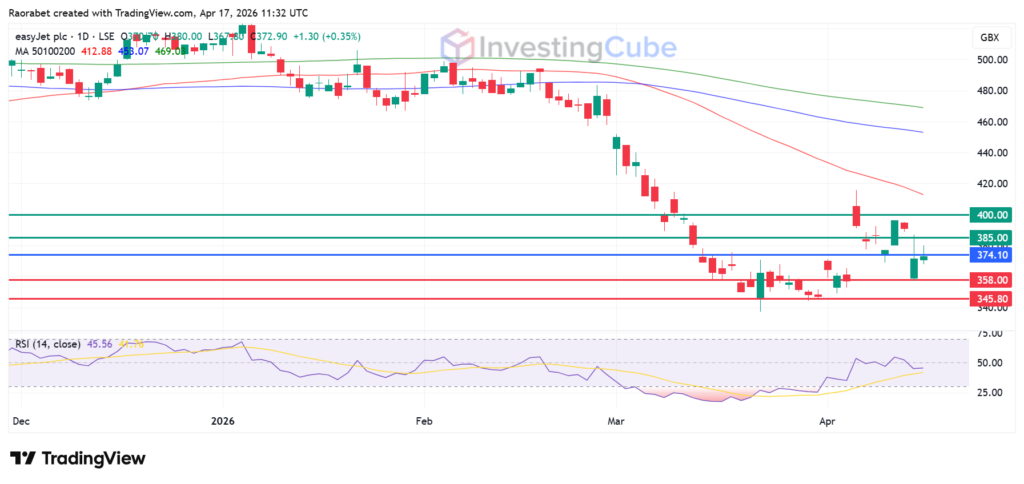
easyJet share price action on the daily chart showing the key levels of support and resistance on April 17, 2026. Created on TradingView
A trading update revealed an expected H1 pre-tax loss of £540–£560 million, with £25 million in extra fuel costs from the Middle East conflict and £30 million in additional legal provisions, while Q3 forward bookings fell two percentage points year-on-year.
Yes. easyJet is 70% hedged for the summer at $706 per tonne. However, the unhedged portion of its fuel needs remains susceptible to prevailing spot prices, which are currently around $1,500. This exposure means that each $100 fluctuation in oil prices could represent an approximately £40 million risk to second-half costs.
A recovery depends on a normalisation of booking cycles. If geopolitical tensions ease and the easyJet Holidays division continues its growth, the stock could see a rebound.