




- The Indian government's announcement of a ₹1.5 trillion investment in railway and wind energy projects has boosted investor confidence in Suzlon's order pipeline
- Increased demand for energy in warmer weather has translated to higher demand for renewables, especially at a time when oil prices have spiked
- Execution risk remains a potential hindrance to Suzlon share price gains, despite a massive 6.4 GW order book
Suzlon Energy share price hit a 52-week low of ₹43.85 on February 23, after a long, painful downtrend that started in late 2025. However, April has brought a dramatic change in climate. The stock has gone up more than 30% this month and is now trading close to ₹50. This is because investors are starting to factor in a perfect storm of good market conditions.
What Is Fueling the April Upsurge?
This recent rebound seems to stem from a blend of improving market confidence and specific positive developments within the sector. First was the announcement by the Indian government of a massive ₹1.5 trillion investment in rail and wind energy projects.
Secondly, a reduction in geopolitical tensions across the Middle East has contributed to a moderation in oil prices. This, in turn, has alleviated some of the broader economic pressures on India, generally fostering a wider market recovery.
Simultaneously, there’s been an increase in domestic power consumption, particularly driven by warmer temperatures and higher demand during evening peaks. In these periods, wind energy effectively complements solar generation, and that inadvertently benefits Suzlon. According to reports from the Economic Times, the company has indeed seen renewed interest in renewable solutions as a result of these evolving market conditions.
Because wind speeds typically pick up in the late afternoon and evening, Suzlon’s turbines are increasingly seen as the essential missing piece of the energy puzzle. Not weighed down by debt like before, the company now stands firm with 6.4 GW of projects waiting to be built. Add that to a net cash position of ₹1,556 crore, and what used to be a company fighting collapse has become one capable of filling real gaps across India’s grid.

Order Execution Remains A Key Risk
Although the company’s order book is indeed substantial, there is an observable and increasing disparity between the delivery of components and their actual installation. Should Suzlon (NSE: SUZLON) face ongoing difficulties in resolving last mile issues, such as securing land and establishing grid connections, these significant deliveries might not convert into recognized revenue at the pace the market anticipates.
Suzlon Share Price Forecast
Suzlon share price RSI at 77.70, suggests strong bullish momentum but carrying overbought risks. The stock faces primary resistance at 200-day MA at ₹53.69. A breakthrough here on high volume would open the path toward ₹55.70. Immediate support is found at the 50-day MA at ₹47.70. A deeper safety net sits at the ₹45.00 mark.
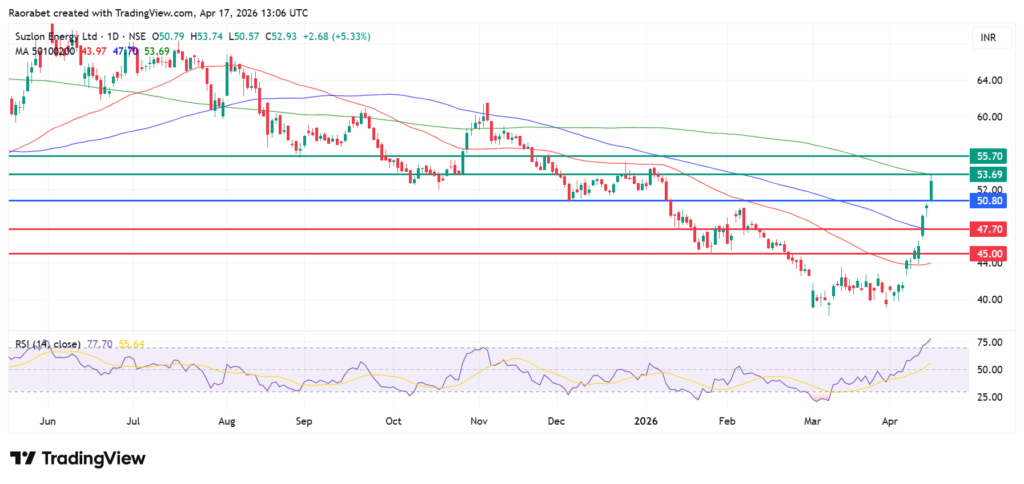
Suzlon Energy stock daily chart on April 17, 2026 with the key levels of near-term support and resistance. Created on TradingView
The rally is driven by a massive ₹1.5 trillion government investment plan for rail/wind. Additionally, a domestic power deficit has underscored the critical role of wind energy during evening hours, when solar power generation is not available.
Because orders and delivered megawatts are different things. The market has watched Suzlon’s book grow before without ground-level progress. Until commissioning timelines improve and debtor collections accelerate, the order book reflects potential, not earnings.
This rebound holds some selective appeal, considering the company’s net cash position and India’s broader renewable energy objectives, which somewhat counter the general market wariness regarding execution challenges. However, near-term volatility around resistance levels warrants caution. Strong delivery in coming quarters would strengthen the case.