




- USD/INR remains supported as high oil prices increase dollar demand from Indian importers.
- The rupee is under pressure from rising crude costs, FPI outflows, and weaker currency inflows.
- Reuters reported that the rupee may stay under pressure after its steepest weekly fall in around three and a half years.
- The RBI may step in to smooth volatility, limiting a one-way rise in USD/INR.
- A break above 94.60 could bring 95.00 into focus, while 94.00 remains the key downside support.
Rupee Outlook Under Pressure: Oil Shocker, Strong Dollar Impacting Sentiment
Currently, the USD/INR currency pair is experiencing positive momentum, with expectations that it will open at the level of 94.26 to 94.30 on Monday, after closing at 94.25 the previous week (Source: Reuters). The Indian rupee depreciated by 1.42% over the week, marking the highest weekly depreciation rate since around three and a half years back (Source: Reuters).
Some of the recent reasons behind the depreciation in the rupee include:
- High oil prices
- Increased demand for the US dollar
- Low foreign inflow into the Indian market
- Hedging by importers
This means that the rise in USD/INR cannot be said to be solely driven by positive momentum in the US dollar. This is due to the fact that India is a major consumer of crude oil. Hence, when oil prices increase significantly, importers and refiners need more dollars to cover their energy bills.
Increasing Price of Oil as a Factor
The first thing that makes the rupee depreciate these days is connected with the increasing price of oil. For instance, because of political uncertainties and low oil production levels near the Strait of Hormuz, the price of Brent crude reached almost $108 per barrel (Source: Reuters).
Regarding the effect of growing prices on oil, we should admit that this aspect is rather important for India, because growing prices on oil will bring about:
- The growth of current account deficit
- Rising expectations of inflation
- Depreciation of Indian currency
(Source: Reuters). Besides, according to the Economic Times, the rupee will experience severe pressure during the week ahead owing to:
- Higher demands for dollars
- Higher expenses for importing oil
- Capital outflows from portfolio investors
(Source: Economic Times). In other words, if the price of oil grows, India needs to spend more dollars on purchasing this type of fuel. As a result, there will be a growing demand for the dollar, which will eventually affect the exchange rate USD/INR.
Strong Dollar and Capital Flow Pressure
There are also additional pressures created on the rupee from the strong US dollar. When risks become high, the safe haven status of the dollar makes it attractive for investors. It helps strengthen the dollar aspect of USD/INR and limits the ability of the rupee to rebound.
Another pressure coming from foreign portfolio investment flows must be mentioned. According to the Economic Times, FPI outflow is one of the main reasons to expect pressure on the rupee soon (Source: Economic Times). Lower investments from overseas investors mean fewer dollars flowing to India and increased pressure on the local currency.
It means USD/INR has two bases of support:
- The dollar side will be supported by risk aversion.
- The rupee side will be supported by oil-related flows and weak investment inflow.

In other words, the upward trend can persist if the above reasons persist.
RBI Intervention Risk May Limit the Upside
While the immediate outlook on USD/INR continues to favor an upside move, traders have to be careful in buying the pair at high levels. According to a Reuters report, the Reserve Bank of India (RBI) had urged its state-run oil refineries to limit their spot purchase of dollars and opt for a dedicated loan for Forex (Source: Reuters). This strategy aims to minimize the direct dollar demand from the refineries and reduce the selling pressure on the rupee (Source: Reuters).
Moreover, this clearly indicates the willingness of the RBI to intervene in case of volatile movement in the rupee. It’s worth noting that while the RBI might not be defending one specific level, they are certainly working towards preventing an uncontrolled depreciation in the value of the rupee.
Technical Analysis
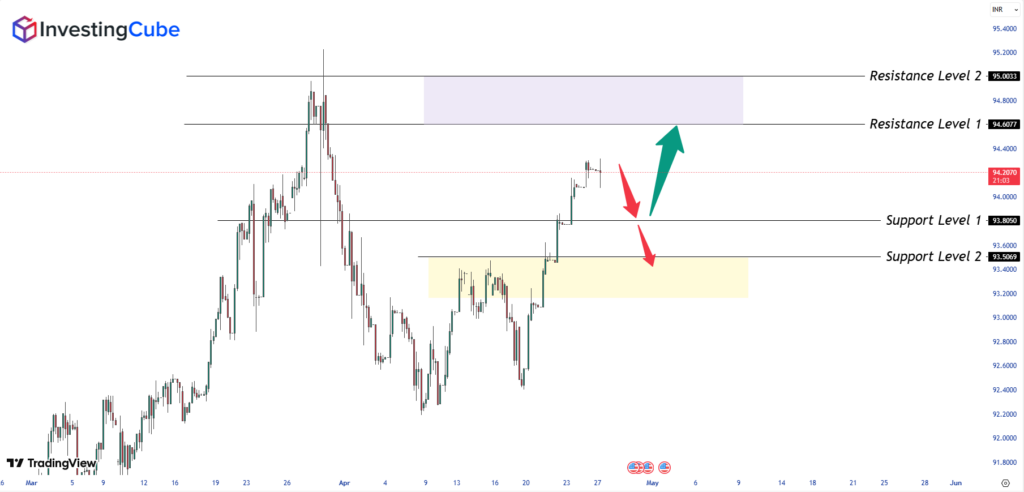
From the technical perspective, the USD/INR will continue to have support as long as the price is above the psychological resistance point at 94.00. If the pair manages to stay above 94.00, the bears can expect to see the potential to push towards 94.50 to 94.60. If the level of 94.60 is broken up, we will probably witness attempts to test the 95.00 level, which is followed by the resistance zone at 95.20 (the area where the highest prices are observed for the last time). According to Reuters, the Indian currency is approaching historical lows due to the high cost of oil and political tensions (Source: Reuters).
At the same time, if the price falls below 94.00, it means that the price is losing its strength, and we can probably see a retreat down to 93.80 to 93.50. However, unless there is a dramatic drop in oil prices, declines in price can expect to draw some buyers.
Near-Term Forecast
The short-term forecast for USD/INR still holds the potential to be bullish or mildly bullish. High oil prices, strong dollar demand by importers, low flows, and outflows of foreign portfolio investors all point to a weak Indian rupee (Sources: Reuters, Economic Times).
In case of sustained high oil prices and no reduction in geopolitical tension regarding the Strait of Hormuz, USD/INR could keep pushing to new heights. Above 94.60-95.00 might be the next target level, whereas a more aggressive run-up could lead to revisiting 95.20’s previous record high area.
However, the RBI’s role in the market is the primary downside risk to the bullish sentiment. Should the RBI pump more dollars or restrict purchases related to oil imports, there would be unexpected drops in USD/INR, even amid an overall uptrend.
From a point of view, the USD/INR may hold on to its current levels for some time because of:
- Higher oil prices
- Importer hedging
- Capital outflows from FPIs
- Increased dollar buying
(Sources: Reuters, Economic Times). If the pair moves past 94.60, it may test 95.00. However, there is a possibility of RBI intervention in the market, which makes the pair’s movement volatile in this range.
Frequently Asked Questions
USD/INR is rising because high oil prices are increasing India’s dollar demand, while FPI outflows and a stronger US dollar are adding pressure on the rupee.
India imports a large amount of crude oil, so higher oil prices mean Indian importers need more US dollars to pay for energy purchases.
The RBI can slow sharp moves by supplying dollars or reducing oil-related dollar demand, but it may not fully reverse the trend if oil prices and dollar strength remain high.