



- Know how to trade the news and the charts safely in this time of extreme market volatility using the guidelines here.
The markets are currently undergoing a period of intense volatility. As you proceed with your market activity, use this guide below to know how to navigate the market volatility in safe manner, especially if you trade the news.
The Process
1. Check the News
For any asset being traded, the first step is to look at the news. If you look at some of the forecast notes for various assets on this site, notice we usually refer to “Price Catalysts” and “Macro Drivers.” The macro drivers tell you what news is generally moving that asset for the week, while the price catalyst homes in on the specific macro drivers that are pushing the price. So this information speaks more to direction than to specific buy or sell levels. Also, it is not a given that the asset will keep running in a straight line. In fact, Charles Dow’s theory of price action says it does not. Price moves in waves, so even within a direction, there will be times when pullbacks can occur, even within a trend. Your job as a trader is to look for where these pullbacks will occur, and there are many tools you can use to do this. You have to use these tools to practice and figure out how best to use them.
2. Check the Charts
Once you are convinced of the asset’s direction, you can set up a trade. Your trade should feature:
- Entry type (market or pending order-limit/stop)
- Stop loss (SL)
- Take Profit (TP)
When your trade is active, it does not usually end there. There is what is called trade management: how you manage an active trade position. There are those who use a “set-and-forget” system because they do not want to stare at charts all day and cannot manage the emotional rollercoaster. I get that. But you also have to understand that many things can go wrong and jeopardize an active trade from the get-go. You have to learn to recognize a bad trade and cut it down fast before it balloons into an unmanageable situation. Sometimes you may have itchy fingers and mistype orders. Sometimes you just find out your analysis was poor. Do you simply close your eyes and hope for the best?
Note that there are other times when it is necessary to let trades with potential to run, so you don’t cut winners too early. Then there is the big monster in the room: risk management.
3. Trade Management/Managing Risk
We can say a lot about risk management, but here are some takeaways.
a) Risk management is there to protect your capital
Your capital is your ammo in the trading warfare arena. Lose your ammunition, and you are as good as gone on the battlefield. In trading, you lose your capital, and you are out of the market. So you have to protect your capital at all costs. Do not risk more than 0.5% – 1% of your total capital in total market exposure. That way, a single black swan or surprise news event does not take you to the cleaners.
b) Risk management means taking the right position size for your account size.
Scaling is not taking more risk per trade, but taking the same level of risk across larger account sizes. Trying to take on more risk per trade is like hoping to walk comfortably with size 12 shoes with size 9 feet. It will never end well.

Trading requires emotional detachment from the money being traded. Most people cannot do this. You are better served by automating your processes if you find yourself unable to trade with emotional detachment. There are now AI tools you can use to do this.
4. Setting Limits
There are certain tools designed to protect your longevity in the trading world, but many traders ignore them. One of these tools is the daily drawdown limit.
Many prop firms have drawdown limits in place. Drawdown limits can be static or dynamic. I prefer the dynamic drawdown limit because it forces you to stay within acceptable risk limits and prevents the cardinal sin of overtrading.
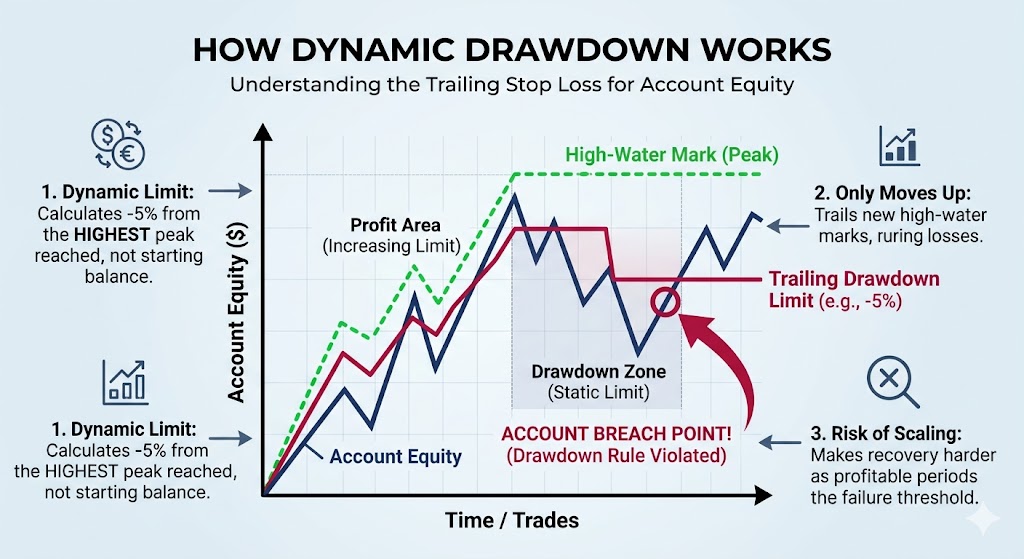
A dynamic drawdown limit works like a trailing stop. If your drawdown limit is set to 5%, the price that constitutes the 5% drawdown will follow your account balance upward when in profit, but will stay the same when losses start to accrue.
The Math
Assume you have a 5% drawdown limit on a $ 5,000 account. Your drawdown limit would be 5% of 5,000 or $250. This amount is subtracted from $5000 to provide your drawdown limit price: $4,750.
If you made a $500 profit on the $5000 account, your 5% starting drawdown on the $5000 account (i.e., 5% of 5,000 or $250) will move northwards and be pegged at $250 below your new account balance. This raises the drawdown limit from $4750 to $5000. If you make another $200, your account balance moves to $5700. Your drawdown price will also move upwards to 5000 (current drawdown price) + (5% of 5700), which is $5,000 + $285 = $5285.
This means that if you suffer losses, your account capital should not fall below $5285. On prop firm accounts, the drawdown limit is reset every day. But if you are trading your own accounts, there is no reset. You have to use this as a defense mechanism to check yourself from rushing trades, taking too many trades in a day, or revenge trading.
Conclusion
Whether you trade the news or just use the charts, or combine both, please adhere to the principles stated in this guide so you can achieve longevity in the markets.