



Current Setup
BAE Systems share price is currently trading lower at £18.32 on 7 October 6, 2026. The 1,21% intraday fall adds to Tuesday’s 4.08% drop, taking the stock 21% below the 52-week high of £23.60 set in March 2026.
The recent weakness reflects a difficult operational backdrop for defense stocks. BAE’s H1 2026 results showed £15.77 billion in sales, £1.70 billion in underlying EBIT, and an order backlog of £84 billion.
The BAE Systems share price fell despite strong numbers because the UK government is mulling delaying a planned increase in defense spending to 3% of GDP amid valuation and geopolitical pressures. Beyond the pushback on raising defense spending to 3% of GDP until the 3rd quarter of 2027 at the earliest, elevated gilt yields have raised borrowing costs, causing jitters in UK markets. Concerns have arisen about whether the UK government can continue funding large-scale defense projects. Furthermore, the stock’s earnings reports have shown higher-than-expected price-to-earnings ratios, leaving it vulnerable to near-term bearish sentiment.
Fundamentals Behind BAE Systems Share Price
1. Global Defense Spending
The Russia-Ukraine war has pushed many European countries to boost their military capabilities. Governments are expanding defense budgets and speeding up procurement processes for various military equipment and combat systems. This has contributed to the company’s strong order book, thanks to its exposure to military enhancement projects in the UK, US, and other allied markets. Global defense spending is the major structural catalyst for the BAE Systems share price.
2. Strong Order Backlog
BAE Systems has a strong order book, with new order intake rising £16.4 billion in H1 2026. This is a strong year-on-year increase from £13.2 billion in the same period of 2025. As of 30 June, the company’s reported order backlog was £84 billion. The strong order backlog provides significant revenue visibility, which could help the company navigate current short-term economic conditions.
3. Higher US/UK Defense Demand
The geopolitical impasse in the Middle East has added a new layer of US demand, even as the UK progresses its fighter jet and submarine projects. The company guided to a better 2026 outlook in July, forecasting underlying profit growth of 10–12%. This represents improved guidance when compared with its previous 9–11% guidance. The company cited strong demand from the US and UK as the reason for the upgrade.

4. Drone and E-Warfare
BAE Systems looks poised to acquire Dutch counter-drone company Robin Radar Systems for more than €2 billion. If confirmed, this move would strengthen the company’s position as a key defense technology player. The move also reflects the growing importance of drones and counter-drone systems in modern-day warfare.
The technical picture remains cautious following a second successive bearish session. The intraday decline is now testing the immediate support zone at 1824-1735.5. If this support zone is degraded, the 2 August 2025 low at 1683 becomes visible. Below this point, the 2 December 2025 low at 1597 becomes the next downside target.
BAE Systems Share Price Forecast Scenarios
Bull Case→Above £20.00: The recovery move that takes out the £20.00 psychological barrier and unlocks upside targets at £20.62 and £22.77 could be supported by faster approval of the UK government’s defense budget increase. Commentary in the UK Budget speech pointing in this direction could support the stock. The company’s large order backlog and earnings already support the bull case.
Base Case→Between £20.00- £20.00: This consolidation zone reflects investors assessing the stock’s current valuation amid UK surging bond yields (gilts) that have hit 28-year highs. Valuations will also depend on how quickly defense contracts convert into additional revenue. Until new headlines on the UK’s defense budget increase hit the wires, this is where the BAE Systems share price stands.
Bear Case→Below £17.30: Continued selling pressure from concerns over higher borrowing costs (due to the sharp increase in Gilt bond yields) could lead to a decisive break below the £17.30 price mark formed by the 22 June low.
Technical Outlook
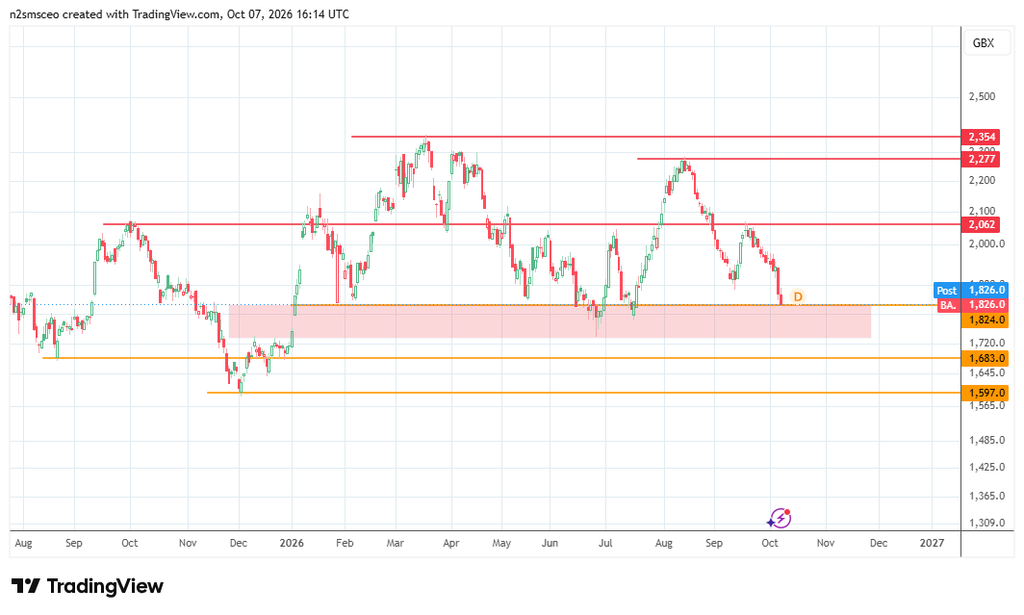
Conversely, a bounce on the current support makes a case for a bullish retest of the resistance at 2062, formed by a historical high on 12 October 2025 and a recent high on 17 September 2026. If the bulls uncap this barrier, a march towards the 12 August high at 2277 cannot be ruled out. A potential pitstop forms at the 18 July 2025 high of 1940. This barrier would need to be breached for 2277 to become visible.