




- The FTSE 100 index is currently being dictated by the UK 10-year gilt yields, oil prices and fiscal headlines around the upcoming budget.
Current Setup
The FTSE 100 has recovered from last week’s sharp sell-off. Although it opened today’s session on a lower note, it currently trades at 10,518–10,520, following Monday’s close at 10,497.94. The index gained 0.13% on Tuesday after UK government bond yields eased and oil prices fell below $100 per barrel on improved oil shipping.
Despite this modest rebound, the broader technical picture remains fragile. Last Thursday’s negative start to the month, with a huge 1.68% decline (its largest single-day drop since May 2026), underscores how fragile global stock indices are to current global bond yields, which triggered
The FTSE 100 index is now trading in an environment governed by oil prices on one hand and Gilt yields on the other. Both factors move inversely to the FTSE 100 index, as lower oil prices and lower Gilt yields tend to improve risk appetite for equities and support the FTSE 100. Where oil prices and the UK bond yields start to head northwards, the FTSE 100 comes under pressure.
Three variables will dominate the FTSE 100’s price narrative this month:
1. UK 10Y gilt yield
2. Brent crude
3. FTSE 100 financial-sector performance
Current Macro Drivers of the FTSE 100
1. UK Gilt Yields
This is the immediate macro driver and currently the biggest recent threat confronting the FTSE 100. Rising gilt yields raise borrowing costs for businesses, including those listed on the FTSE 100 index. It also raises the cost of margin facilities used for equity trading. The 10-year gilt yield rose sharply last week, touching off 5.40%. This is the highest it has been in 19 years, even as the 30-year gilt yield rose to 5.94%, a 28-year high. This was the major trigger for the 1 October sell-off. However, the market has shown some stabilization following the easing of gilt yields.
A rise in gilt yields puts valuation pressure on listed equities, which is FTSE-negative. Conversely, a drop in gilt yields is FTSE-supportive because it reduces valuation pressure on listed stocks.

2. Oil Prices
Oil prices remain a double-sided catalyst for the FTSE 100. The index has a healthy population of some of the world’s biggest oil companies; BP and Shell come to mind. Higher oil prices boost earnings for these companies, and a rise in the oil majors’ share prices can positively affect the FTSE 100’s value. At the same time, other companies listed on the index face potential margin compression and valuation pressure from higher oil prices, which typically raise operating costs. Persistently elevated oil prices can also destroy demand and reduce consumer discretionary spending, which hurts manufacturers and companies that offer discretionary goods and services.
3. Financial Stocks
Banking stocks were some of the worst hit in the 1 October sell-off. The financials fell 4.2% as the bond-market shock intensified. HSBC and Barclays were badly affected, losing around 4%. The NatWest share price fell even more, down more than 5% on the day. However, these stocks have rebounded as gilt yields eased. Banking stocks may still face additional scrutiny ahead of the UK Budget, making them volatile and sensitive to any fiscal messaging.
4. FTSE 100: A Structurally Diverse Index
The FTSE 100 is a structurally diverse index, with large exposure to several sectors such as banking, energy, mining, consumer goods and pharmaceuticals. This varied exposure provides some insulation from the factors that typically impact indices like the Nasdaq 100, which have a heavy lean towardg toward high-duration technology stocks. Strong commodity prices and the relatively inexpensive valuation of the listed indices (12.7X earnings vs 19X for the S&P 500) typically support the FTSE 100 index.
FTSE 100 Forecast Scenarios
Bullish case → Break above 10,600: This scenario plays out if oil prices fall sustainably toward $90, accompanied by a retreat in US Treasury and gilt yields. This would allow the index to pursue higher targets at 10700 and above. Lower gilt yields would allow banking and consumer stocks to provide an additional boost to the move.
Base case→FTSE 100 stays range-bound: The current support at 10400 provides the range’s floor, while the 10700 resistance forms the ceiling. The FTSE 100 will likely stay in this range if uncertainty about UK fiscal policy blunts the impact of falling gilt yields and declining oil prices.
Bear case→ Breakdown of the 10440 pivot: If oil prices start to rise again and bond yields follow suit, this would strengthen the downside case. The downside move is enhanced if Brent crude rises above $105, with the 10-year gilt yield clearing the 19-year highs at 5.40%.
Technical outlook
For the bears, the 10,400–10,440 area is the critical support. A breakdown of this zone makes a case for a further decline towards the 10120-10165 support zone, formed by the previous lows of April-June 2026. A further decline targets the 20 March low at 9790.
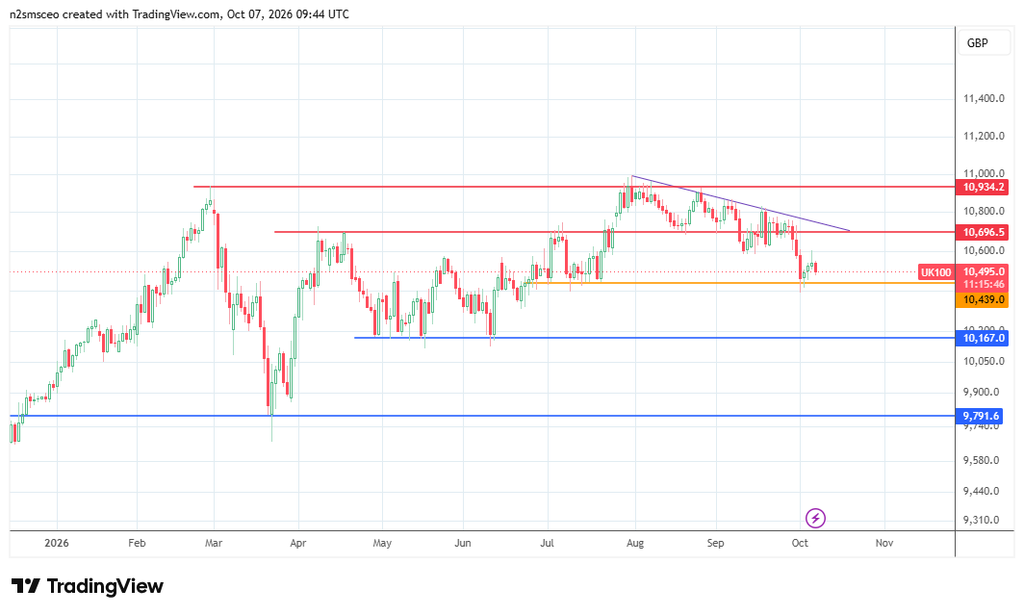
On the flip side, the uncapping of the 10600-10700 resistance zone (April/July 2026 highs) improves the short-term technical structure and supports a further push towards the 27 February/26 August highs at 10,930.