




- EUR/USD rebounded to around 1.1246 during Tuesday's European session, recovering from Monday's 17-month low below 1.1200 as selling pressure on the euro eased.
- France's fiscal crisis remains the biggest euro risk, after surging French borrowing costs widened spreads against German bonds and raised concerns about contagion across the eurozone.
- The EUR/USD forecast remains fragile despite improving short-term momentum, with 1.1260-1.1280 emerging as the first resistance area and 1.1200 remaining an important downside level.
EUR/USD is attempting to put some distance between itself and a 17-month low on Tuesday, but the euro’s latest recovery comes with a sizeable warning label: France’s debt problems have not gone away.
The euro to US dollar exchange rate climbed to around 1.1246 during Tuesday’s European session, extending its recovery from Monday’s plunge below 1.1200. Your latest hourly chart also shows EUR/USD trading above its 20-period moving average near 1.1221, with short-term momentum improving.
The move follows one of the euro’s most difficult sessions this year. EUR/USD fell to its lowest level since May 2025 on Monday as a selloff in French government bonds intensified concerns over France’s finances and the possibility of broader stress across eurozone debt markets.
Tuesday’s rebound is encouraging in the very short term. It is not yet enough to erase those concerns.
Why Is EUR/USD Rising Today?
The EUR/USD price is recovering as pressure in global bond markets eases slightly and the dollar loses some of the momentum that drove the euro sharply lower on Monday. European equities also moved higher Tuesday, while longer-dated bond yields eased after last week’s severe fixed-income selloff. The euro recovered about 0.2% to $1.1239 earlier in the European session after touching its 17-month low overnight.
There is also less immediate support for the dollar from Federal Reserve expectations.
Softer US employment data have dramatically reduced expectations for another Fed interest-rate increase in October. The probability of an October hike has fallen from roughly two-thirds in late September to around one-fifth.
Normally, that kind of Fed repricing would provide considerably more support for EUR/USD. This time, Europe’s own problems are getting in the way.
France Debt Crisis Remains the Biggest Risk for EUR/USD
France has become one of the most important drivers of the euro outlook. French government borrowing costs have surged as investors question the country’s ability to bring its budget deficit under control. More importantly for EUR/USD, the stress has started spreading beyond French assets.
Reuters reported that the gap between French and German 10-year government bond yields widened beyond 140 basis points, levels not seen since the eurozone sovereign debt crisis more than a decade ago. That matters because the euro represents an entire monetary union, not just France.
If investors begin demanding substantially higher risk premiums to hold bonds issued by heavily indebted eurozone governments, the issue becomes broader than French politics. It raises questions about financial conditions across the currency bloc.
That fear helped push the euro below $1.12 on Monday, while the currency also weakened against sterling, the Swiss franc and Japanese yen. For EUR/USD, therefore, stabilisation in European bond markets could be just as important as what happens to US interest rates.

US Dollar Remains Firm Despite Lower Fed Rate Hike Bets
The other half of the EUR/USD outlook is proving equally complicated. The US dollar has remained resilient despite the sharp reduction in expectations for an October Fed hike. The Dollar Index stayed in positive territory early Tuesday after advancing modestly Monday.
Elevated US Treasury yields remain an important reason. The 10-year Treasury yield edged higher Monday, continuing to provide underlying support for the greenback even as expectations for immediate Fed tightening diminished. That creates an unusual setup for the euro dollar exchange rate.
A less hawkish Fed should theoretically narrow the rate advantage enjoyed by the dollar. But high long-term Treasury yields and European fiscal concerns are preventing EUR/USD from benefiting fully from that shift. The result is a euro that can rebound sharply from oversold levels without necessarily establishing a broader recovery.
Eurozone Retail Sales Put Euro Economy Back in Focus
Traders also have fresh European economic data to digest Tuesday. Eurozone retail sales for August are due from Eurostat at 11:00 CEST, with economists looking for a modest monthly rebound after retail volumes fell 0.6% in July.
The report matters because the eurozone economy is already dealing with higher energy costs and persistent inflation while consumer demand remains subdued. Later Tuesday, attention shifts back across the Atlantic, where US trade data and comments from Federal Reserve officials could influence the US dollar outlook. ECB policymakers are also due to speak.
For EUR/USD, those events arrive at a time when both sides of the currency pair are being pulled by competing forces: falling near-term Fed hike expectations in the US and worsening fiscal confidence in Europe.
EUR/USD Forecast: Can the Euro Recover Above 1.1250?
The EUR/USD chart shows a meaningful improvement in short-term momentum. The pair has recovered from approximately 1.1160-1.1170 and is now trading around 1.1246. More importantly, EUR/USD has moved above its 20-hour moving average at roughly 1.1221.
MACD has also turned positive, with the MACD line above its signal line and the histogram moving further into positive territory. That supports the current rebound. The immediate test sits around 1.1250-1.1260. A sustained break could bring the recent 1.1280 area back into focus, followed by the psychologically important 1.1300 level.
On the downside, 1.1220 provides the first area to watch. Below that, 1.1200 and Monday’s low around 1.1160 become increasingly important.
The broader EUR/USD trend remains vulnerable while the pair stays below 1.1300. Tuesday’s recovery shows that buyers are returning at lower levels, but a lasting euro recovery will probably require something the chart alone cannot deliver: calmer French bond markets and a weaker US dollar.
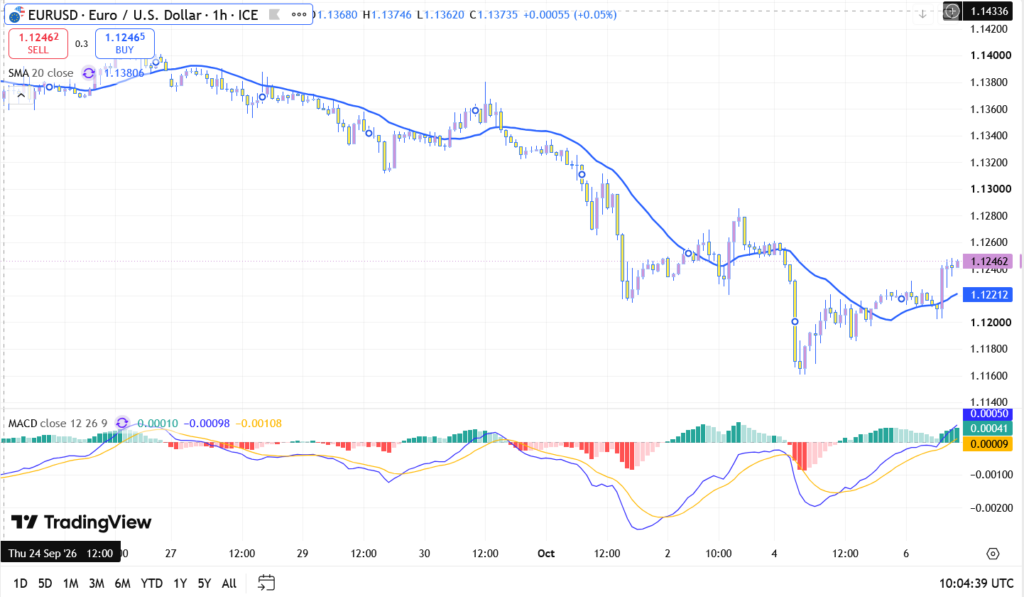
EUR/USD was trading around 1.1246 during Tuesday’s European session on October 6, recovering from the 17-month low reached Monday.
A move toward 1.1300 becomes more plausible if EUR/USD holds above 1.1220 and breaks the 1.1250-1.1280 resistance zone. A sustained recovery would also likely require easing French fiscal concerns and softer US Treasury yields.
EUR/USD is rebounding as pressure in global bond markets eases and traders continue to price a much lower probability of an October Federal Reserve rate hike. However, concerns over France’s finances continue to limit the euro’s recovery.