



Current setup
The USD/INR pair faces renewed upside risk after Brent crude prices soared to $117 per barrel late last week. In Monday’s session, USD/INR extended gains for the third straight session, climbing 0.29% as Brent crude held around $116 per barrel. The rupee’s latest round of weakening has also followed rising importer demand as import costs soar due to a more expensive dollar.
The latest move risks unwinding the rupee’s recent recovery, which began with strong RBI support measures and returning foreign portfolio inflows linked to the initial public offering of Jio Platforms. This was not unexpected, as RBI policy measures have largely been transient amid ongoing geopolitical risks that have kept oil prices well above $100.
USD/INR: Key Macro Drivers
1. India’s Import Bill within Elevated Crude Prices
India is the world’s 3rd-largest energy importer. This heavy dependence on imported crude, which is priced in US dollars, makes the rupee vulnerable to situations that bring about sustained increases in global energy prices. A $115-a-barrel Brent crude oil price is virtually double the Q4 2025 price. Higher energy prices mean India must raise more dollars to pay for higher product costs. This increased dollar demand drives external financing pressures and raises USD demand at the expense of the local currency. If energy prices remain at current levels or higher, USD/INR is likely to move higher. The rupee needs a meaningful decline (to <$100 per barrel) to see a relief rally, but not a full reversal.
2. RBI Intervention
In addition to the recent rate hike, the RBI’s recent measures helped the rupee recover to below 95.00. However, intervention has only slowed volatility and any outsized rupee-weakening moves, but it cannot reverse external rupee pressures (geopolitical tensions -> higher prices -> foreign portfolio outflows). At best, any rupee rallies vs the US dollar have created dip-buying opportunities, as shown in the chart below, where the recent USD/INR decline bounced off recent support levels.
3. Foreign Portfolio Flows
The upcoming Jio Platforms IPO has brought in some foreign portfolio inflows, which have also supported the rupee in recent sessions. However, this is not a strongly supportive driver because net foreign investor flows out of Indian markets remain. Furthermore, the recent inflows may not be sustained once the IPO ends, leaving the pair’s price determinants in the hands of the other macro drivers.
4. US Dollar and Fed Policy
The Federal Reserve’s upcoming policy decision could impact the USD via US long-term bond yields and interest-rate expectations for the December meeting. Goldman Sachs has already indicated that the Fed will hike rates by 25 bps at its December meeting. With only one meeting left in the year after Wednesday’s decision, any Fed guidance could affect USD/INR.

USD/INR forecast scenarios
Bull case: A break above the 95.24 resistance could ensue if crude oil prices keep rising, or the Fed is decidedly hawkish after Wednesday’s FOMC meeting. A rise in US bond yields could also drive USD demand, which pulls foreign portfolio funds out of Indian markets and into the safety of US Treasuries.
Base case: The pair could trade unevenly within the range defined by 94.30 and 95.24, as traders balance last week’s RBI measures and IPO-driven foreign inflows against higher oil prices and USD demand driven by US bond yields.
Bear case: A breakdown of 94.30 could follow resolution of the geopolitical crisis in the Middle East. This would unwind the energy risk premium and send Brent crude crashing below $90. This is the only real catalyst that drives the USD/INR lower in a sustained manner.
Technical Outlook
The 95.24 resistance is currently being tested. A break above this barrier brings in the 11 June/20 August highs at 95.76 as the first upside target. If this barrier is cleared, the 96.00 psychological barrier and previous intervention level come into play. Only if this level is taken out can the bulls revisit the 96.96 high of 20 May 2026.
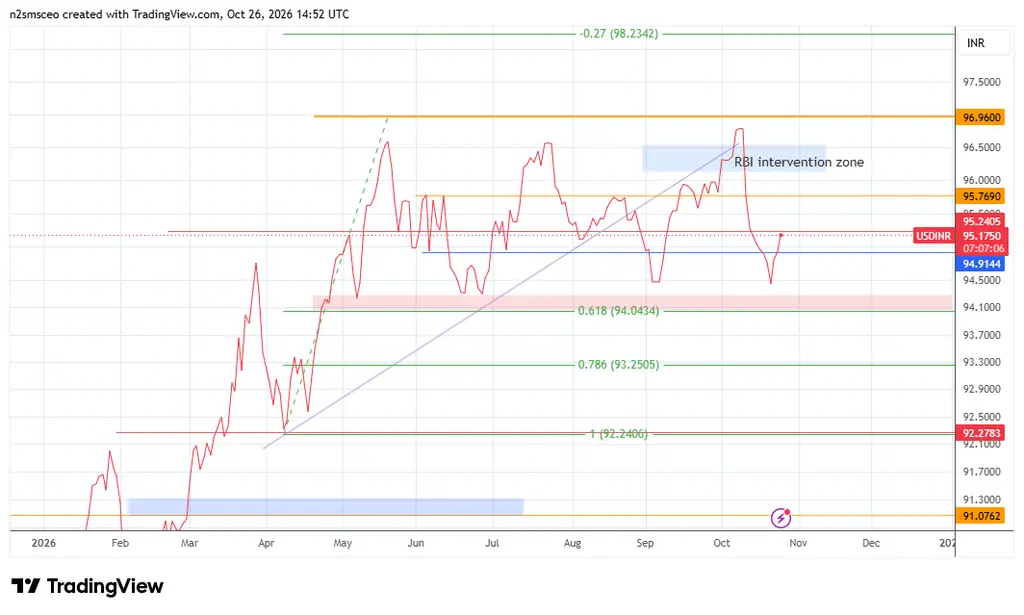
Conversely, a rejection at 95.24 and a subsequent breakdown of the 94.30-94.03 zonal support bring downside targets to 93.25, with 92.24 lining up as a deeper target and the 50% Fibonacci retracement of the 9 April – 20 May upswing.