



- Earnings shared, buy early.
- Check ratios, avoid traps.
- Reinvest compounds long wealth.
Dividend stock is a type of stock that provides its owners with a portion of the company’s earnings. The owner receives payment for owning the stock. This makes dividend investing an attractive option for investors looking for consistent cash flow. This article is designed to teach you how dividends function, how to select dividend-paying stocks, and what to watch out for when selecting dividend-paying stocks. Our goal is to make this process easy to understand. We use several large, well-known corporations only as examples, not as stock selections. So, We don’t hype up anything. We outline the steps to take. Let’s begin.
What Are Dividend Stocks and How Do Dividends Work?
What exactly are dividend stocks? These are shares in mature, money-making companies that provide cash payments to their shareholders. Examples of these types of businesses include banks, utilities and consumer goods manufacturers (such as Coca Cola, Johnson & Johnson and Unilever). Again, these are simply examples; this is not an endorsement. Dividends are typically paid on a quarterly basis. However, some companies pay semi-annually and others pay annually.
Four dates matter. They always come in the same order. The table shows them.
| Date | What happens |
| Declaration date | The board announces the dividend. |
| Ex-dividend date | New buyers no longer get this payment. |
| Record date | The company checks who owns the shares. |
| Payment date | The cash arrives in your account. |
The key rule is simple. You must own the stock before the ex-dividend date to get the payment. Buy on or after that day and the payment goes to the seller. The SEC’s investor site explains this well. In many markets, the record date is the same day as the ex-dividend date, or one day after. Check your exchange.
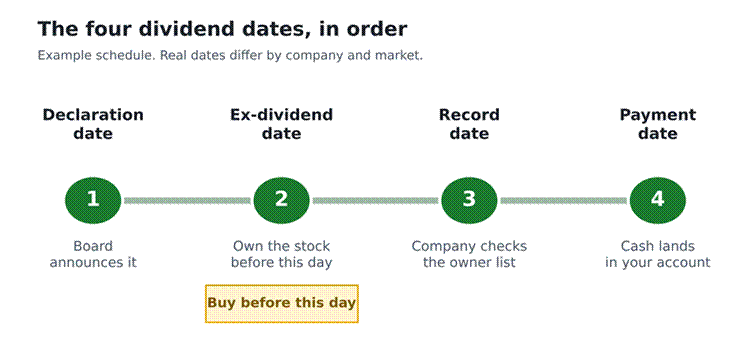
Image 1: The four dividend dates in order. The green circles show the steps from declaration to payment. The yellow box marks the key rule. You must buy before the ex-dividend date.
Best Dividend Stocks: How to Choose Dividend-Paying Stocks
No one single list of “best dividend stocks” exists. What works best for you will depend upon what you want to achieve. Therefore, we provide you with a way to check if a stock is right for you, rather than provide you with a list of companies. These five checks can help you determine if a particular stock fits your investment goals.
- Dividend Yield: This is an annual dividend payment that is then divided by the current stock price. When you are looking at this number, make sure to compare it to other companies in the same industry.
- Payout ratio is the percentage of earnings that a company distributes to its shareholders. Investors often become concerned when the payout ratio exceeds 70 percent to 80 percent.
- Dividend growth: years of raises in a row. Long streaks show discipline.
- Earnings and cash flow: steady profits pay steady dividends.
- Debt: heavy debt can force a cut.
Our guide to dividend yield, with formula and calculator walks through the math.
Dividend paying stocks should also be good businesses. Look at earnings per share and the P/E ratio. Our guide to fundamental analysis shows how to read both. Size matters too. Large, stable companies, often called blue chips, usually pay steadier dividends than small ones. Small caps can pay well, but they carry more risk.
High Dividend Stocks and High Yield Dividend Stocks: Opportunity or Risk?
High dividend stocks seem to be the way to go. It’s much better to get 9% of your money back than only 3%. However, a high dividend can also indicate that there is trouble ahead. A dividend is calculated by dividing what you receive in cash from a stock by its current price. If the value of the stock drops, then the percentage of cash you receive will increase. At this point, the company may still be doing exactly what it has always done. It’s possible that the reason for the drop in the value of the stock is due to investors expecting the company to reduce the amount of cash that it gives out to shareholders.
As an example, if a company has a yearly payout of $4 per share and its current price per share is $100, then the yield on this stock would be 4%. Let’s assume that over the course of one year, profits decrease and the price per share falls to $50. Now the yield has increased to 8%. It appears that this is a great deal. However, if we take into account the fact that the company had earnings of $3 per share, the payout ratio for this company is calculated as follows: payout ($4) divided by earnings ($3), which equals 133%. At this point, the company is paying out more than it earns. This cannot continue indefinitely. Therefore, the company will have to borrow money, use savings, or reduce its dividend payments.
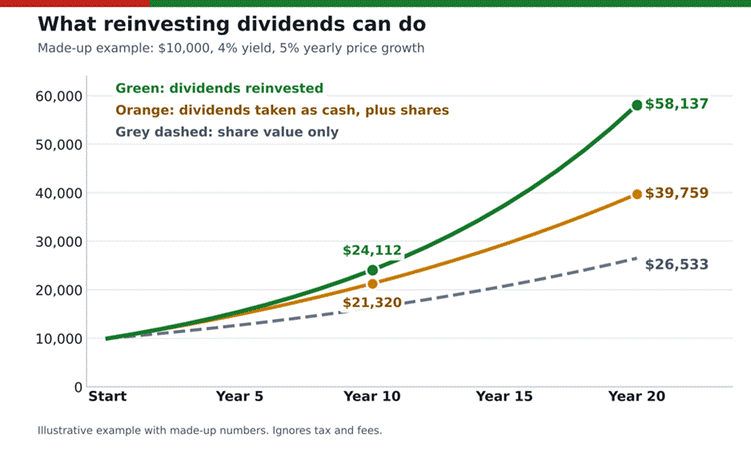
Image 2: The high-yield trap. The price falls from $100 to $50 while the dividend stays at $4. The yield doubles from 4% to 8%. The red zone warns that profit may not cover the payout.
So how do you check? First, divide the dividend by earnings per share. Second, look at free cash flow, the cash left after costs. Third, see whether profits are falling. Read our guide on high dividend yield stocks, engines of income or traps. A high yield dividend stock can still be a good buy. The dividend just has to be covered.
Highest Dividend Yield Stocks and Highest Paying Dividend Stocks: What to Check First
Many individuals are looking for the best dividend-yielding stocks or the ones that pay the most. I won’t provide you with a list of the top-paying dividend stocks. The reason is that lists become outdated very quickly. Yields may vary daily. I recommend using a checklist. Go through the checklist in this order.
- Does profit cover the dividend? Check the payout ratio.
- Is cash flow strong? Dividends are paid in cash, not profit.
- Did the price drop sharply? A crash often explains a big yield.
- Has the company cut its dividend before? Past cuts can repeat.
- How much debt does it carry compared with earnings?
Remember that the highest paying dividend stocks (by dollar) are not necessarily the highest paying by percent. A larger company might have a high dollar payment per share, but a relatively low percentage. Use percentage rather than dollars per share when comparing returns. Place the data next to other similar companies. Our guide on how to pick stocks gives a full step-by-step method.
Monthly Dividend Stocks and Weekly Dividend Stocks: How They Work
Companies that pay dividends do so on a quarterly basis. However, there are some companies (known as monthly dividend stocks) which provide a dividend payment each month. This type of stock is good for individuals who need to have a source of income to help cover their monthly expenses. There are many articles on the internet that list the “best” monthly dividend stocks. However, before investing in these types of stocks, it is important to understand what they are. Many monthly dividend paying stocks include Real Estate Investment Trusts (REITs), Business Development Companies (BDCs), and Mutual Funds. Because these types of companies typically distribute nearly all of their earnings as dividends, they can offer investors very high yields, but also increased levels of risk.
Are monthly dividend-paying stocks always better than quarterly dividend-paying stocks? No. The main difference lies within the annual return on investment (ROI). If you have two stocks that both pay 4% annually, one pays 4% every three months (quarterly) and the other pays 4% every month, you will receive the same amount of cash each year from both. However, the monthly paying stock will spread that cash out over the course of the year. Do not take on more risk simply because of the frequency of payments. Look at how consistent the company’s dividend payments have been over the past few years.
Now let’s talk about the weekly dividend stocks. Now be completely honest with yourself about this. There are very few individual stocks that actually pay a weekly dividend. Most of the time when you find a company that does pay a weekly dividend, it will be a fund or an ETF.

Their payouts can swing, and some return your own capital. Our guide on ETFs, index funds and mutual funds explains how funds differ from single stocks.
Dividend Investing Strategies: Income, Growth, and Reinvestment
The three most popular methods for dividend investing include income investing, which provides a steady flow of income now; growth investing, where the investor seeks out companies that consistently increase their dividend payments annually; and the combination of these two. By reinvesting your dividends, you will be able to purchase additional shares with each dividend payment.
In this hypothetical example, you make a $10,000 investment in a stock with a 4% yield. The price increases by 5% each year. After 10 years, if you reinvest your dividends, you will have accumulated approximately $24,112. If you do not reinvest, then your stock value and cash will total approximately $21,320. After 20 years, the difference between what you could have earned if you had reinvested your dividends compared to what you would have earned if you had not reinvested your dividends is even greater. You would have accumulated approximately $58,137 versus approximately $39,759. These calculations are merely examples. They do not account for taxes or fees. Your actual results may vary. It is time that does much of the work.
Image 3: Reinvestment over 20 years. The green line shows dividends reinvested. The orange line shows dividends taken as cash plus shares. The grey dashed line shows share value only. The gap widens with time.
Mixing styles can lower risk. Read our guide on growth and value stocks to see how they fit together.
Do not put everything in one basket. Spread money across sectors. Our guide to choosing mutual funds shows one way to diversify.
Tax matters too. Dividend tax rules differ by country. This is not tax advice. In the US, qualified dividends can be taxed at lower rates than ordinary income. The IRS explains the types.
In the UK, you get a yearly dividend allowance. Above it, dividends are taxed by income band. See GOV.UK for details.
In India, dividends are added to your income and taxed at your slab rate. Companies may also deduct tax at source. The Income Tax Department has the rules.
Many Gulf countries, such as the UAE, do not tax personal dividend income. Some, such as Saudi Arabia, apply withholding tax to foreign investors. Rules change often. Check with a local tax adviser.
Frequently Asked Questions About Dividend Stocks
How do dividend stocks make money?
The company pays you a portion of their profits through cash dividends. In addition, you can realize a gain from an increase in the price of your stock. Therefore, your overall return consists of the sum of the dividends you receive and the potential appreciation of the stock’s value.
What is a good dividend yield for a beginner?
Most first-timers begin with a reasonable return on investment (usually 2% to 5%) and prioritize security. If you are looking for a higher return on your investment, there will be more things to consider before you make a decision.
Are high dividend stocks safe?
Not necessarily. An extremely large dividend yield may indicate that a reduction in dividends is on its way. Before making any decisions about purchasing the stock, you should evaluate the company’s dividend payout ratio, its cash flow, and its current level of indebtedness.
Are monthly dividend stocks better than quarterly dividend stocks?
No, there is no default setting. The total yearly yield will be used for calculation. Funds or REITs (Real Estate Investment Trusts) that pay on a monthly basis may also have higher risks associated with them.
How much money do you need to live off dividends?
To determine how much money is required to generate the desired annual income, divide your desired income by the yield rate. For example, if you would like to earn $30,000 per year with a 4% yield, then you will require $750,000. If you have a 3% yield, then you will require $1,000,000. Since yields can vary and dividends can be reduced, it is recommended that you include an additional amount in your portfolio as a safety margin.