



- XIRR calculates the annualized return for investments that happen on different dates like SIPs, for example. It does this by tracking the exact timing of every cash flow
- Absolute return doesn't account for time. While CAGR suits single lump-sum investments best, XIRR is the correct measure for regular or even irregular contributions
- Remember, past XIRR figures are historical and can be quite volatile over short periods. Fees, taxes, and country-specific rules will also reduce the net return you actually keep.
XIRR (Extended Internal Rate of Return) calculates the yearly return on investments made at various times. Take, for instance, regular monthly payments into a Systematic Investment Plan (SIP). Simpler ways to measure returns often assume all your money went in at once.
XIRR on the other hand tracks the precise timing and amount of every cash transaction, offering a much clearer view of your personal investment performance.
How Mutual Fund Returns Are Measured: Absolute Return, CAGR, and XIRR
When evaluating mutual fund performance, you will typically see three main return metrics: Absolute Return, CAGR, and XIRR. The choice of metric can significantly impact how you perceive your investment growth.
| Measure | What It Shows | Best Used For | Key Limitation |
| Absolute Return | Indicates the total percentage gain or loss over a period | Short periods (under one year) or quick checks | Misleading for multi-year periods (for example, 30% over 5 years looks great until annualized). |
| CAGR | Steady annual growth rate | Single lump-sum investments held over multiple years | Cannot accurately account for recurring investments like SIPs or staggered withdrawals. |
| XIRR | Annualized return with timed cash flows | SIPs, irregular investments, or portfolios with multiple transactions | It reflects historical performance and can appear skewed over very short timeframes. |
CAGR works best for a single initial investment. XIRR, however, handles investments made over time, whether they’re regular or not. CAGR assumes just one starting point and an ending value, with growth compounding at a steady rate.
XIRR, in contrast, manages multiple investments or withdrawals made on various dates. Each installment in a regular investment plan has its own holding period, and XIRR accounts for this.
What Is XIRR in Mutual Funds and Why Does It Matter?
XIRR calculates the single annualized rate that brings the net present value of all cash flows to zero. It does this by considering the actual transaction dates. Imagine it’s the constant interest rate a bank account would need to pay to match your investment’s outcome, taking into account all your deposit dates.
If you are an investor using SIPs, an earlier installment gets more time to grow than a later one. XIRR reflects this, giving each contribution appropriate weight according to its investment duration.
When you invest with a monthly SIP, every payment buys in at a different Net Asset Value (NAV) and stays invested for a different amount of time. Your first monthly investment compounds over the entire period, but later ones are in the market for less time.
How to Calculate XIRR Step by Step (With Excel and Google Sheets)
You don’t need fancy financial software to calculate XIRR. Both Microsoft Excel and Google Sheets include a built-in XIRR function.
Step-by-Step Instructions
- Open a spreadsheet in Excel or Google Sheets.
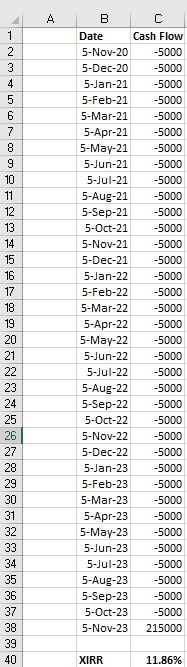
- Create two columns, labeling one ‘Date’ and the other ‘Cash Flow’.
- Record all cash outflows, such as SIP installments or lump-sum purchases, as negative numbers. For example, an outflow of $5,000 would be entered as -5000.
- In the final row, enter the current date and your portfolio’s current total value as a positive number. This represents the final cash inflow.
- In an empty cell, enter the XIRR formula: =XIRR(values, dates), where ‘values’ is your cash flow range and ‘dates’ is your transaction date range.
- Format the resulting cell as a percentage to display your annualized return.
How to Calculate Investment Returns: Formulas and Worked Examples
Absolute return = (Final value − Amount invested) ÷ Amount invested. CAGR = (Final value ÷ Initial value)^(1 ÷ Years) − 1.
For example, if $100,000 grows to $160,000 over four years, the absolute return is 60%, and the CAGR is approximately 12.5% per year. For a SIP example, say you invest $5,000 on the 5th of each month, starting November 5, 2020, and continuing until October 5, 2023. That’s 36 installments, totaling $180,000 invested. If the portfolio is worth $215,000 on November 5, 2023, the absolute return is 19.4%.

If you calculate CAGR on the total invested amount, you’d get 6.1%. This figure is misleading because most of the money wasn’t invested for the entire three-year period. XIRR, however, corrects for this and shows a more accurate annualized return of 11.86% by considering these staggered investments.
CAGR might seem low if most of the money went in for under three years. XIRR fixes this.
How Fees and Taxes Reduce Your Real Return
Fees and taxes can really eat into your investment returns. Costs like ongoing expense ratios and capital gains taxes directly impact how much money you actually get. Even tiny yearly fees can add up over time, seriously changing your portfolio’s final worth.
Say you invest $10,000. If it earns an 11% gross return ($1,100 gain) in a year, but has a 1.00% expense ratio, that’s about $100 in fees. This brings your pre-tax gain down to $1,000 (a 10% return after fees).
Then, if a 15% capital gains tax hits that $1,000 profit, you would pay $150. That leaves you with an $850 net profit, so your actual take-home return is 8.50%.
Mutual Fund Calculator and Mutual Fund Return Calculator: How to Use Them
You can use online mutual fund calculators to get an idea of your returns. They will ask for details like your SIP amount, how often you invest, the investment period, and the final value. Most of these tools actually run XIRR behind the scenes.
Just make sure the calculator uses your real transaction dates, not just guessing at regular intervals. For the most accurate picture, it’s best to grab your full transaction history from the fund provider and plug those exact dates and amounts into a spreadsheet program.
How to Read Your Mutual Fund Statement and Judge Your Returns
When you look at your mutual fund statement, first check the current value. You do this by multiplying your total units by the latest NAV. Also, make sure the transaction amounts and dates match what your bank records show. And pay attention to whether you have a direct or regular plan because their expense ratios can differ.
Compare your XIRR to the fund’s benchmark and its category average over a comparable period. For equity funds, it is advisable to assess performance over at least three to five years.
CAGR tells you the yearly return for one lump sum investment. XIRR calculates your annualized returns when you’ve put money in at different times.
When you invest with SIPs, each payment starts growing on a different date. XIRR helps you accurately track all those contributions and see your true overall return.
There’s no single perfect number. Equity funds often show higher long-term returns than debt funds. But your actual results will really depend on market conditions and how long you’ve kept your money invested.
Subtract the fund’s expense ratio from your gross returns. Later, when you sell your investment, you’ll also deduct any capital gains taxes you owe. What remains is your real return once everything is paid.
Fund companies usually publish CAGR, which assumes you made just one hypothetical lump-sum investment. Your XIRR, though, considers the precise dates and amounts of all your contributions, along with any withdrawals you’ve made.